Forever Layoffs: Why Job Cuts Never Seem to End (and How to Stay Ready)
A colleague's chat status goes grey on a Tuesday. By Thursday their name is gone from the org chart. There's no all-hands and no memo. Six weeks later it happens to someone on the next team. Nobody calls it a layoff, and nobody says it's finished. This has a name now: forever layoffs.
Quick answer
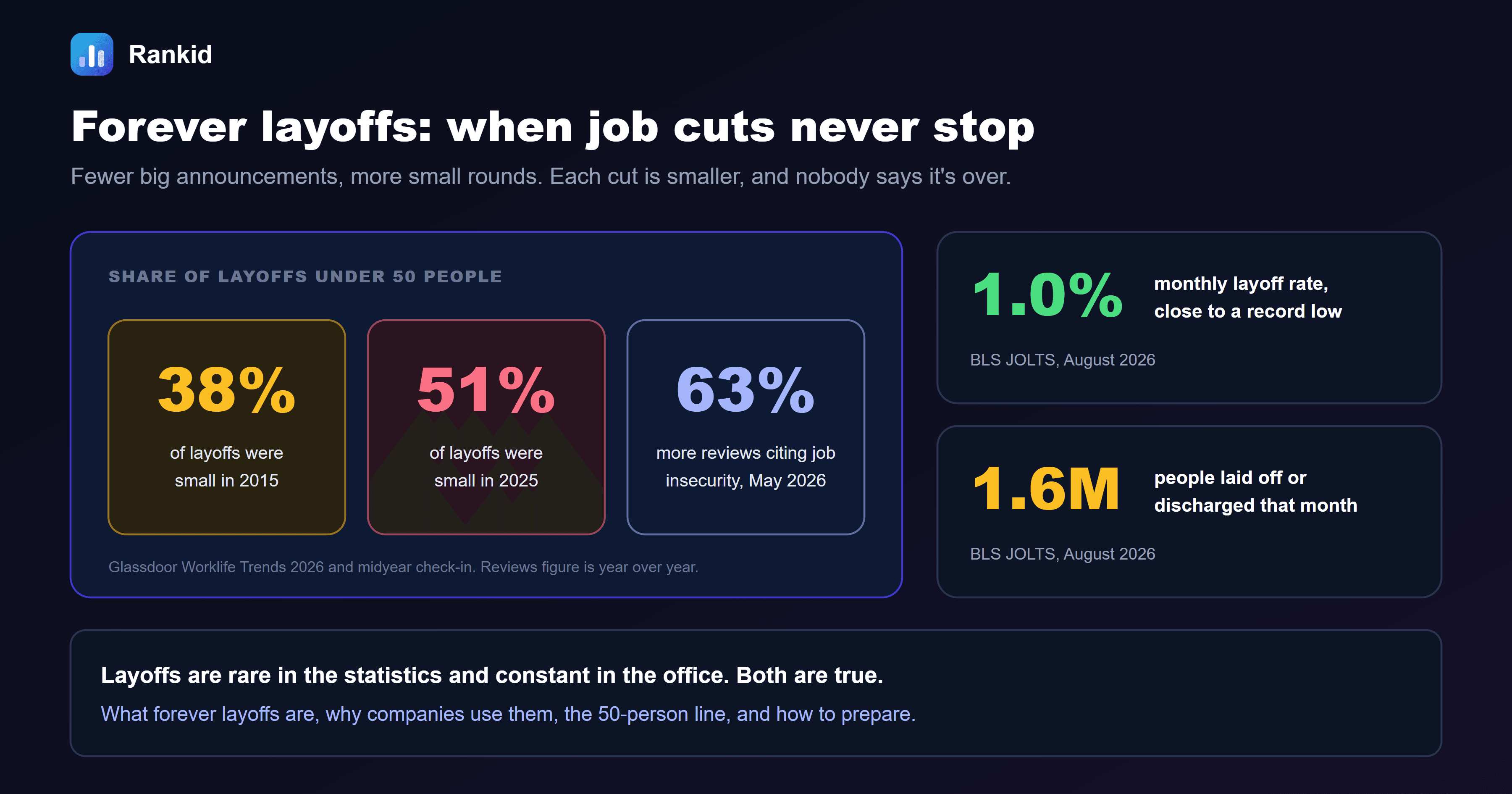
Quick answer: forever layoffs are small, repeated job cuts, usually under 50 people at a time, with no stated end. Glassdoor found small layoffs rose from 38% of all layoffs in 2015 to 51%in 2025. Total layoffs are low, but small rounds often come with no notice and no announcement, so they feel constant. You can't predict a round. You can be ready for one.
What are forever layoffs?
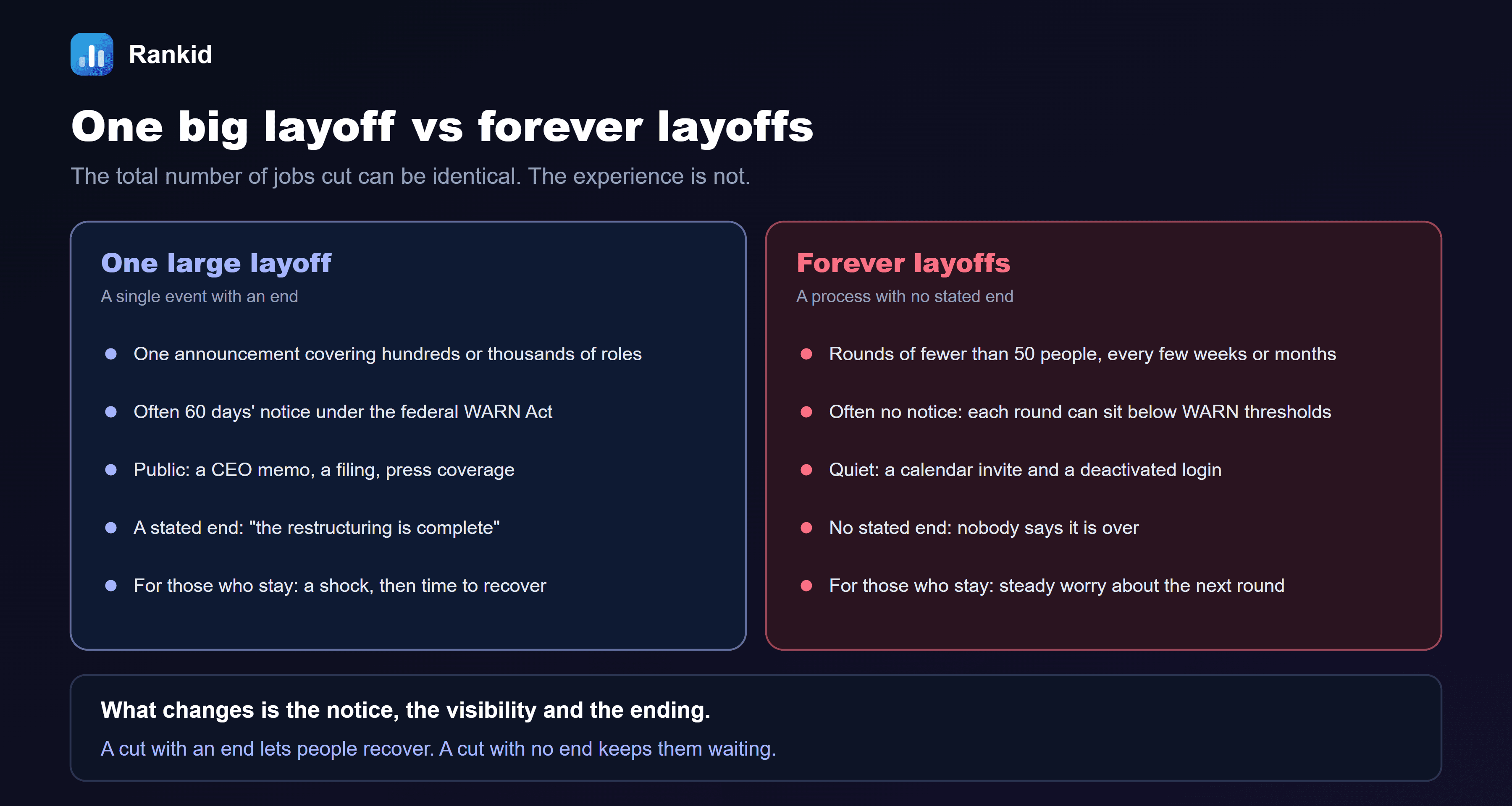
Forever layoffs are job cuts made in small groups, repeatedly, instead of in one large event. Glassdoor introduced the term in its Worklife Trends 2026 report, describing a shift from rare, large reductions to frequent layoffs of fewer than 50 workers at a time. You'll also hear them called rolling layoffs.
Three things define them:
- They're small. A handful of people, a single team, one office.
- They repeat. Every quarter, every month, or whenever a forecast is missed.
- They have no ending. Nobody announces that the restructuring is complete.
Forever layoffs in 2026: what the numbers show
- Small layoffs are now the majority. Layoffs of fewer than 50 people were 38% of all layoffs in 2015 and 51% in 2025 (Glassdoor).
- Job insecurity is on people's minds. In May 2026, mentions of job insecurity in Glassdoor reviews by current employees were up 63% year over year. Mentions of layoffs were up 29%.
- Total layoffs are low. The US layoff and discharge rate was 1.0% in August 2026 (BLS JOLTS), close to the lowest on record.
- Announced cuts have fallen.Employers announced 573,195 job cuts through September 2026, down 39% on the same period of 2025. September's 43,281 was the lowest for that month since 2022 (Challenger, Gray & Christmas).
Low layoffs, high anxiety. Both are true.
Why companies cut this way
- Planning cycles are shorter. Headcount is reviewed every quarter against the forecast, so cuts follow the same rhythm.
- Small rounds stay out of the news.Twelve people leaving doesn't make a headline or move a share price.
- Notice rules are built for large events.A small round usually sits below the federal threshold for 60 days' notice. More on that below.
- It looks reversible. Leaders can cut a little, watch the numbers, and cut again without committing to a big figure.
- Performance management has tightened. Some rounds are framed as removing low performers. See the keeper test.
- A standing explanation is available. AI is now cited for many cuts, whether or not it did the work. See AI washing.
Hiring is slow at the same time, which changes what a small cut means for the person in it. See the low-hire, low-fire job market.
The 50-person line: why small rounds come without notice
US layoff notice law was written for plant closings. That history explains a lot about how small rounds feel.
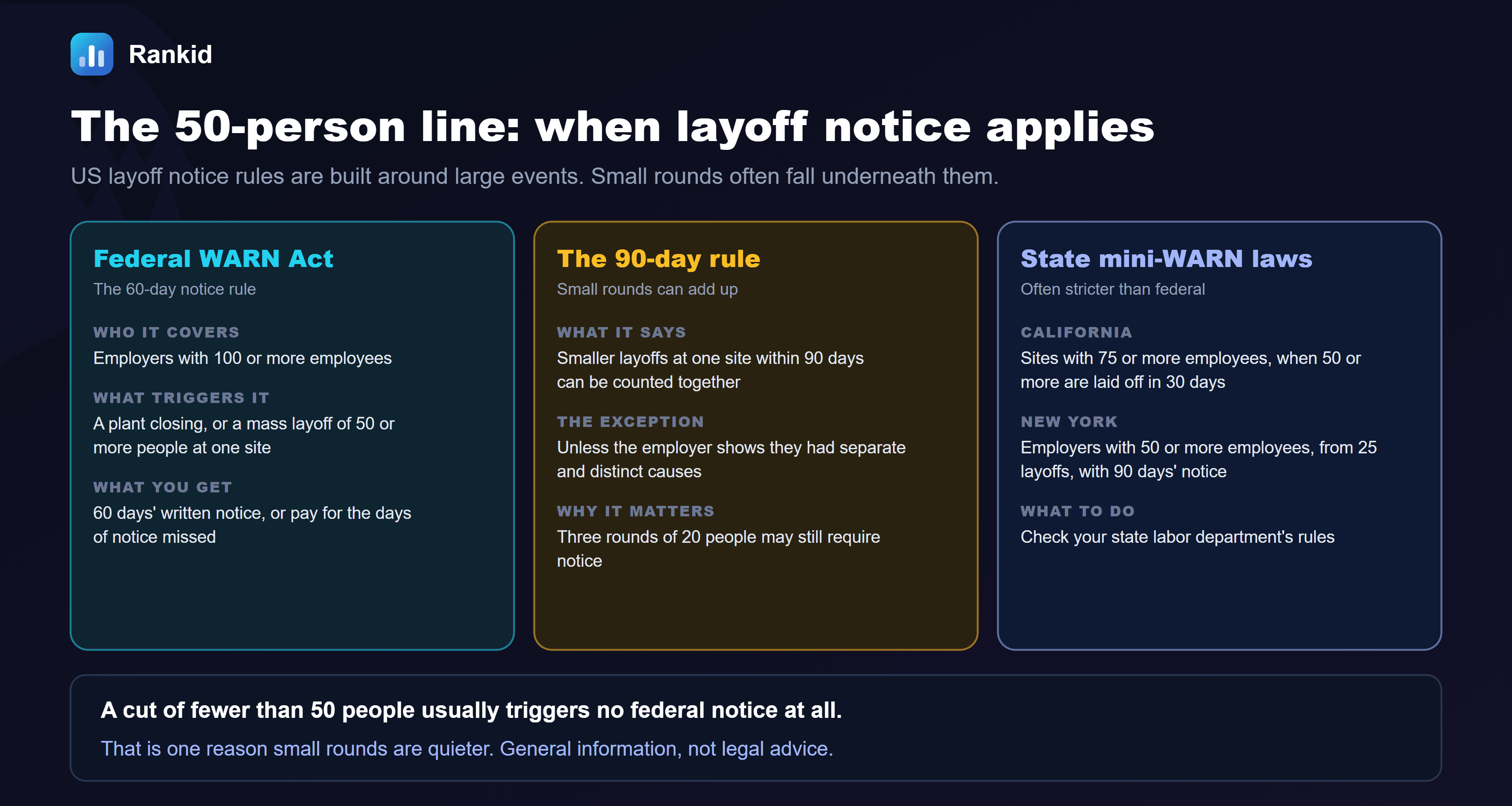
- The federal WARN Actcovers employers with 100 or more employees. It generally requires 60 days' written notice of a plant closing, or of a mass layoff of 50 or more people at one site (where they make up at least a third of the workforce there), or of 500 or more.
- Below 50 at a site, it usually doesn't apply. A round of 30 can happen with no notice at all.
- Rounds can be added together. Layoffs at one site within any 90-day period count together unless the employer shows they had separate and distinct causes. Three rounds of 20 in two months may still need notice.
- State laws can be stricter.California's applies to sites with 75 or more employees. New York's covers employers with 50 or more, can apply from 25 layoffs, and requires 90 days' notice.
If you were let go in one of several small rounds close together, note the dates and the headcount if you know it. Your state labor department or an employment lawyer can tell you whether notice was owed. This is general information, not legal advice. For the difference between a temporary and a permanent cut, see furlough vs layoff.
Signs your employer is doing rolling layoffs
- You learn about departures from a bounced email, not an announcement.
- Roles are closed when people leave, and the work is shared out.
- There have been two or more "small reorganizations" in twelve months.
- Leaders talk about "ongoing efficiency" or "continuous review" with no end date.
- Hiring is frozen in most teams but open in one or two.
- Nobody has said the words "we're done."
One of these is normal business. Several together is a pattern. For the wider list, see signs layoffs are coming. If the pressure is aimed at you individually, read quiet firing.
How to stay ready
A single large layoff comes with warning signs and often with notice. A small round comes with a meeting invite that morning. The preparation has to already be done.
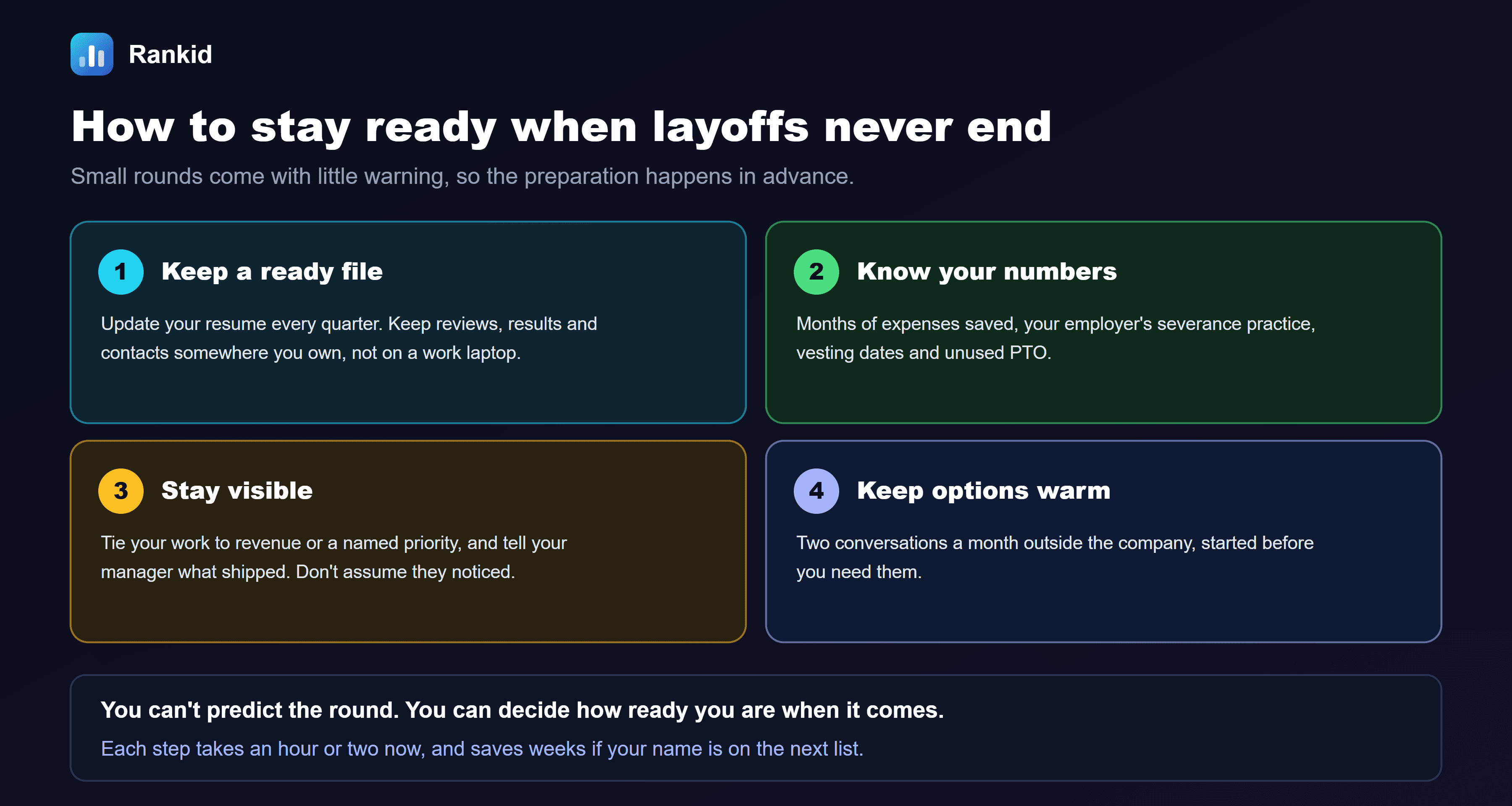
Keep a ready file
Know your numbers
Stay visible
Keep options warm
None of this means assuming the worst. It means the question "what would I do?" already has an answer, which is what lets you stop thinking about it.
Find out how ready your resume is
Paste your resume and a job description you'd apply for tomorrow. Rankid gives you a free 0-100 match score and shows the exact requirements you meet and miss, so the gaps are fixed before you need them to be. No signup required.
Check your match score freeIf you're still there after a round
- Ask what happens to the work.Get it in writing which of your former colleague's tasks are now yours and which have stopped. Otherwise you inherit all of it.
- Ask the direct question."Is this the last round planned?" Your manager may not know. How they answer still tells you something.
- Don't over-read your own survival.It reflects this quarter's priorities, not a permanent verdict.
- Watch your own state. Guilt, anger and a drop in motivation are common in people who stay. See quiet cracking.
- Decide on purpose.Staying because you've weighed it is different from staying because moving feels risky. See job hugging.
For employers: what forever layoffs cost
Small rounds are cheaper to announce and more expensive to live with. Glassdoor's chief economist Daniel Zhao has described the effect as keeping workers in suspense, constantly worried about their job security, with "a really negative impact on culture and morale and hence productivity."
- Cut once if you can. One deeper reduction with a clear end does less lasting damage than four shallow ones.
- Say when it's over.If you can't promise that, say what would trigger another round and when you'll next review.
- Tell people who left. Staff notice anyway. Silence reads as concealment.
- Track the 90-day total. Small rounds at one site can add up to a WARN obligation. Involve legal counsel before the second round, not after the third.
- Remove the work, not only the person.If the tasks stay, you've cut capacity and raised the workload of the people you most need to keep.
- Watch who leaves next. The employees with the most options go first. See employee turnover rate and revenge quitting.
- Handle exits properly. A consistent process and fair terms are seen by everyone who stays. See employee offboarding.
Hiring again after a round? Get each hire right
When headcount is tight, every opening matters more. Rankid scores every applicant against your job description on a consistent 0-100 scale and shows the exact requirements each matched and missed. First 5 resumes free, no signup.
Try bulk screening freeFrequently asked questions
What are forever layoffs?
Forever layoffs are small job cuts that happen again and again, usually fewer than 50 people at a time, with no announcement that the cutting has finished. Glassdoor's economists used the term in their Worklife Trends 2026 report to describe a shift away from rare, large layoffs toward frequent small ones. They are also called rolling layoffs.
Are forever layoffs actually increasing?
The small-layoff share is. Glassdoor found that layoffs of fewer than 50 people made up 38% of all layoffs in 2015 and 51% in 2025. Total layoffs are not unusually high: the US layoff and discharge rate was 1.0% in August 2026, close to a record low, and announced job cuts through September 2026 were down 39% on 2025 according to Challenger, Gray & Christmas. The change is in how cuts are delivered.
Why do companies do rolling layoffs instead of one big layoff?
Small rounds let a company adjust headcount as forecasts change, avoid a public announcement, and spread the cost. A round of fewer than 50 people at one site also usually falls below the threshold for 60 days' notice under the federal WARN Act. The trade-off is that staff never hear that the cuts are over.
Do small layoffs require notice under the WARN Act?
Often not. The federal WARN Act applies to employers with 100 or more employees and generally requires 60 days' notice for a plant closing or a mass layoff of 50 or more people at a single site. Smaller layoffs at the same site within a 90-day period can be added together unless the employer shows they had separate causes. Several states, including California and New York, have stricter laws.
Do you get severance in a small layoff?
It depends on the employer. US law does not generally require severance pay, whatever the size of the layoff. Many companies offer it under a policy or in exchange for signing a release, and the amount can be negotiable. Ask HR for the written policy before you need it.
How do I know if my company is doing rolling layoffs?
Look for departures that are announced late or not at all, roles that are closed rather than backfilled, more than one small reorganization in a year, and leadership language such as ongoing efficiency or continuous review. One small cut can be a one-off. Two or three within twelve months, without anyone saying the process is finished, is a pattern.
How do I prepare for a layoff I can't predict?
Keep your resume and a record of your results up to date and stored outside work systems, know your savings runway and your employer's severance practice, make sure your manager knows what you deliver, and keep a few outside conversations going. Each of these is easier to do while you are still employed.
Are forever layoffs bad for companies?
They carry real costs. Glassdoor's chief economist Daniel Zhao has said rolling cuts keep workers in suspense, with a negative effect on culture, morale and productivity. Mentions of job insecurity in Glassdoor reviews were up 63% year over year in May 2026. Employees who expect another round tend to take fewer risks, share less, and start looking elsewhere.
Key takeaways
- Forever layoffs are small, repeated job cuts, usually under 50 people at a time, with no announcement that the cutting is finished. They are also called rolling layoffs.
- Glassdoor found layoffs of fewer than 50 people rose from 38% of all layoffs in 2015 to 51% in 2025.
- Total layoffs are low: the US layoff rate was 1.0% in August 2026. That is still about 1.6 million people in a month, mostly in rounds too small to be announced.
- The federal WARN Act generally requires 60 days' notice only for cuts of 50 or more at one site, though rounds within 90 days can be added together and some state laws are stricter.
- Signs include unannounced departures, roles closed instead of backfilled, repeated small reorganizations, and no statement that the process has ended.
- Prepare in advance: a current resume and record of results kept outside work systems, a known savings runway and severance policy, visible work, and a few live outside contacts.
- For employers, one clear cut with a stated end does less damage to morale and retention than a series of small ones.
Frequently asked questions
What are forever layoffs?
Forever layoffs are small job cuts that happen again and again, usually fewer than 50 people at a time, with no announcement that the cutting has finished. Glassdoor's economists used the term in their Worklife Trends 2026 report to describe a shift away from rare, large layoffs toward frequent small ones. They are also called rolling layoffs.
Are forever layoffs actually increasing?
The small-layoff share is. Glassdoor found that layoffs of fewer than 50 people made up 38% of all layoffs in 2015 and 51% in 2025. Total layoffs are not unusually high: the US layoff and discharge rate was 1.0% in August 2026, close to a record low, and announced job cuts through September 2026 were down 39% on 2025 according to Challenger, Gray & Christmas. The change is in how cuts are delivered.
Why do companies do rolling layoffs instead of one big layoff?
Small rounds let a company adjust headcount as forecasts change, avoid a public announcement, and spread the cost. A round of fewer than 50 people at one site also usually falls below the threshold for 60 days' notice under the federal WARN Act. The trade-off is that staff never hear that the cuts are over.
Do small layoffs require notice under the WARN Act?
Often not. The federal WARN Act applies to employers with 100 or more employees and generally requires 60 days' notice for a plant closing or a mass layoff of 50 or more people at a single site. Smaller layoffs at the same site within a 90-day period can be added together unless the employer shows they had separate causes. Several states, including California and New York, have stricter laws.
Do you get severance in a small layoff?
It depends on the employer. US law does not generally require severance pay, whatever the size of the layoff. Many companies offer it under a policy or in exchange for signing a release, and the amount can be negotiable. Ask HR for the written policy before you need it.
How do I know if my company is doing rolling layoffs?
Look for departures that are announced late or not at all, roles that are closed rather than backfilled, more than one small reorganization in a year, and leadership language such as ongoing efficiency or continuous review. One small cut can be a one-off. Two or three within twelve months, without anyone saying the process is finished, is a pattern.
How do I prepare for a layoff I can't predict?
Keep your resume and a record of your results up to date and stored outside work systems, know your savings runway and your employer's severance practice, make sure your manager knows what you deliver, and keep a few outside conversations going. Each of these is easier to do while you are still employed.
Are forever layoffs bad for companies?
They carry real costs. Glassdoor's chief economist Daniel Zhao has said rolling cuts keep workers in suspense, with a negative effect on culture, morale and productivity. Mentions of job insecurity in Glassdoor reviews were up 63% year over year in May 2026. Employees who expect another round tend to take fewer risks, share less, and start looking elsewhere.