Micro-Retirement: What It Really Costs, How to Plan One, and How to Get Hired After
The traditional plan goes like this: work for forty years, then take all your time off at once, at 65, and hope you're healthy enough to enjoy it. A growing number of workers, especially Gen Z and millennials, are rewriting it. They're taking their retirement in installments now, a few months at a time, and planning to work longer later. It's called a micro-retirement, and it's either the smartest career move of the decade or a very expensive vacation. The difference is the math.
Quick answer
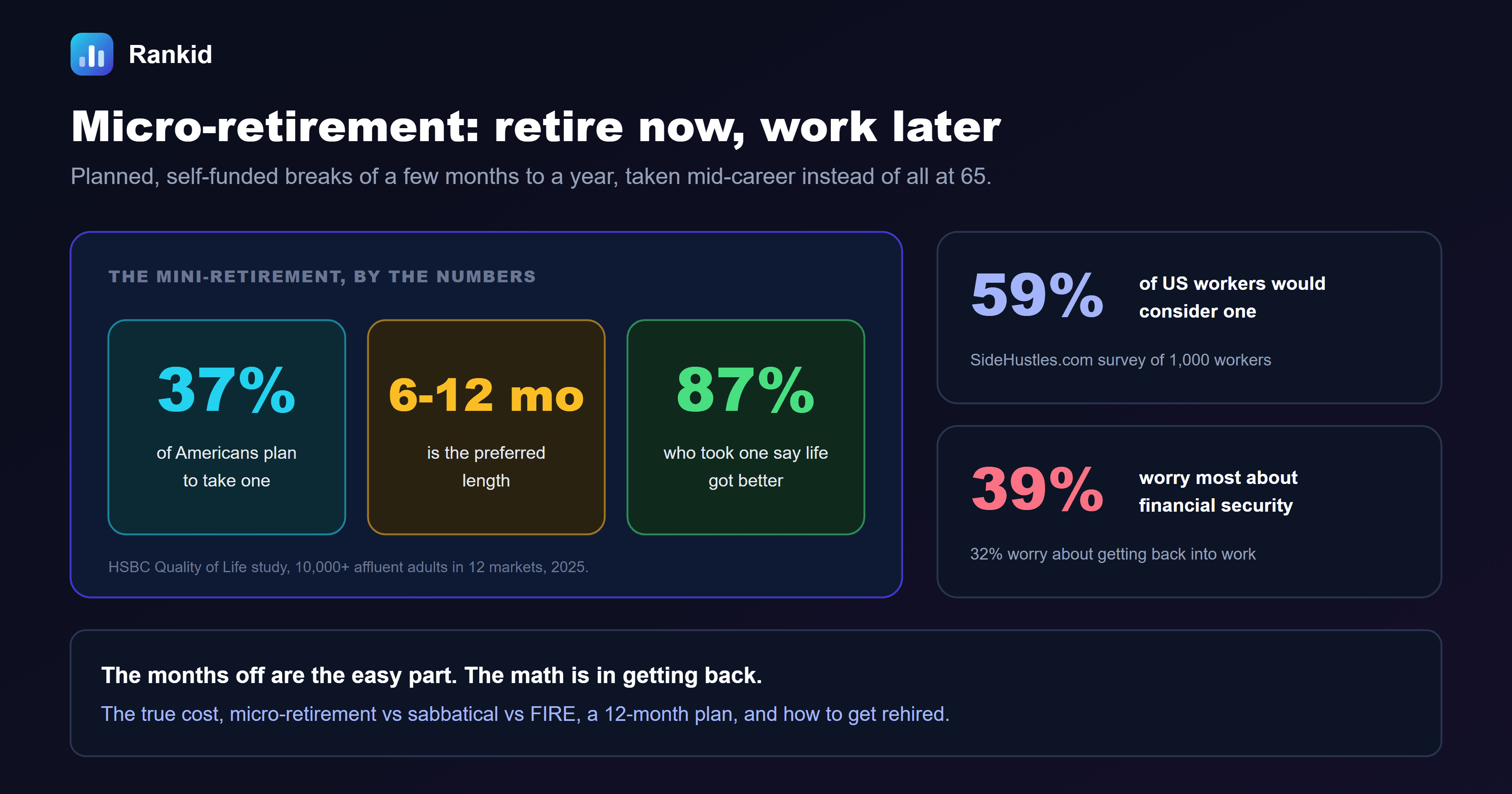
Quick answer: a micro-retirement is a planned, self-funded break of a few months to a year, taken mid-career. HSBC found 37% of Americans plan one, and 87%of people who've taken one say it improved their life. The hidden costs aren't the months off: they're health insurance (pricier since ACA subsidies lapsed in 2026), lost 401(k) compounding, and a job-search buffer for coming back. A six-month break on $4,000 a month needs about $40,000 in cash. Plan it 12 months out, keep one skill warm, and explain it in one confident line.
What is a micro-retirement?
A micro-retirement (or mini-retirement) is a deliberate break from paid work, usually one to twelve months, that you plan and pay for yourself, then return from. The idea was popularized by Tim Ferriss's The 4-Hour Workweekback in 2007, but it went mainstream on TikTok in 2025, when Gen Z workers started posting about quitting to "retire for a bit."
What separates it from simply being between jobs is intent. A layoff gap happens to you. A micro-retirement is scheduled, budgeted and has an end date, and many people plan to take several over a career. In HSBC's research, Gen X and millennials hope to take an average of three, and Gen Z and boomers 2.9.
Why micro-retirements are surging now
- Burnout with no exit.Engagement is falling and many workers feel stuck. When normal vacation doesn't fix exhaustion, some people decide a long reset is cheaper than a breakdown. If that sounds familiar, our guide to quiet cracking covers the warning signs.
- Retirement feels far away and uncertain.With longer careers ahead, many younger workers would rather have time while they're young and work a few extra years at the end.
- Careers aren't linear anymore. Job hopping, portfolio careers and conscious unbossing have made a gap look less like a red flag and more like a choice.
- People want it written into benefits. In a 2025 SideHustles.com survey of 1,000 US workers, 59% said they would consider a micro-retirement, and 75% wanted employers to offer formal policies like unpaid sabbaticals.
What do people actually do with the time? In that survey, 57% planned to use it for mental health recovery, 52% for travel and 29% for creative projects. HSBC found motivations shift by generation: Gen Z leans toward personal development, millennials toward family, Gen X toward travel and boomers toward wellbeing.
Micro-retirement vs sabbatical vs career break vs FIRE
These terms get used interchangeably, but they carry very different risks.
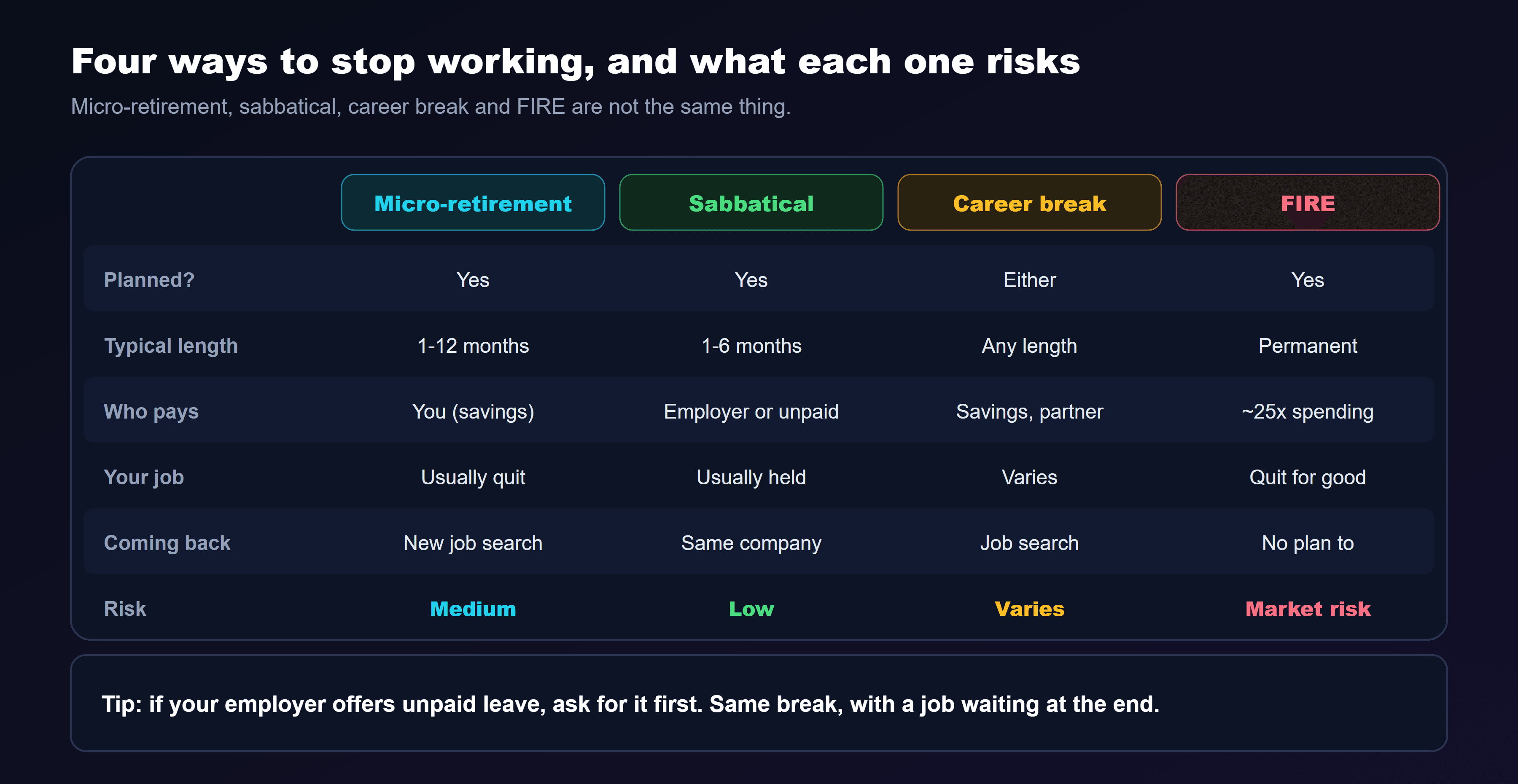
- Micro-retirement: planned, self-funded, usually means quitting, and ends with a new job search.
- Sabbatical:an approved leave, paid or unpaid, and your job is usually waiting. It's the lowest-risk version if your employer offers it.
- Career break: the umbrella term for any gap, planned or not, including caregiving, health, study or a layoff. See our guide to explaining employment gaps.
- FIRE (financial independence, retire early): permanent. It typically requires about 25 times your annual spending invested. A micro-retirement is the opposite bet: spend some savings now, keep working longer.
The true cost of a micro-retirement (the math most people skip)
Most people budget for rent, food and travel. Those are the easy parts. Here's a worked example for a six-month break, for someone earning $70,000 with $4,000 a month in living costs.
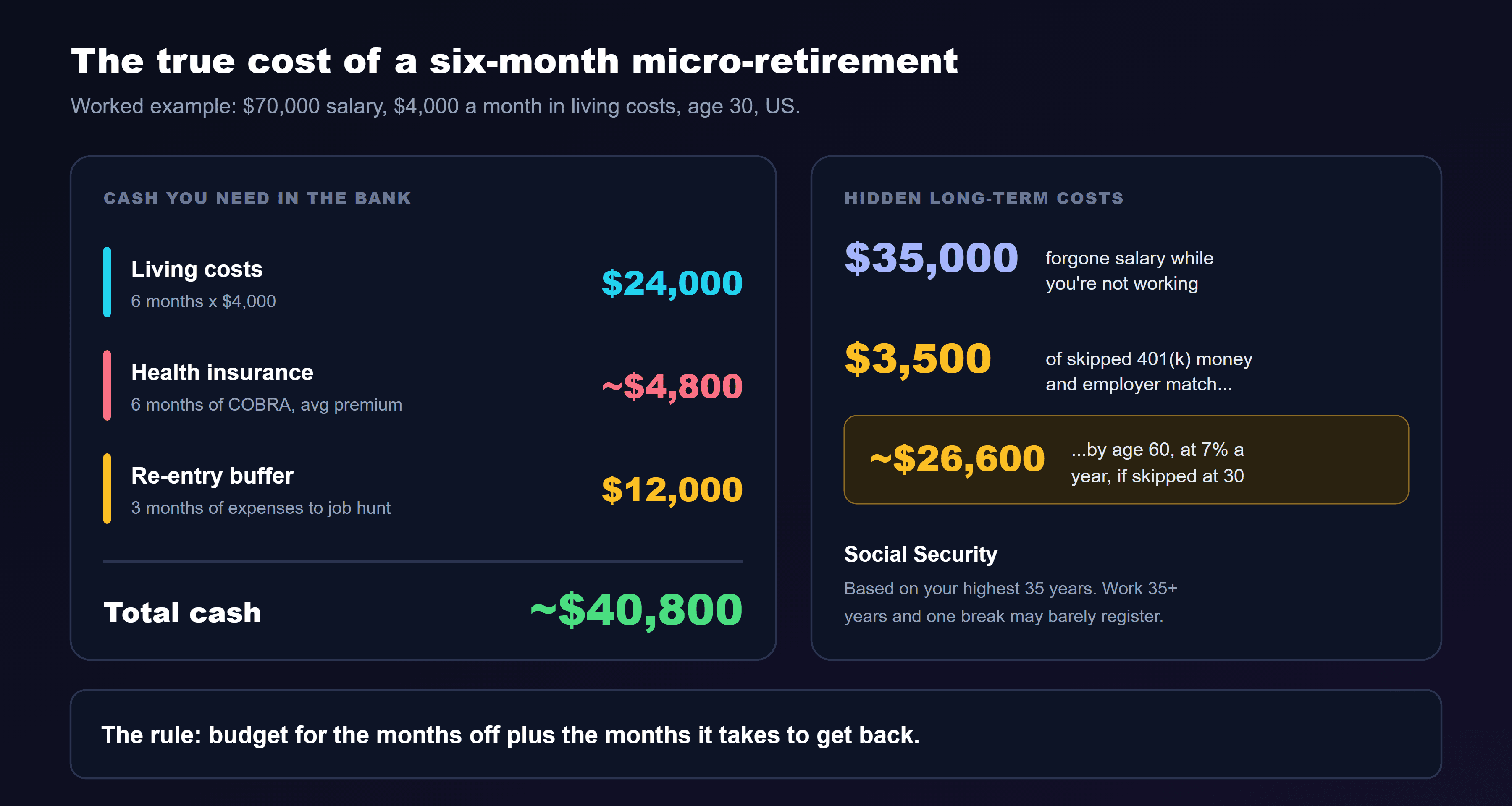
Living costs: $24,000
Health insurance: about $4,800 (US)
Re-entry buffer: $12,000
The hidden cost: compounding
What about Social Security?
Who should not take a micro-retirement (yet)
- Anyone with less than six months of total runway.If you can't cover the break plus the search buffer without debt, you're planning a crisis, not a retirement.
- Visa holders. On an H-1B or similar employment-based status, you generally have a grace period of up to 60 days after your job ends. A long break can put your status at risk, so talk to an immigration attorney first.
- People in a frozen job market. If hiring in your field is slow and layoffs are frequent, re-entry may take far longer than you expect. Our guide to the entry-level job market shows how uneven hiring is right now.
- Anyone about to vest.If you're a few months from a bonus, stock vesting or a 401(k) match vesting date, time the break after it.
- People who can get the same break with a safety net. If your employer offers a sabbatical or unpaid leave, ask for that first.
How to plan a micro-retirement: a 12-month timeline
12 months out: run the numbers
9 months out: ask about a sabbatical
6 months out: lock in health insurance and finances
3 months out: protect the relationships
During the break: keep one skill warm
Two months before returning: start the search
How to explain a micro-retirement and get hired after
Here's the good news: most career breaks are common, and hiring managers know it. In LinkedIn's survey of 23,000 workers and 4,000 hiring managers, 62% of employees had taken a career break. But about 20% of hiring managers admitted rejecting career-break candidates outright, while 51%said they'd be more likely to call back if they understood why. The fix is to tell them.
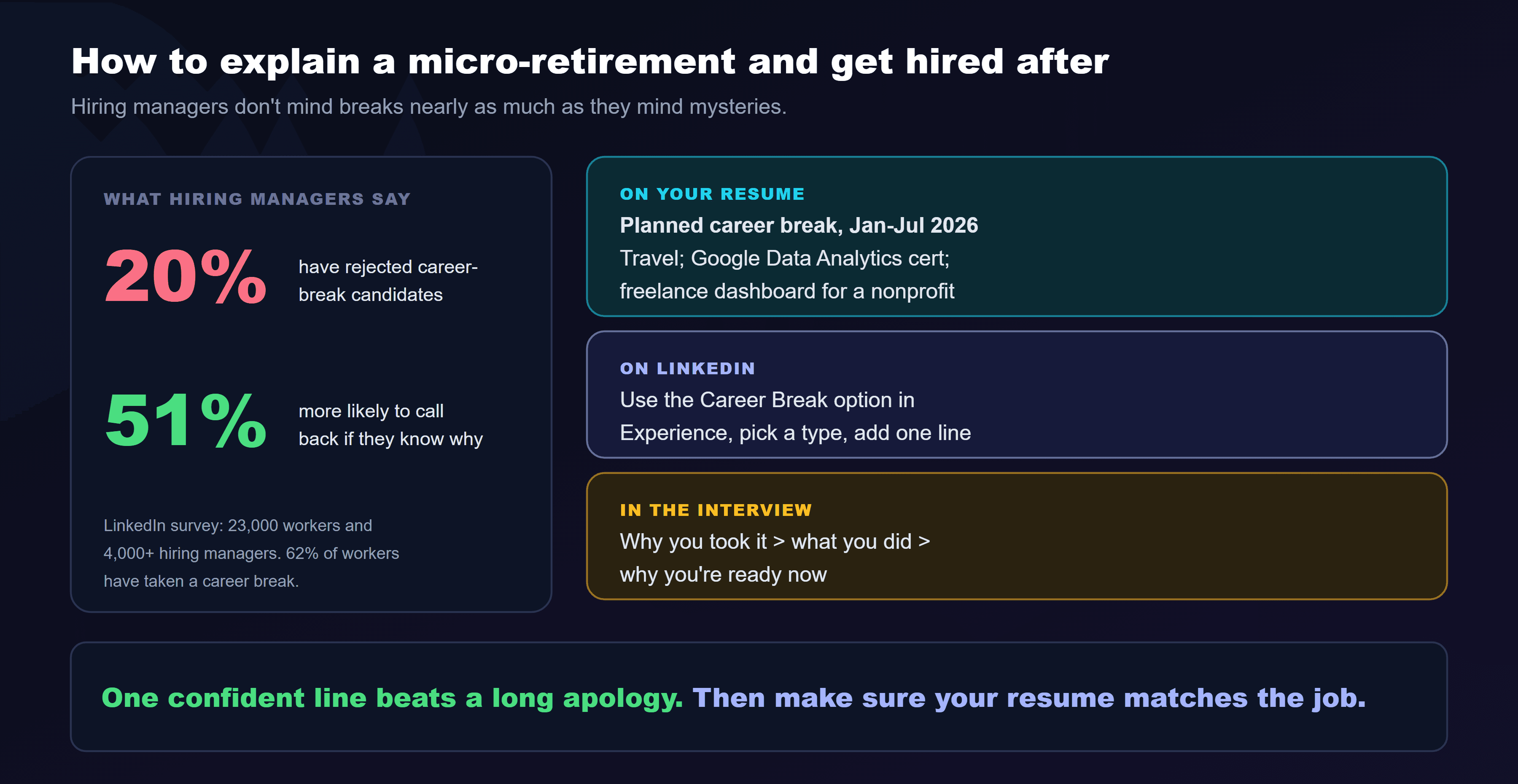
- On your resume:treat it like a job entry. "Planned career break, Jan-Jul 2026: travel through South America; completed Google Data Analytics certificate; built a volunteer dashboard for a local nonprofit." One or two lines, no apology.
- On LinkedIn: add it with the Career Break option in your experience section, choose a type (such as travel, personal goal pursuit or health and wellbeing) and add a line of detail.
- In the interview:use a three-part answer: why you took it, what you did, why you're ready now. "After five years leading launches, I took a planned six-month break to travel and reset. I used part of it to get certified in SQL, and I'm coming back with a lot of energy for exactly this kind of role."
- Don't over-explain burnout.You can be honest without detail: "I'd been running hard for years and chose to take a planned break rather than coast."
The resume still has to match the job
Coming back? Check your resume against the job
Paste your resume and a job description into Rankid for a free 0-100 match score, plus the exact requirements you meet and miss, so your return search starts strong. No signup required.
Check your match score freeFor employers: sabbaticals beat resignations
Every micro-retirement that starts with a resignation is a sabbatical you didn't offer. Replacing an employee costs far more than holding their seat for a few months, and people who leave to rest often don't come back.
- Offer structured unpaid leave. Even a simple policy, such as up to three months unpaid after three years of service, can keep people who would otherwise quit.
- Treat it as retention, not a perk. Track it alongside your employee turnover rate.
- Use it to test succession. Covering a role for a few months is a low-risk way to develop the next person. See our guide to succession planning.
- Don't penalize gaps in hiring. Candidates with planned breaks are often rested, motivated and clear about what they want. Judge them on skills and fit, not on continuity.
Screen on skills, not gaps
Rankid scores every resume against your job description on a consistent 0-100 scale and shows which requirements each candidate matched and missed, so returning candidates are judged on what they can do. First 5 resumes free, no signup.
Try bulk screening freeFrequently asked questions
What is a micro-retirement?
A micro-retirement, also called a mini-retirement, is a deliberate, self-funded break from work, usually lasting a few months to a year, taken during your career rather than at the end of it. People use it to recover from burnout, travel, care for family or pursue a project, then return to work. Unlike a layoff gap, it's planned in advance, and many people plan to take more than one.
How popular are micro-retirements?
Growing fast. HSBC's 2025 Quality of Life study of more than 10,000 affluent adults found 37% of US respondents plan to take a mini-retirement, preferably for 6 to 12 months, and 87% of people worldwide who had taken one said it improved their quality of life. A 2025 SideHustles.com survey of 1,000 US workers found 59% would consider a micro-retirement and 75% want employers to offer formal policies for one.
How much money do you need for a micro-retirement?
Budget for four things: your living costs for every month off, health insurance, a re-entry buffer of three to six months of expenses for the job search afterward, and the retirement contributions you'll skip. For example, a six-month break on $4,000 a month of expenses needs about $24,000 for living costs, roughly $4,800 for six months of COBRA at average premiums, and a $12,000 search buffer, so around $40,000 in cash, plus the long-term cost of paused 401(k) contributions.
What's the difference between a micro-retirement and a sabbatical?
A sabbatical is an approved leave from your current employer, paid or unpaid, and your job is usually waiting when you come back. A micro-retirement usually means leaving your job, funding the break yourself and finding a new role afterward. If your employer offers sabbaticals or unpaid leave, it's often the lower-risk version of the same idea, because you may keep your job and sometimes your benefits.
Does a career break hurt your chances of getting hired?
It can if you don't explain it. In a LinkedIn survey of more than 4,000 hiring managers, about 20% said they had rejected candidates with career breaks outright, but 51% said they'd be more likely to call a candidate back if they understood why the break happened. A short, confident explanation and evidence that your skills are current remove most of the risk.
How do I explain a micro-retirement on my resume?
List it as a dated entry, like a job: 'Planned career break, Jan-Jul 2026: Travel through South America; completed Google Data Analytics certificate; freelance dashboard project for a nonprofit.' On LinkedIn, use the Career Break option in the experience section. Keep it to one or two lines and point to anything that kept your skills current.
Does taking a year off affect Social Security?
Usually only a little. US Social Security benefits are based on your highest 35 years of indexed earnings. If you'll work more than 35 years in total, one low or zero year may be replaced by a working year and have little or no effect. If you'll work fewer than 35 years, each zero year lowers your average slightly. You can check your record and estimates at ssa.gov.
What happens to my health insurance during a micro-retirement?
In the US, leaving a job usually ends employer coverage on your last day or at the end of that month. You can elect COBRA, typically within 60 days, to keep the same plan for up to 18 months, but you pay the full premium plus up to 2%. Losing job-based coverage also opens a 60-day special enrollment period on the ACA Marketplace. The enhanced Marketplace subsidies expired at the end of 2025, so compare prices carefully before you quit.
Key takeaways
- A micro-retirement is a planned, self-funded break of a few months to a year taken mid-career, often more than once.
- HSBC found 37% of Americans plan one, ideally for 6-12 months, and 87% of those who took one said it improved their quality of life.
- Budget for four things: living costs, health insurance, a 3-6 month re-entry buffer, and skipped retirement contributions.
- A six-month break on $4,000 a month needs about $40,000 in cash; a skipped $3,500 in 401(k) money at 30 could be worth about $26,600 at 60.
- US health insurance is the trap: COBRA costs about $790 a month at average premiums, and enhanced ACA subsidies expired at the end of 2025.
- Ask for a sabbatical or unpaid leave first. It's the same break with a job waiting at the end.
- 62% of workers have taken a career break; 51% of hiring managers are more likely to call back if they know why.
- Explain it in one confident line on your resume, LinkedIn and in interviews: why you took it, what you did, why you're ready now.
Frequently asked questions
What is a micro-retirement?
A micro-retirement, also called a mini-retirement, is a deliberate, self-funded break from work, usually lasting a few months to a year, taken during your career rather than at the end of it. People use it to recover from burnout, travel, care for family or pursue a project, then return to work. Unlike a layoff gap, it's planned in advance, and many people plan to take more than one.
How popular are micro-retirements?
Growing fast. HSBC's 2025 Quality of Life study of more than 10,000 affluent adults found 37% of US respondents plan to take a mini-retirement, preferably for 6 to 12 months, and 87% of people worldwide who had taken one said it improved their quality of life. A 2025 SideHustles.com survey of 1,000 US workers found 59% would consider a micro-retirement and 75% want employers to offer formal policies for one.
How much money do you need for a micro-retirement?
Budget for four things: your living costs for every month off, health insurance, a re-entry buffer of three to six months of expenses for the job search afterward, and the retirement contributions you'll skip. For example, a six-month break on $4,000 a month of expenses needs about $24,000 for living costs, roughly $4,800 for six months of COBRA at average premiums, and a $12,000 search buffer, so around $40,000 in cash, plus the long-term cost of paused 401(k) contributions.
What's the difference between a micro-retirement and a sabbatical?
A sabbatical is an approved leave from your current employer, paid or unpaid, and your job is usually waiting when you come back. A micro-retirement usually means leaving your job, funding the break yourself and finding a new role afterward. If your employer offers sabbaticals or unpaid leave, it's often the lower-risk version of the same idea, because you may keep your job and sometimes your benefits.
Does a career break hurt your chances of getting hired?
It can if you don't explain it. In a LinkedIn survey of more than 4,000 hiring managers, about 20% said they had rejected candidates with career breaks outright, but 51% said they'd be more likely to call a candidate back if they understood why the break happened. A short, confident explanation and evidence that your skills are current remove most of the risk.
How do I explain a micro-retirement on my resume?
List it as a dated entry, like a job: 'Planned career break, Jan-Jul 2026: Travel through South America; completed Google Data Analytics certificate; freelance dashboard project for a nonprofit.' On LinkedIn, use the Career Break option in the experience section. Keep it to one or two lines and point to anything that kept your skills current.
Does taking a year off affect Social Security?
Usually only a little. US Social Security benefits are based on your highest 35 years of indexed earnings. If you'll work more than 35 years in total, one low or zero year may be replaced by a working year and have little or no effect. If you'll work fewer than 35 years, each zero year lowers your average slightly. You can check your record and estimates at ssa.gov.
What happens to my health insurance during a micro-retirement?
In the US, leaving a job usually ends employer coverage on your last day or at the end of that month. You can elect COBRA, typically within 60 days, to keep the same plan for up to 18 months, but you pay the full premium plus up to 2%. Losing job-based coverage also opens a 60-day special enrollment period on the ACA Marketplace. The enhanced Marketplace subsidies expired at the end of 2025, so compare prices carefully before you quit.