AI Washing: Are Companies Really Laying People Off Because of AI? (2026 Data)
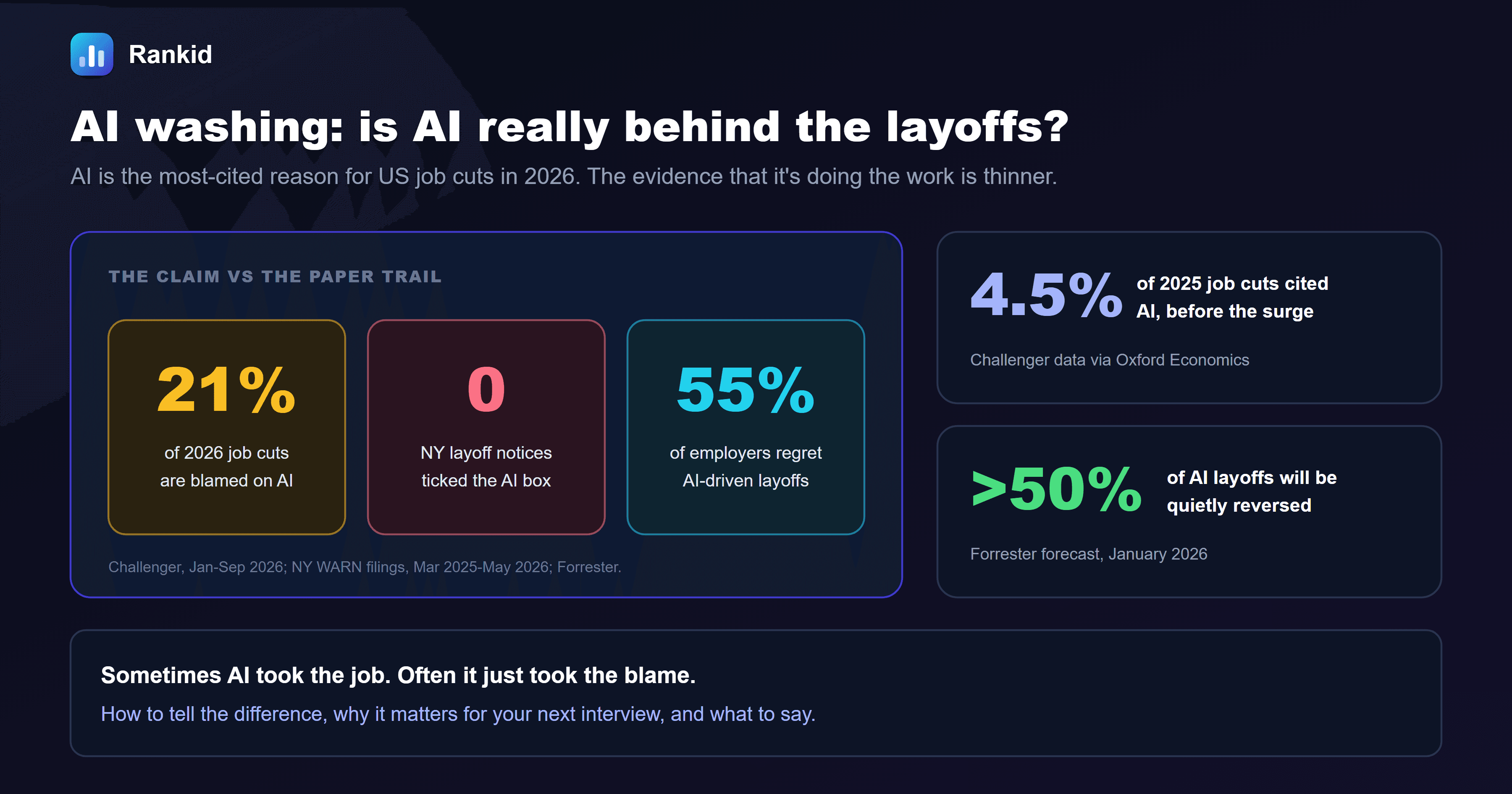
In 2025, about one in every twenty-two announced US job cuts was blamed on artificial intelligence. In the first nine months of 2026, it was more than one in five. Either AI became nearly five times better at replacing people in a single year, or something else changed: the story companies prefer to tell. Economists have a name for the second explanation. They call it AI washing, and if you've been laid off this year, knowing the difference changes how you should talk about it.
Quick answer
Quick answer: AI washing is blaming layoffs on AI when the real cause is cost-cutting, weak demand or over-hiring. AI is the top stated reason for 2026 US job cuts (120,136, about 21%), but Oxford Economics found firms aren't replacing workers with AI at scale, no New York layoff notice has ticked the automation box, and Forrester says 55%of employers regret AI-driven cuts. If it happened to you, your skills probably aren't obsolete. Say "restructuring," not "replaced by AI," and lead with a result.
What is AI washing?
AI washing, in the context of layoffs, is when a company says artificial intelligence is the reason for job cuts when the real drivers are the usual ones: costs, slowing demand, a correction after over-hiring, or moving work somewhere cheaper. Research firm Forrester defines it as attributing financially motivated cuts to futureAI implementation, meaning the AI that supposedly replaced the workers often isn't running yet.
The term is borrowed from greenwashing, where a company overstates how environmentally friendly it is. You'll also see "AI washing" used for companies that exaggerate how much AI is in their products. This guide is about the layoff version, sometimes called AI redundancy washing.
AI washing is not the same as 'AI isn't affecting jobs'
AI layoff statistics for 2026: the claim
Outplacement firm Challenger, Gray & Christmas tracks announced US job cuts and the reason each employer gives. Its September 2026 report shows how quickly the stated reasons have shifted.
- Employers announced 573,195 job cuts from January to September 2026, down 39% from the same period in 2025.
- Artificial intelligence was the most-cited reason, linked to 120,136 cuts, about 21% of the total. It ranked ahead of market and economic conditions (114,124), closings (99,092) and restructuring (79,892).
- A year earlier the picture was very different. Roughly 55,000 cuts were attributed to AI in the first eleven months of 2025, about 4.5% of all announced cuts.
- The trend isn't smooth. In September 2026 alone, AI was cited for 3,961 cuts, about 9% of that month's total.
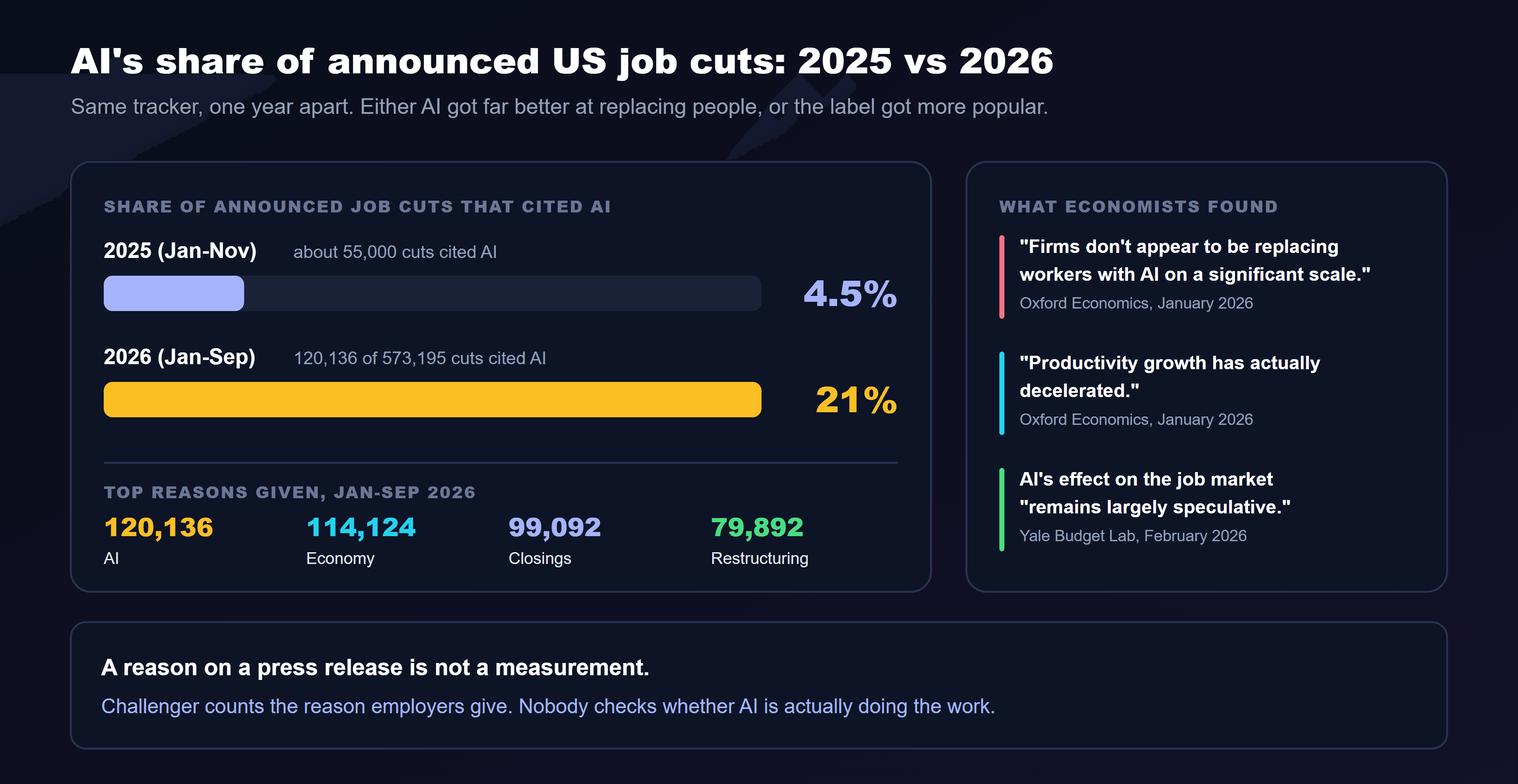
One detail matters more than any of the numbers: Challenger records the reason an employer states. Nobody audits whether a model is actually doing the work those people used to do.
The evidence that AI is taking the blame, not the jobs
Four independent lines of evidence point the same way.
Productivity isn't rising the way it would if AI were replacing people
When the claim has to go in a legal filing, it disappears
The employers themselves are having second thoughts
The cuts are landing at companies that are doing well
Why companies blame AI
- It turns bad news into good news."We hired too many people in 2021" is an admission. "AI has made us more efficient" is a growth story. Oxford Economics suspects "some firms are trying to dress up layoffs as a good news story rather than bad news, such as past over-hiring."
- Investors reward it. An AI narrative signals that a company is keeping up, which matters when the same company is spending heavily on AI.
- It makes the cut sound inevitable.Nobody chose this; the technology did. That is easier to say to remaining staff than "we decided to reduce costs."
- It covers other moves. If the same roles reappear in a lower-cost country or at a lower salary, the driver was labor cost, not software.
- It fits the wider pattern of "forever layoffs." Glassdoor has described a shift to small, rolling cuts through the year. A standing AI explanation suits that pattern well. See the signs layoffs are coming for how to spot the next round.
The AI-washing test: 5 questions to ask about any "AI layoff"
You can apply this to your own layoff or to one you read about. No single answer is proof. Three or more pointing the same way is a strong signal.
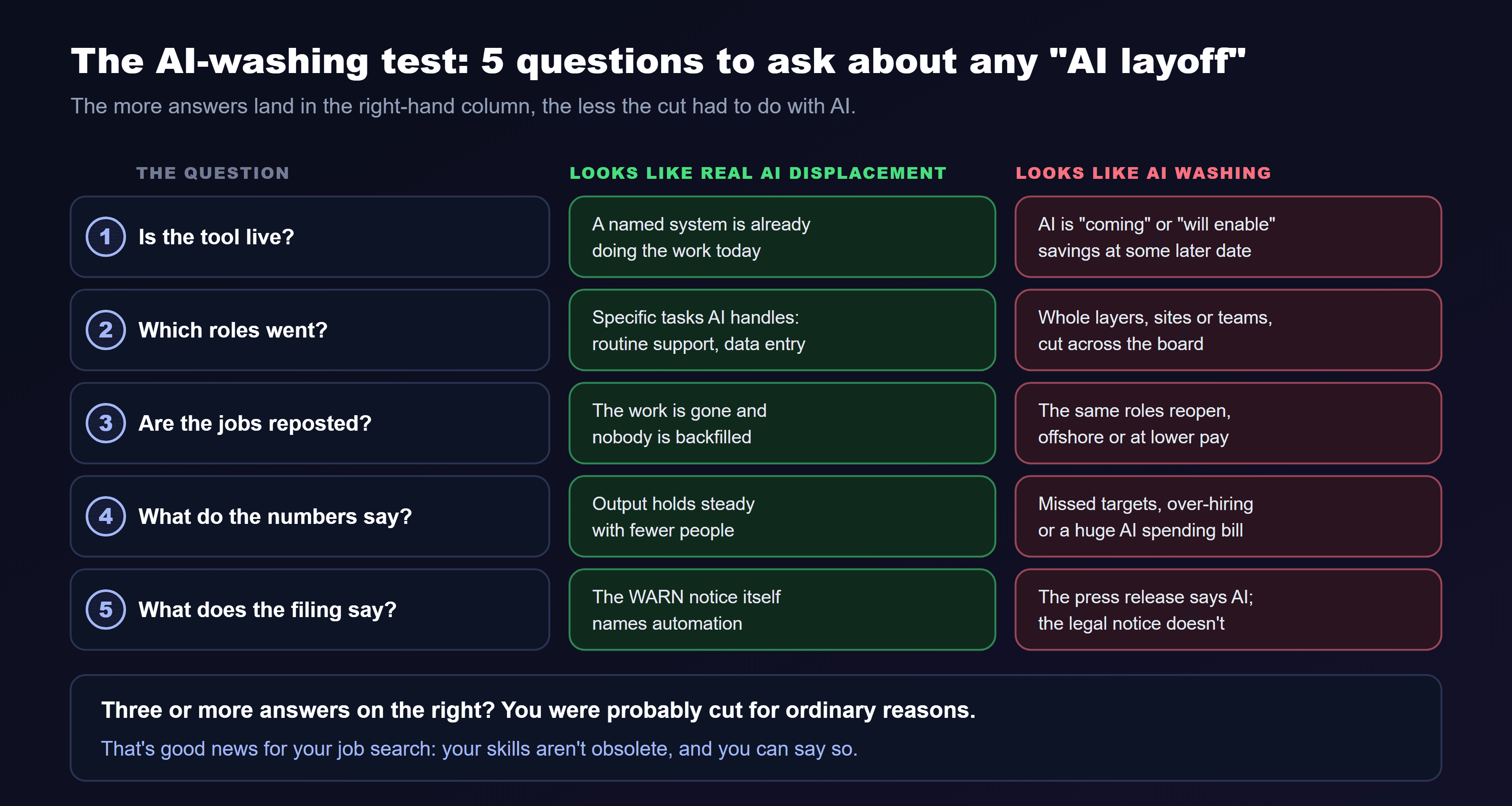
- Is the tool live?Real displacement has a named system already handling the work. AI washing talks about what AI "will enable."
- Which roles went?AI automates tasks, such as routine support tickets or data entry. It doesn't remove an entire management layer, a whole office or 10% of every department.
- Are the jobs reposted?Check the company's careers page and LinkedIn over the next three months. The same job title reopening in another country, or at a lower grade, tells you what the cut was really about.
- What do the financials say? Missed targets, a hiring binge two years ago, or a very large AI capital budget are all simpler explanations.
- What does the legal notice say? In a mass layoff, the WARN notice is filed with the state and is often public. Compare its wording with the press release.
Why it matters to you if the reason was really AI or not
A layoff is a layoff, and your final paycheck is the same either way. But the label affects three things.
- Your confidence, and your plan."A machine does my job now" suggests you need a new career. "The company cut costs" suggests you need a new employer. Those are very different job searches, and most people in 2026 are in the second group.
- How employers read your resume.A recruiter who hears "replaced by AI" may wonder whether your skills are out of date. That worry is usually unfounded, and it's yours to remove.
- Your options if the role comes back. If your job is reposted or the company starts rehiring, you may be a strong candidate to return, sometimes on better terms. See our guide to boomerang employees.
A legal note, not legal advice
How to explain an "AI layoff" in an interview
This is where AI washing does its quiet damage. The company's story becomes your story, and "replaced by AI" is a poor way to introduce yourself.
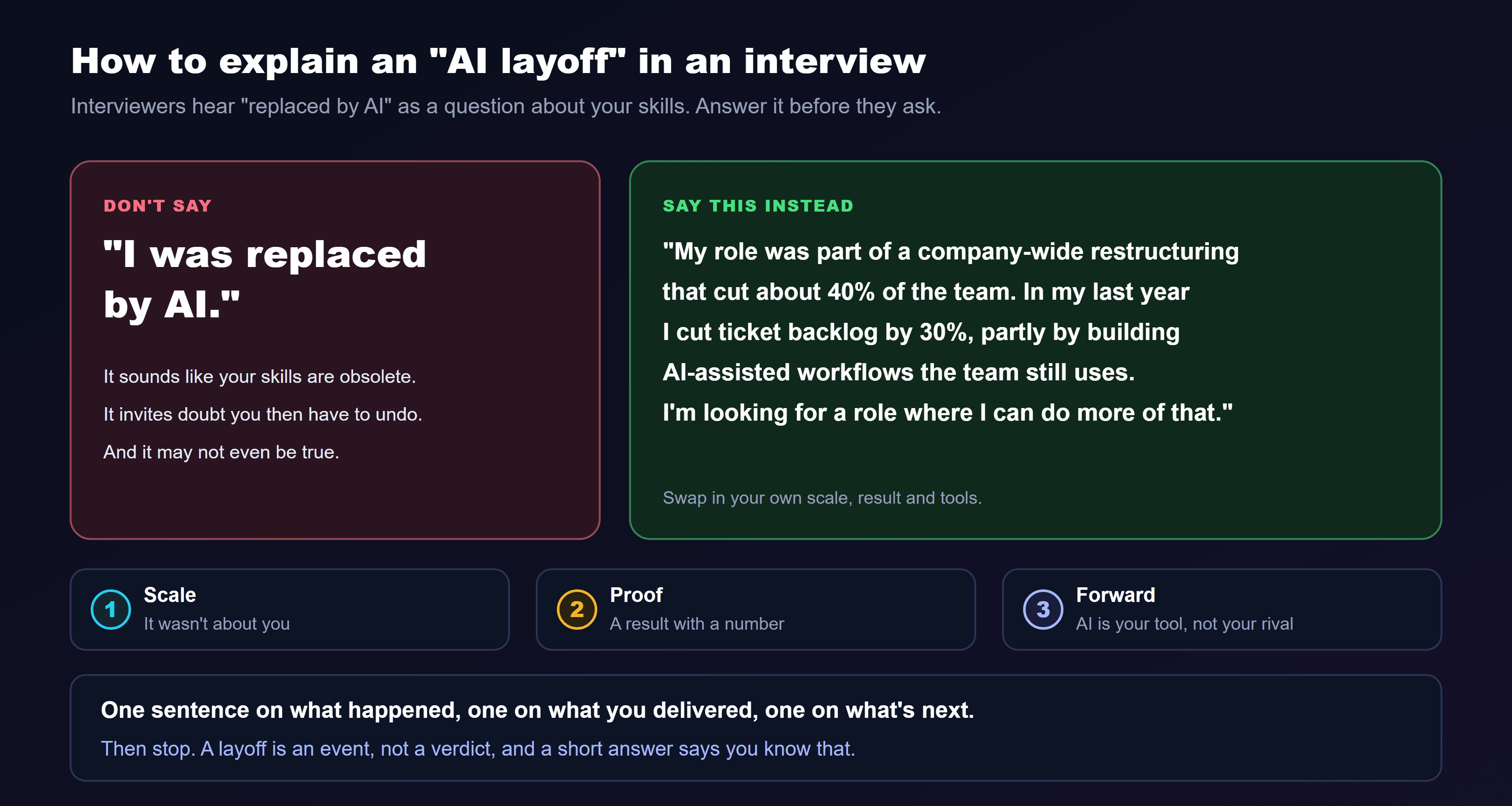
Use three sentences, in this order:
- Scale.State what happened to the group, not to you. "My role was part of a restructuring that cut about 40% of the team."
- Proof. Give one result with a number from your last year. If you need help finding one, see how to quantify achievements.
- Forward.Say what you want next, and show AI as something you use. "I built AI-assisted workflows the team still relies on, and I want to do more of that."
Then stop talking. A short, calm answer tells the interviewer the layoff isn't a sore point. The same wording works for the "reason for leaving" box on an application; see reasons for leaving a job and how to answer common interview questions.
What to do if you were laid off "because of AI"
- Run the five-question test. Work out, for your own benefit, which kind of layoff this was.
- Read before you sign.Check the severance amount, the deadline and what you're waiving. Many agreements are negotiable.
- Add AI to your resume as a skill.List the tools you actually used and what they achieved. Employers are hiring people who work well with AI far faster than they're replacing people with it.
- Watch the careers page.Set an alert for your old job title at your old company. If it reappears, you'll want to know.
- Aim at roles where judgment matters.Forrester expects the heaviest pressure on junior roles, routine software work and customer service. Moving toward work that involves decisions, relationships or accountability is a sensible hedge. If you're early in your career, read what AI is doing to entry-level jobs.
- Handle the gap plainly. A 2026 layoff needs no apology. See how to explain employment gaps.
Laid off? See how your resume scores against your next role
Paste your resume and a job description into Rankid for a free 0-100 match score and the exact requirements you meet and miss, including the AI and tooling skills employers are now asking for. No signup required.
Check your match score freeFor employers: how to announce cuts without AI washing
Blaming AI can feel like the kinder message. It tends to cost more later.
- Say the real reason.If it's cost, say cost. Employees usually know, and Glassdoor has described a widening gap in trust between staff and leadership as rolling layoffs continue.
- Don't cut ahead of the technology.If the AI system isn't live and tested, you're removing capacity on a forecast. That is how the 55% regret figure happens.
- Keep your documents consistent. The press release, the WARN notice, the termination lettersand what managers say in the room should give the same reason. A mismatch is what a plaintiff's lawyer looks for first.
- Run an adverse impact check. Before finalizing a list, test whether the cuts fall disproportionately on any protected group. Our adverse impact guide covers the four-fifths rule.
- Don't refill what you called obsolete. If you expect to rehire for the role within months, a furlough or redeployment may be cheaper than a layoff followed by a new search.
- Protect the pipeline. Cutting junior roles first saves the least money and removes the people who would have become your experienced staff in three years.
Hiring again? Use AI where it helps, with a human deciding
Rankid scores every applicant against your job description on a consistent 0-100 scale and shows the evidence behind each score, so your team shortlists faster and still makes the call. First 5 resumes free, no signup.
Try bulk screening freeFrequently asked questions
What is AI washing?
In the context of layoffs, AI washing is when a company attributes job cuts to artificial intelligence when the real reasons are ordinary ones such as cost-cutting, weak demand, past over-hiring or offshoring. Forrester describes it as attributing financially motivated cuts to future AI implementation. The term borrows from greenwashing, and it is also used more broadly for companies that overstate how much AI is in their products.
Are companies really laying people off because of AI?
Some are, but far fewer than the headlines suggest. AI was the most-cited reason for announced US job cuts in the first nine months of 2026, at 120,136 of 573,195 cuts, or about 21%, according to Challenger, Gray & Christmas. But that figure records the reason employers give, not whether AI is doing the work. Oxford Economics concluded in January 2026 that firms don't appear to be replacing workers with AI on a significant scale, and noted that productivity growth had slowed, which is the opposite of what mass automation would produce.
Why would a company blame AI for layoffs?
Because it is a better story. Saying 'we over-hired' or 'demand is weak' signals a mistake or a struggling business. Saying 'AI has made us more efficient' signals innovation, and investors tend to reward it. Oxford Economics put it this way: some firms are trying to dress up layoffs as a good news story rather than bad news, such as past over-hiring. AI spending itself is also a factor, since some cuts fund large AI infrastructure budgets rather than result from AI doing the work.
How can I tell if my layoff was really caused by AI?
Ask five questions. Is a named AI system already doing the work, or is it still planned? Were specific automatable tasks cut, or whole teams and layers? Are the same roles being reposted, offshore or at lower pay? Do the company's financials point to missed targets or over-hiring? And does the legal layoff notice mention automation, or only the press release? If three or more answers point away from AI, the cut was probably an ordinary cost decision.
Do companies regret AI layoffs?
Many do. Forrester's 2026 predictions report found 55% of employers regret laying off workers because of AI, and its January 2026 jobs forecast predicts over half of layoffs attributed to AI will be quietly reversed as companies run into operational problems. Gartner has predicted that by 2027 half of organizations that planned to significantly cut customer service staff because of AI will abandon those plans.
How do I explain being laid off because of AI in an interview?
Don't say you were replaced by AI. Describe the event at its true scale, add a result, and point forward: 'My role was part of a company-wide restructuring that cut about 40% of the team. In my last year I reduced ticket backlog by 30%, partly by building AI-assisted workflows. I'm looking for a role where I can do more of that.' This is accurate, it shows the layoff wasn't about your performance, and it positions AI as a tool you use.
Do companies have to disclose when layoffs are caused by AI?
Mostly no. New York is the first state to ask: since March 2025 its WARN layoff notice form has included a checkbox for whether technological innovation or automation contributed to the layoffs. In the first year, more than 160 companies filed notices and none ticked it. At the federal level, Senators Mark Warner and Josh Hawley introduced the AI-Related Job Impacts Clarity Act in November 2025, which would require large companies and federal agencies to report AI-related job cuts to the Department of Labor; it has not become law.
How many jobs will AI actually replace?
Forecasts vary widely. Forrester's January 2026 forecast estimates AI could account for about 6% of US job losses by 2030, roughly 10.4 million roles, while augmenting about 20% of jobs rather than eliminating them. Junior roles, software development and customer service face the most pressure. That is a real change, but it is a gradual one, and far smaller than a reading of 2026 layoff announcements would suggest.
Key takeaways
- AI washing is blaming layoffs on AI when the real cause is cost-cutting, weak demand, over-hiring or offshoring.
- AI is the most-cited reason for 2026 US job cuts: 120,136 of 573,195 through September, about 21%, up from about 4.5% in 2025 (Challenger).
- That figure records the reason employers give. Oxford Economics found firms aren't replacing workers with AI at scale, and productivity growth has slowed.
- In New York, where layoff notices ask about automation, more than 160 companies filed in the first year and none ticked the box.
- Forrester reports 55% of employers regret AI-driven layoffs and expects over half to be quietly reversed.
- Use the five-question test: is the tool live, which roles went, are jobs reposted, what do the financials say, and what does the legal filing say?
- In interviews, say 'restructuring', give the scale, add a result with a number, and present AI as a tool you use.
- Employers should state the real reason, keep every document consistent, and avoid cutting ahead of technology that isn't working yet.
Frequently asked questions
What is AI washing?
In the context of layoffs, AI washing is when a company attributes job cuts to artificial intelligence when the real reasons are ordinary ones such as cost-cutting, weak demand, past over-hiring or offshoring. Forrester describes it as attributing financially motivated cuts to future AI implementation. The term borrows from greenwashing, and it is also used more broadly for companies that overstate how much AI is in their products.
Are companies really laying people off because of AI?
Some are, but far fewer than the headlines suggest. AI was the most-cited reason for announced US job cuts in the first nine months of 2026, at 120,136 of 573,195 cuts, or about 21%, according to Challenger, Gray & Christmas. But that figure records the reason employers give, not whether AI is doing the work. Oxford Economics concluded in January 2026 that firms don't appear to be replacing workers with AI on a significant scale, and noted that productivity growth had slowed, which is the opposite of what mass automation would produce.
Why would a company blame AI for layoffs?
Because it is a better story. Saying 'we over-hired' or 'demand is weak' signals a mistake or a struggling business. Saying 'AI has made us more efficient' signals innovation, and investors tend to reward it. Oxford Economics put it this way: some firms are trying to dress up layoffs as a good news story rather than bad news, such as past over-hiring. AI spending itself is also a factor, since some cuts fund large AI infrastructure budgets rather than result from AI doing the work.
How can I tell if my layoff was really caused by AI?
Ask five questions. Is a named AI system already doing the work, or is it still planned? Were specific automatable tasks cut, or whole teams and layers? Are the same roles being reposted, offshore or at lower pay? Do the company's financials point to missed targets or over-hiring? And does the legal layoff notice mention automation, or only the press release? If three or more answers point away from AI, the cut was probably an ordinary cost decision.
Do companies regret AI layoffs?
Many do. Forrester's 2026 predictions report found 55% of employers regret laying off workers because of AI, and its January 2026 jobs forecast predicts over half of layoffs attributed to AI will be quietly reversed as companies run into operational problems. Gartner has predicted that by 2027 half of organizations that planned to significantly cut customer service staff because of AI will abandon those plans.
How do I explain being laid off because of AI in an interview?
Don't say you were replaced by AI. Describe the event at its true scale, add a result, and point forward: 'My role was part of a company-wide restructuring that cut about 40% of the team. In my last year I reduced ticket backlog by 30%, partly by building AI-assisted workflows. I'm looking for a role where I can do more of that.' This is accurate, it shows the layoff wasn't about your performance, and it positions AI as a tool you use.
Do companies have to disclose when layoffs are caused by AI?
Mostly no. New York is the first state to ask: since March 2025 its WARN layoff notice form has included a checkbox for whether technological innovation or automation contributed to the layoffs. In the first year, more than 160 companies filed notices and none ticked it. At the federal level, Senators Mark Warner and Josh Hawley introduced the AI-Related Job Impacts Clarity Act in November 2025, which would require large companies and federal agencies to report AI-related job cuts to the Department of Labor; it has not become law.
How many jobs will AI actually replace?
Forecasts vary widely. Forrester's January 2026 forecast estimates AI could account for about 6% of US job losses by 2030, roughly 10.4 million roles, while augmenting about 20% of jobs rather than eliminating them. Junior roles, software development and customer service face the most pressure. That is a real change, but it is a gradual one, and far smaller than a reading of 2026 layoff announcements would suggest.