Pay Compression: Why New Hires Earn as Much as You (and What to Do About It)
You train the new hire. You answer their questions for three months. Then a job posting for your own title goes up, with a salary range, and the bottom of the range is more than you earn. Nobody decided to underpay you. No one sat in a room and chose it. It happened by arithmetic, and it has a name: pay compression.
Quick answer
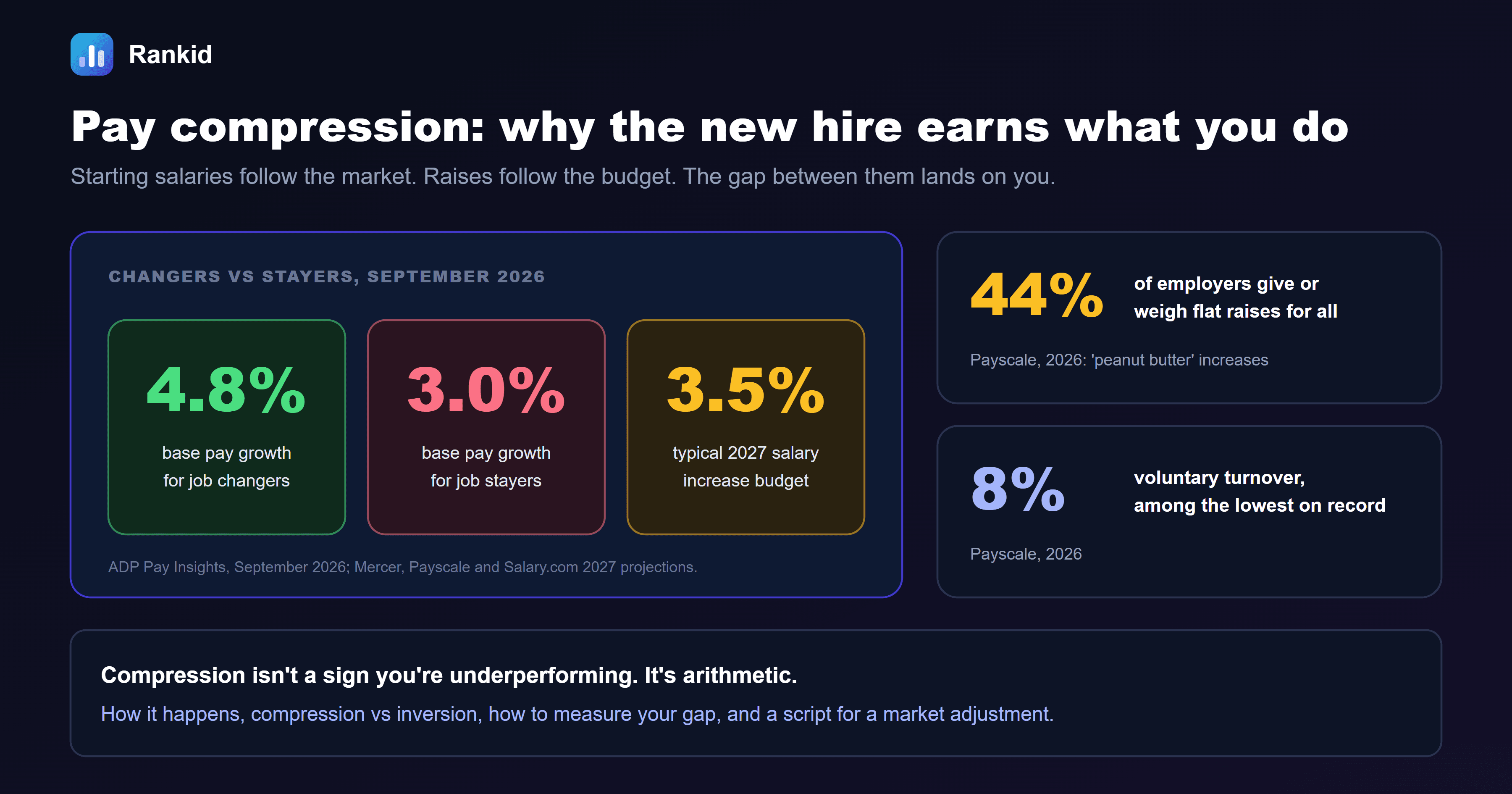
Quick answer: pay compression is when new hires earn almost as much as, or more than, experienced employees in the same job. It happens because starting pay follows the market while raises follow a budget. In September 2026, base pay rose 4.8% for job changers and 3.0% for stayers (ADP). The fix is a market adjustment, which is a different request from a merit raise, and you ask for it with current salary ranges in hand.
What is pay compression?
Pay compression is when pay differences between employees become too small to reflect real differences in experience, skill or responsibility. You'll also see it called salary compression or wage compression.
It shows up in three places:
- Between new and experienced employees in the same job. This is the most common form.
- Between levels,when a junior role's pay catches up with the senior role above it.
- Between managers and their teams, when a supervisor earns barely more than the people they supervise.
Some people call the result a loyalty tax: the amount you forgo each year by staying instead of being hired fresh at today's rate.
How pay compression happens
Two numbers set your pay over time, and different people control each one.
- Starting salaries are set by the market. To fill a role, a company has to offer what other companies are offering this year.
- Raises are set by the budget.Once you're inside, your increase comes from a fixed pool agreed by finance, usually a few percent.
When the first number grows faster than the second, the gap opens by itself. Here is an example.
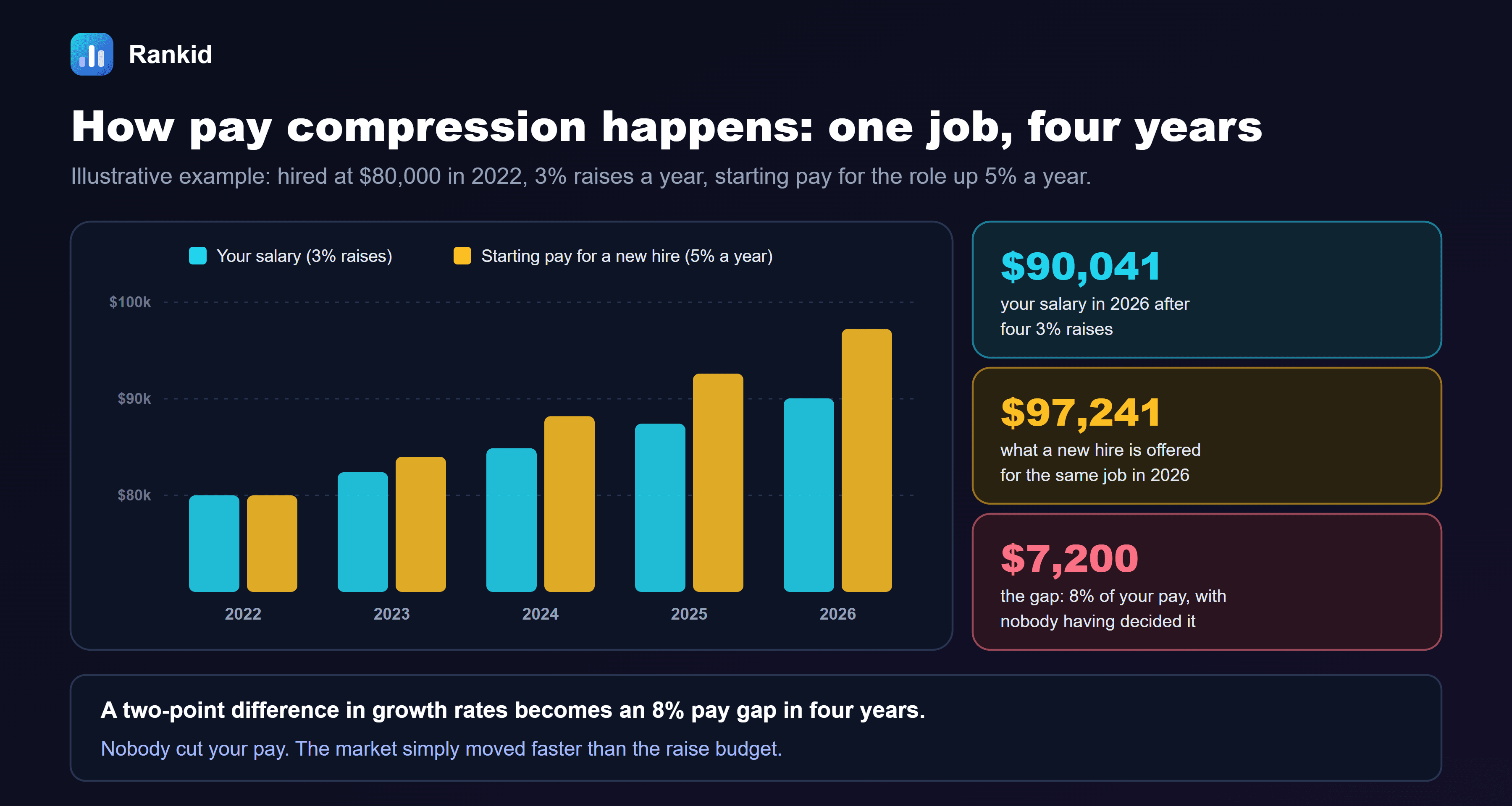
- You're hired in 2022 at $80,000 and get a 3% raise every year.
- The going rate for your role rises 5% a year over the same period.
- By 2026 you earn $90,041. A new hire in the same job is offered $97,241.
- The gap is $7,200, or 8% of your pay. You have four more years of experience and the lower salary.
Other causes push in the same direction:
- Minimum wage increases.The lowest pay rate rises by law, and the rates just above it don't move.
- Scarce skills. A hot skill commands a premium for new hires that existing staff with the same skill never received.
- Flat raises. Giving everyone the same percentage keeps every existing gap in place.
- Overtime. Hourly staff with overtime can out-earn the salaried manager above them. See exempt vs non-exempt.
- Counteroffers.People who threaten to leave get corrected. People who don't, aren't. See counteroffers when you resign.
- Promotions without pay. A bigger title at the old salary compresses you against your new peers. See dry promotions.
Pay compression in 2026: what the numbers show
- Job changers 4.8%, job stayers 3.0%.That's year-over-year base pay growth in ADP's Pay Insights for September 2026. Including bonuses and commissions, it was 7.3% against 4.4%.
- Switchers 5.0%, stayers 3.6%.The Atlanta Fed's Wage Growth Tracker for August 2026.
- Raise budgets of about 3.5% for 2027. Employer surveys cluster tightly: WTW projects 3.4%, Mercer, Payscale and Salary.com 3.5%, and WorldatWork 3.6%. Salary.com reports actual merit increases of 3.2% in 2026, with only 0.7% set aside for equity and market adjustments.
- 44% of organizations are giving or considering "peanut butter" raises,the same increase spread across everyone, according to Payscale's 2026 Compensation Best Practices Report (3,413 respondents).
- Voluntary turnover is 8%, which Payscale describes as one of the lowest rates ever recorded.
The gap closed in 2025. It's back.
Pay compression vs pay inversion
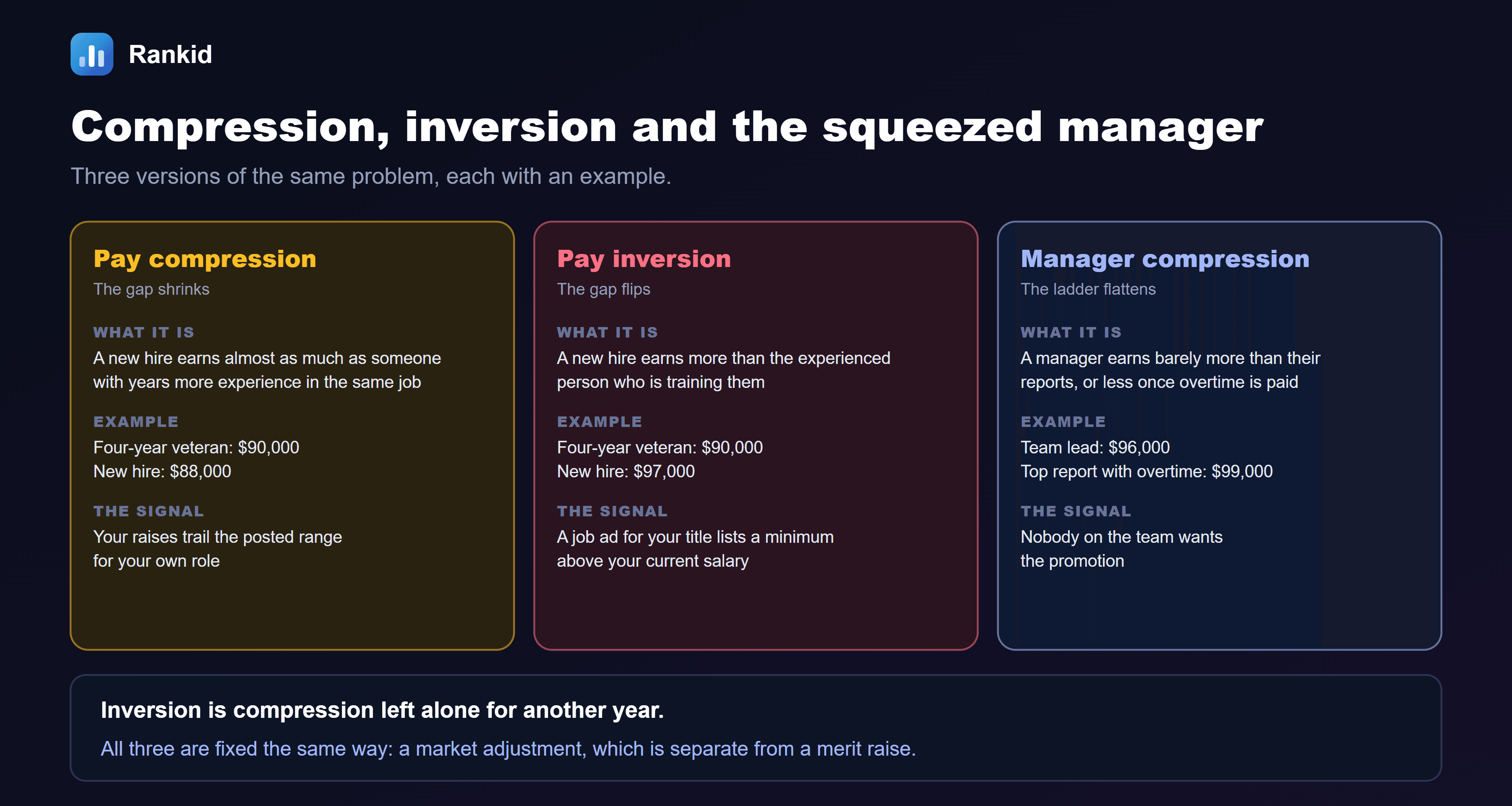
- Compression: the gap has narrowed. The new hire earns $88,000 and you earn $90,000 after four years.
- Inversion: the gap has reversed. The new hire earns $97,000 and you earn $90,000.
- Manager compression:the step up to management pays so little, or so much less than a report's overtime, that nobody wants it.
Signs you're affected
- A posting for your own title shows a range whose minimum is near or above your salary.
- You've been in the role three years or more with raises of around 3% each time.
- A recruiter quotes a figure for a similar job that's well above yours.
- You were promoted without a pay change, or with a small one.
- Colleagues who left and came back earn more than those who stayed.
- Your pay sits in the lower third of your band despite strong reviews. See salary bands and compa-ratio.
Pay transparency lawshave made this far easier to check. In Payscale's 2026 survey, 57% of organizations said they post salary ranges in job ads. You no longer have to guess what your employer pays new people. Often it's on the careers page.
Is pay compression legal?
Yes. Paying a new hire more than an existing employee isn't against the law. Two things are worth knowing:
- It becomes a legal issue if the gaps follow a protected characteristic. If the longer-serving, lower-paid group is mostly women, or mostly older workers, compression can turn into an equal pay or discrimination claim.
- You can generally talk about pay. Most private-sector, non-supervisory employees in the US have a legal right to discuss wages with coworkers. A policy forbidding it is usually unenforceable.
This is general information, not legal advice.
How to ask for a market adjustment
A merit raise rewards performance and comes from the annual budget. A market adjustment corrects pay that has fallen behind the going rate. They're decided differently, often from different money. Ask for the wrong one and the answer is "the budget is 3%."
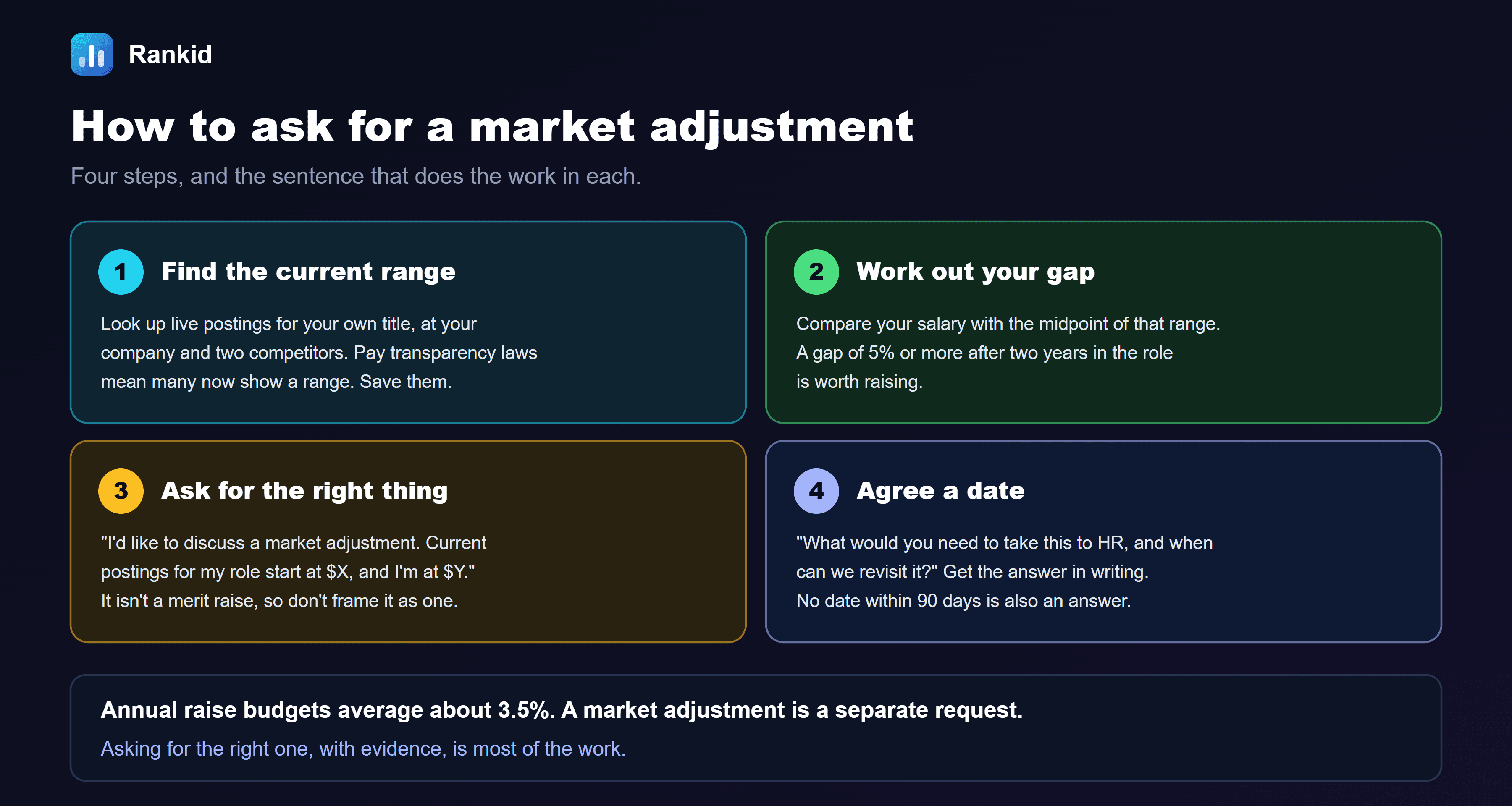
Find the current range
Work out your gap
Ask for the right thing
Agree a date
Timing matters. Raise it two or three months before budgets are set, not at your review, when the money has already been divided. More on timing and wording in how to ask for a raise.
If the answer is no, you have your number and the market has its number. An external move is the remaining way to close the gap, which is exactly what the ADP figures show. Weigh it against what you value in your current job, and see job hopping and how to negotiate salary before you do.
See how you'd fare at today's rate
Paste your resume and a current posting for your own role. Rankid gives you a free 0-100 match score and shows the exact requirements you meet and miss. It's useful evidence for a market adjustment, and a head start if you decide to look. No signup required.
Check your match score freeFor employers: how to find and fix pay compression
Low turnover hides the problem. People who can't easily move aren't content, they're waiting. When hiring picks up, the most compressed employees are usually the most experienced, and they leave first.
- Run a compression analysis every year. For each job, plot pay against time in role. A flat or downward line is compression.
- Set minimum gaps. A common rule of thumb is at least 10% to 15% between a manager and their highest-paid report, and a visible step between levels.
- Fund market adjustments separately.If corrections come out of the merit pool, they never happen. Salary.com's figure of 0.7% set aside for equity adjustments shows how thin that funding usually is.
- Skip the peanut butter. An equal percentage for everyone leaves every gap in place. Target the money at the people furthest behind.
- Fix existing pay before you post a range.If a public range will show current staff they're below the minimum, correct that first.
- Update ranges annually. Old ranges are how new hires end up at the top of a band on day one. See salary bands.
- Stop paying for threats. A raise that only arrives with a resignation teaches everyone how to get one.
- Check for patterns. If the compressed group skews by sex, race or age, you have a legal risk as well as a retention one.
The cost of doing nothing is concrete: replacing an experienced employee at the market rate you declined to pay them, plus recruiting and ramp-up time. See employee turnover rate and cost per hire.
Hiring at market rate? Make every offer count
Rankid scores every applicant against your job description on a consistent 0-100 scale and shows the exact requirements each matched and missed, so the salary you offer goes to the candidate who best fits the role. First 5 resumes free, no signup.
Try bulk screening freeFrequently asked questions
What is pay compression?
Pay compression is when the difference in pay between employees shrinks to the point where it no longer reflects differences in experience, skill or seniority. The most common form is a new hire earning almost as much as someone who has done the same job for years. It is also called salary compression or wage compression.
What causes pay compression?
Starting salaries are set by the outside job market, while raises for existing employees are set by an internal budget. When market pay rises faster than the raise budget, new hires come in at rates that catch up with longer-serving staff. Other causes include minimum wage increases that lift the lowest pay without moving the levels above, premium pay for scarce skills, overtime that pushes hourly staff past salaried managers, and counteroffers made only to people who threaten to leave.
What is the difference between pay compression and pay inversion?
Pay compression means the gap between a new hire and an experienced employee has narrowed. Pay inversion means it has reversed, so the new hire earns more than the experienced employee. Inversion is what compression turns into if nothing is done.
Is pay compression illegal?
Not in itself. US employers are free to pay new hires more than existing staff. It becomes a legal problem when the resulting pay differences follow sex, race, age or another protected characteristic, which can breach the Equal Pay Act, Title VII or state pay equity laws. Employers should check compression patterns for that reason.
What should I do if a new hire makes more than me?
First confirm it with evidence, such as the salary range on a current posting for your own role. Work out the gap between your pay and the midpoint of that range. Then ask your manager for a market adjustment, which is a correction to bring your pay in line with the current rate and is separate from a merit raise. Bring the data, ask what is needed to take it to HR, and agree a date to revisit it.
Can I talk to coworkers about pay?
In the US, most private-sector employees have the right to discuss pay with coworkers under the National Labor Relations Act, and employers generally cannot ban or punish it. The protection does not cover supervisors, and it works differently in the public sector. Sharing pay information is one of the main ways compression comes to light.
Do job switchers still earn more than job stayers?
Yes. In ADP's September 2026 Pay Insights, base pay rose 4.8% year over year for job changers and 3.0% for job stayers. The Atlanta Fed's Wage Growth Tracker showed 5.0% for switchers and 3.6% for stayers in August 2026. The gap briefly closed in 2025, when stayers' wage growth matched or exceeded switchers' for several months, but it has reopened.
How do employers fix pay compression?
They run a compression analysis comparing pay with tenure and performance in each job, set a minimum gap between levels, and make targeted market adjustments for the people furthest behind. They also update salary ranges every year, bring existing staff to the new range before posting it, and stop relying on counteroffers. Spreading the same percentage raise across everyone does not fix compression, because it leaves the gaps where they were.
Key takeaways
- Pay compression is when new hires earn almost as much as experienced employees in the same job. Pay inversion is when they earn more.
- It happens because starting salaries follow the market while raises follow a budget.
- In September 2026, base pay rose 4.8% for job changers and 3.0% for job stayers (ADP). Raise budgets for 2027 are projected at about 3.5%.
- A 3% annual raise against a market rising 5% leaves you $7,200 behind on an $80,000 starting salary after four years.
- Compression is legal unless the pay gaps follow a protected characteristic, and most private-sector employees can legally discuss pay.
- Ask for a market adjustment, not a merit raise, using current salary ranges for your own role, and agree a date to revisit it.
- Employers should run a yearly compression analysis, fund market adjustments separately, and avoid equal-percentage raises that leave gaps in place.
Frequently asked questions
What is pay compression?
Pay compression is when the difference in pay between employees shrinks to the point where it no longer reflects differences in experience, skill or seniority. The most common form is a new hire earning almost as much as someone who has done the same job for years. It is also called salary compression or wage compression.
What causes pay compression?
Starting salaries are set by the outside job market, while raises for existing employees are set by an internal budget. When market pay rises faster than the raise budget, new hires come in at rates that catch up with longer-serving staff. Other causes include minimum wage increases that lift the lowest pay without moving the levels above, premium pay for scarce skills, overtime that pushes hourly staff past salaried managers, and counteroffers made only to people who threaten to leave.
What is the difference between pay compression and pay inversion?
Pay compression means the gap between a new hire and an experienced employee has narrowed. Pay inversion means it has reversed, so the new hire earns more than the experienced employee. Inversion is what compression turns into if nothing is done.
Is pay compression illegal?
Not in itself. US employers are free to pay new hires more than existing staff. It becomes a legal problem when the resulting pay differences follow sex, race, age or another protected characteristic, which can breach the Equal Pay Act, Title VII or state pay equity laws. Employers should check compression patterns for that reason.
What should I do if a new hire makes more than me?
First confirm it with evidence, such as the salary range on a current posting for your own role. Work out the gap between your pay and the midpoint of that range. Then ask your manager for a market adjustment, which is a correction to bring your pay in line with the current rate and is separate from a merit raise. Bring the data, ask what is needed to take it to HR, and agree a date to revisit it.
Can I talk to coworkers about pay?
In the US, most private-sector employees have the right to discuss pay with coworkers under the National Labor Relations Act, and employers generally cannot ban or punish it. The protection does not cover supervisors, and it works differently in the public sector. Sharing pay information is one of the main ways compression comes to light.
Do job switchers still earn more than job stayers?
Yes. In ADP's September 2026 Pay Insights, base pay rose 4.8% year over year for job changers and 3.0% for job stayers. The Atlanta Fed's Wage Growth Tracker showed 5.0% for switchers and 3.6% for stayers in August 2026. The gap briefly closed in 2025, when stayers' wage growth matched or exceeded switchers' for several months, but it has reopened.
How do employers fix pay compression?
They run a compression analysis comparing pay with tenure and performance in each job, set a minimum gap between levels, and make targeted market adjustments for the people furthest behind. They also update salary ranges every year, bring existing staff to the new range before posting it, and stop relying on counteroffers. Spreading the same percentage raise across everyone does not fix compression, because it leaves the gaps where they were.