Stay-or-Pay Contracts (TRAPs): Can Your Employer Make You Pay to Quit? The 2026 Guide
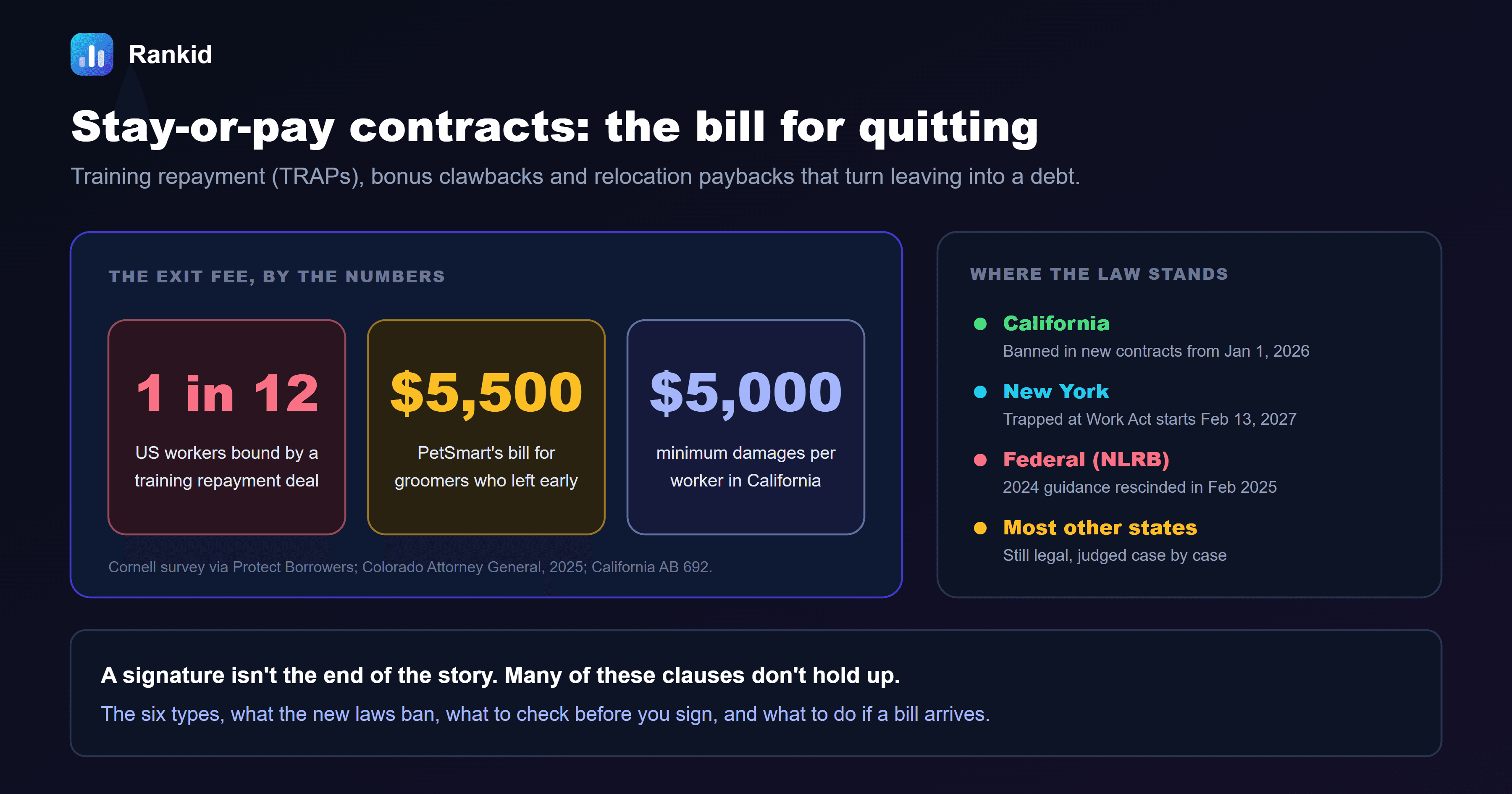
You find a better job. You give notice, work your last shift and hand back your badge. Three weeks later an envelope arrives from your old employer: you owe them $5,500for the "free" training you got when you started. That's not a hypothetical. It's what PetSmart groomers were told, and it's the reason one of the least-known clauses in employment contracts now has a nickname, a wave of lawsuits and, in two of the biggest US states, a ban.
Quick answer
Quick answer: a stay-or-pay contract makes you repay your employer if you leave before a set date, usually for training, a bonus or relocation. Nearly 1 in 12 US workers has a training repayment deal. California banned most of them in contracts signed from January 1, 2026, and New York follows on February 13, 2027. Elsewhere they're legal if reasonable, but many don't hold up. Before signing, check that the debt is prorated, capped at real cost and waived if you're let go. If you get a bill, don't pay on the spot: ask for the agreement and an itemized cost, and get advice.
What is a stay-or-pay contract?
A stay-or-pay contract is any term in your employment paperwork that says: if you leave before a certain date, you owe us money. Lawyers and regulators also call these training repayment agreement provisions (TRAPs), clawbacks, employment promissory notes or employer-driven debt.
They're often described as the new non-compete. A non-compete agreementstops you from taking certain jobs after you leave. A stay-or-pay clause doesn't stop you going anywhere. It just puts a price on the door. As courts and lawmakers have restricted non-competes, some employers have turned to debt to do the same job.
The 6 types of stay-or-pay clause
Not all of these are unfair. A prorated tuition agreement for a degree you chose is a reasonable trade. A bill for mandatory orientation is not. Here are the forms you're likely to see.
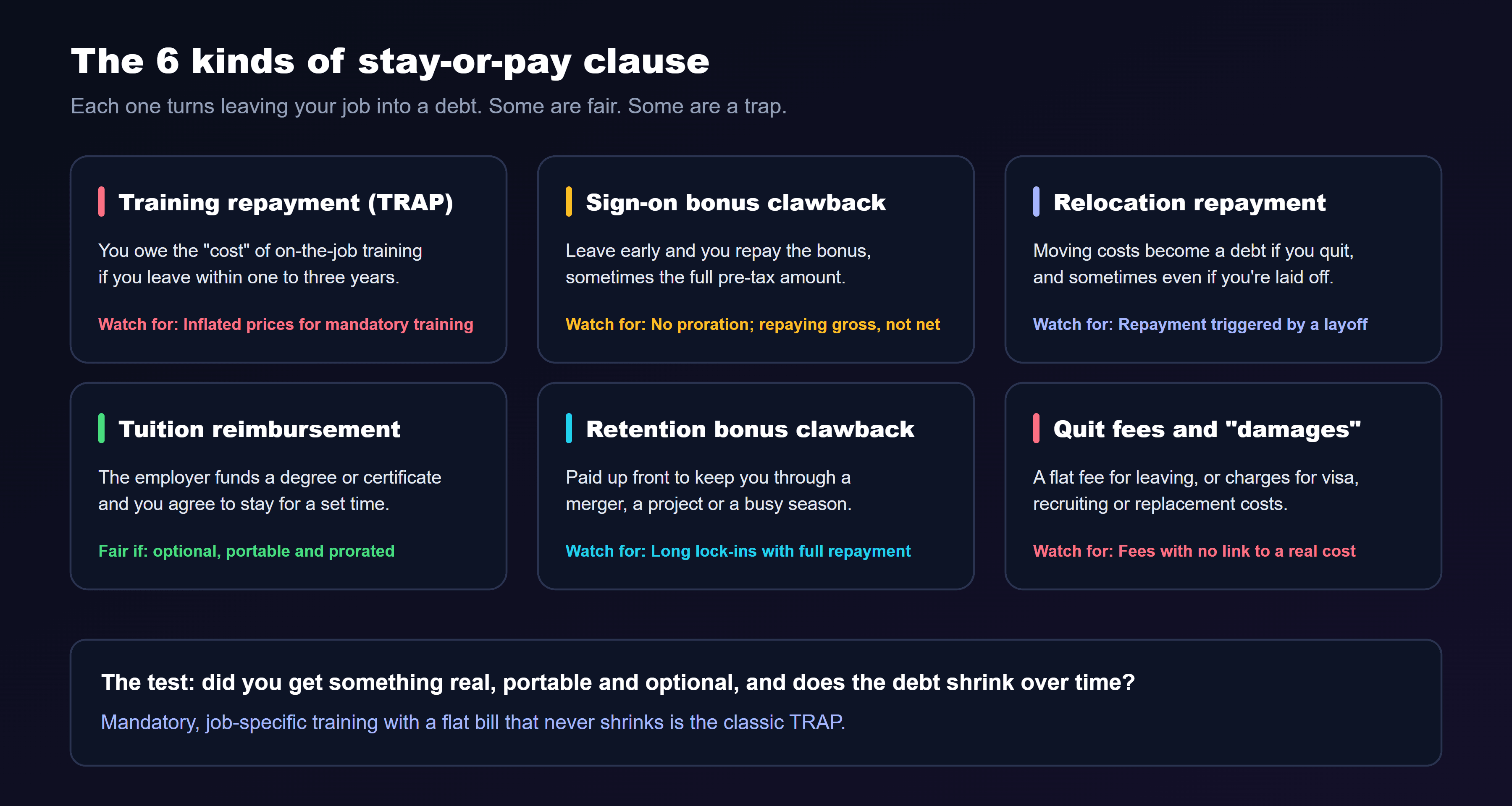
- Training repayment (TRAP).You agree to repay the "cost" of training if you leave within one to three years. The problem cases involve training that is mandatory, specific to the employer and priced far above what it costs to deliver.
- Sign-on bonus clawback.Leave within 12 to 24 months and you repay the bonus. Watch for two details: whether it's prorated, and whether you repay the gross amount even though you only received the after-tax amount.
- Relocation repayment.Moving costs the company paid become a debt if you leave early. The worst versions apply even if you're laid off.
- Tuition reimbursement. The employer pays for a degree or certification and you agree to stay for a period afterward. This is usually the fairest type, because the qualification is yours and you chose it.
- Retention bonus clawback. A bonus paid up front to keep you through a merger, a project or a busy season, repayable if you go.
- Quit fees and "liquidated damages." A flat fee for leaving, or charges for visa sponsorship, recruiting fees or the cost of replacing you.
A simple fairness test
How common are stay-or-pay contracts?
More common than most people realize, and growing.
- Nearly 1 in 12US workers was bound by a training repayment agreement in 2020, according to Cornell survey research cited by the advocacy group Protect Borrowers. That's roughly double the share in 2014, when it was about 4%.
- In a July 2023 report on "employer-driven debt," the Consumer Financial Protection Bureau said these arrangements are especially common in nursing, trucking, aviation and retail.
- The same report described a trucking company that charged drivers $6,500 for training if they left early, while paying driving schools only $1,400 to $2,500 per driver to deliver it.
That last example shows why regulators got interested. When the bill is several times the real cost, the clause isn't recovering an investment. It's a penalty for leaving.
Real cases: PetSmart and HCA Healthcare
- PetSmart.The company advertised a free "Grooming Academy," then required groomers to sign agreements to repay around $5,000 to $5,500 if they left within two years. A former groomer sued in California in 2022. In November 2025, Colorado's attorney general announced a $225,000 settlement with the company over the practice.
- HCA Healthcare. In July 2025, one of the largest US hospital operators settled with state attorneys general for about $2.9 million over training repayment agreements for new nurses, with restitution for nurses who had paid.
In both cases, the workers were in jobs where walking away from a few thousand dollars isn't realistic. That's the point of the clause, and it's why some people stay in roles that are making them miserable. If that's you, read our guides to job hugging and quiet cracking.
Is stay-or-pay legal? Where the law stands in 2026
The short version: federal regulators stepped in, then stepped back, and the states took over.
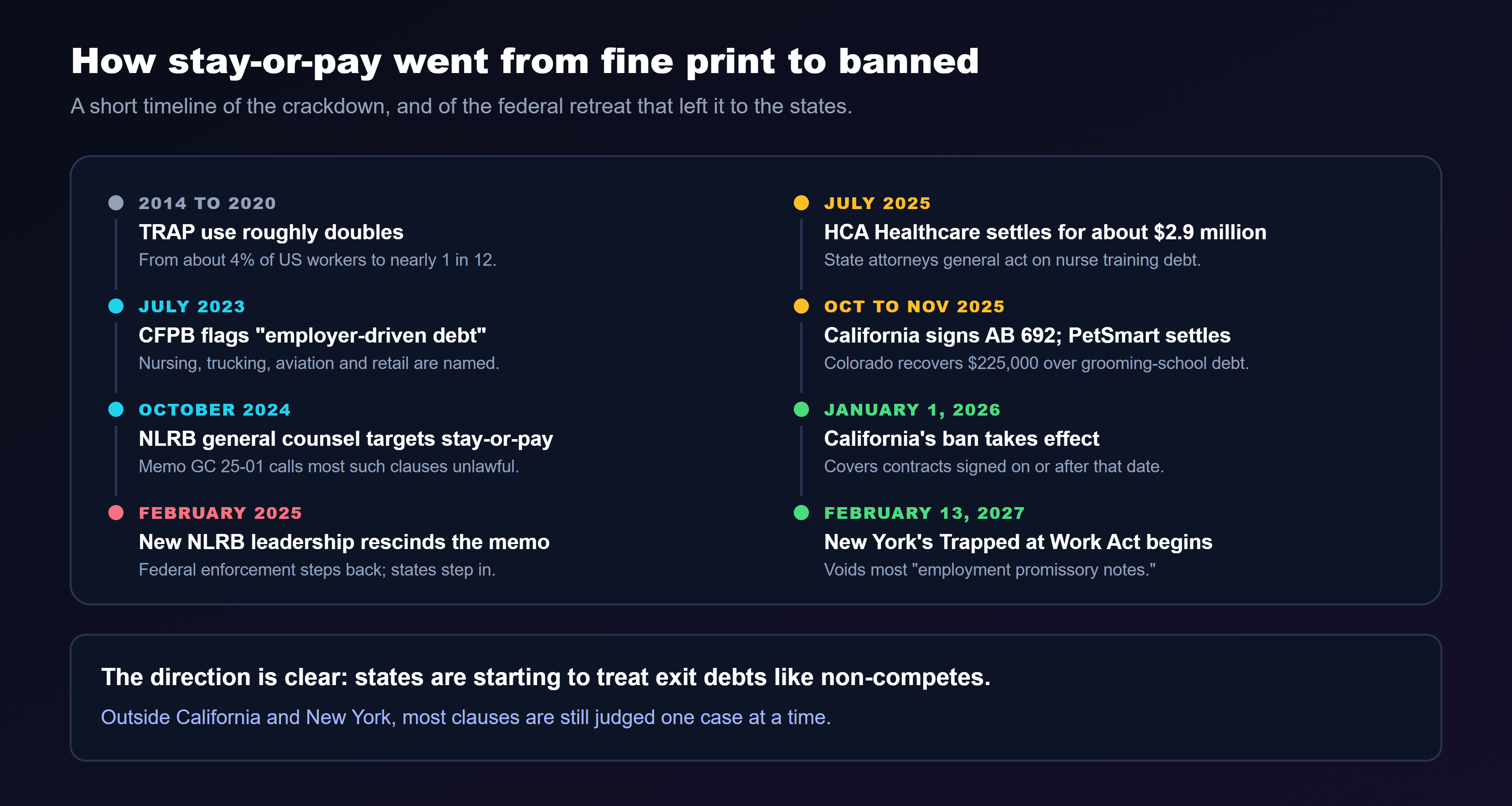
California: banned in new contracts. AB 692, signed on October 13, 2025, makes it unlawful to include in an employment contract, or require a worker to sign, a term that makes them pay the employer for leaving. It applies to contracts entered into on or after January 1, 2026; older agreements aren't covered by it. The exceptions are narrow:
- Tuition for a transferable credential, if it's in a separate agreement, the credential isn't a condition of the job, repayment is capped at the employer's actual cost and prorated, and nothing is owed if you're let go without misconduct.
- Discretionary sign-on bonuses, if there's a separate agreement, you get at least five business days to consult a lawyer, repayment is prorated and interest-free, the retention period is no more than two years, you can choose to defer the payment until the period ends, and nothing is owed if you're let go without misconduct.
- Government loan assistance programs and approved apprenticeships.
Workers can recover their actual damages or $5,000, whichever is greater, plus attorney's fees.
New York: banned from 2027.The Trapped at Work Act, signed on December 19, 2025 and amended on February 13, 2026, voids most "employment promissory notes." It takes effect on February 13, 2027. It allows separate, prorated tuition agreements for transferable credentials, and lets employers recover bonuses or relocation help only where the employee is terminated for misconduct or in a few other limited situations. Penalties are $1,000 to $5,000 per violation.
Federal: guidance withdrawn.In October 2024, the National Labor Relations Board's general counsel issued a memo (GC 25-01) arguing that most stay-or-pay provisions violate federal labor law. In February 2025, the new acting general counsel rescinded it, along with dozens of other memos. There is currently no federal ban.
Everywhere else: case by case.In most states these clauses are legal if they're "reasonable," and state attorneys general have been using consumer protection and wage laws to go after the worst ones. Several other states have introduced bills, so check your state's current rules.
Outside the US
Will it hold up? What makes a clause enforceable
Even where stay-or-pay is legal, a specific clause may not be. These factors come up again and again:
- Actual cost. An amount tied to a real, documented cost is easier to enforce than a round number that looks like a penalty.
- Who benefited.Training that only teaches you the employer's own systems looks like a business expense. A recognized qualification looks like a benefit to you.
- Proration. A debt that shrinks each month is treated as fairer than one that stays at 100% until the last day.
- Involuntary exits.Clauses that still apply when you're laid off or fired without cause are the hardest to defend.
- Minimum wage.Under the Fair Labor Standards Act, wages must be paid "free and clear." A repayment that effectively pushes your pay below minimum wage, or cuts into overtime, can be an unlawful kickback.
- How it was presented.Advertising training as "free" and then billing for it is the kind of thing consumer protection laws were written for.
Before you sign: how to read and negotiate a repayment clause
Repayment terms tend to sit deep in an offer letter, a bonus agreement or onboarding paperwork you're asked to sign on day one. Read them before you accept the offer, not after.
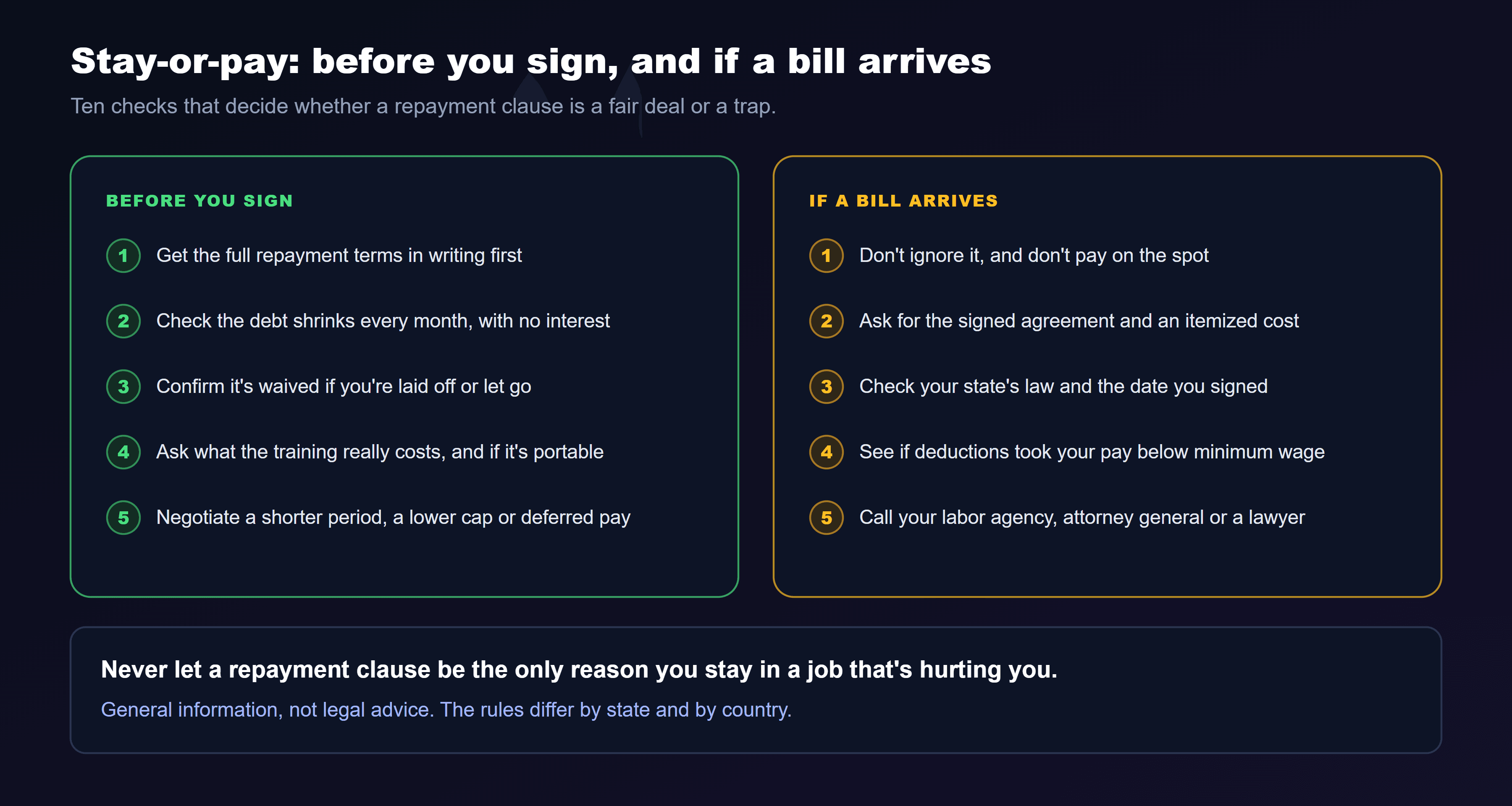
Get the full terms in writing first
Check that the debt shrinks
Check what happens if you don't choose to leave
Ask what it really costs, and whether it's yours to keep
Negotiate
A script that works
What to do if you get a bill after quitting
- Don't ignore it, and don't pay on the spot. An unanswered demand can end up with a debt collector. A quick payment can be hard to get back.
- Ask for the paperwork. Request the agreement you signed and an itemized breakdown of how the amount was calculated.
- Check the date and your state. A California contract signed in 2026 is treated very differently from one signed in 2023.
- Check your final pay. If money was deducted from your last paycheck, look at whether you authorized it in writing and whether it took you below minimum wage.
- Do the math on proration. If you stayed most of the period and they want 100%, say so in writing and offer the prorated amount, if anything.
- Get help.Your state labor department, the attorney general's consumer protection office, a legal aid group or an employment lawyer can tell you where you stand. Many lawyers offer a free first consultation.
Planning to leave soon? Read the clause before you resign, time your exit around any date when the debt drops or expires, and keep copies of everything. Our guides to notice periods and resignation letterscover the rest. And if a new employer wants you badly enough, it's common to ask them to cover a clawback as part of your sign-on package.
Leaving a job that's holding you back?
Paste your resume and a job description into Rankid for a free 0-100 match score and the exact requirements you meet and miss, so your next move is worth making. No signup required.
Check your match score freeFor employers: what you can still do
Wanting a return on training or relocation is reasonable. Trapping people with debt is increasingly illegal, and it doesn't work: people who stay only because they can't afford to leave are not the workforce you want. A safer approach:
- Audit your templates. Check offer letters, bonus agreements, relocation policies and onboarding documents for any repayment language, especially for California hires since January 2026 and New York hires ahead of February 2027.
- Pay bonuses in arrears. A retention bonus paid at the end of the period needs no clawback at all.
- Prorate and cap. Tie any repayment to documented, actual cost, reduce it monthly and waive it for layoffs and terminations without misconduct.
- Keep required training free.Training that's a condition of the job is a cost of doing business. Never advertise it as free and bill for it later.
- Earn retention instead. Clear growth paths, fair pay and good managers keep people longer than debt does. See our guides to individual development plans, onboarding and reducing turnover.
This is a fast-moving area, so have employment counsel review your agreements state by state.
Hire people who want to stay
Rankid scores every applicant against your job description on a consistent 0-100 scale and shows the exact requirements each matched and missed, so you hire for real fit from the start. First 5 resumes free, no signup.
Try bulk screening freeFrequently asked questions
What is a stay-or-pay contract?
A stay-or-pay contract is any employment term that requires you to pay your employer money if you leave before a set date. The most common forms are training repayment agreement provisions (TRAPs), sign-on and retention bonus clawbacks, relocation repayment clauses, tuition reimbursement repayment and flat 'quit fees.' The effect is the same in each case: leaving your job creates a debt.
Can my employer make me pay for training if I quit?
Only if you signed an agreement saying so, and even then it may not be enforceable. In California, most training repayment clauses in contracts signed on or after January 1, 2026 are unlawful under AB 692. New York's Trapped at Work Act voids most of them from February 13, 2027. In other states, courts look at whether the amount reflects the employer's real cost, whether the training mainly benefited the employer, and whether repayment would push your pay below minimum wage.
Do I have to pay back a sign-on bonus if I quit?
Usually yes, if your offer letter or bonus agreement includes a repayment clause and you leave within the stated period, commonly 12 to 24 months. Check whether the amount is prorated and whether you owe the gross amount or only what you received after tax. In California, new sign-on bonus clawbacks must meet strict conditions: a separate agreement, prorated and interest-free repayment, a retention period of no more than two years, and no repayment if you're let go without misconduct.
Are training repayment agreements enforceable?
It depends on the state and the terms. They are more likely to be enforced when the training was optional, led to a recognized, portable qualification, was priced at the employer's actual cost and is repaid on a sliding scale. They are more likely to be struck down or challenged when the training was mandatory and job-specific, the price was inflated, the debt doesn't shrink over time, or it applies even if you're laid off.
What does California's AB 692 ban?
AB 692 makes it unlawful to include in an employment contract, or require a worker to sign, a term that makes them pay the employer if they leave. It applies to contracts entered into on or after January 1, 2026. There are narrow exceptions for tuition for transferable credentials, discretionary sign-on bonuses that meet set conditions, approved apprenticeships and government loan programs. Workers can recover actual damages or $5,000, whichever is greater, plus attorney's fees.
What is New York's Trapped at Work Act?
It's a New York law, signed in December 2025 and amended in February 2026, that voids most 'employment promissory notes': agreements that require an employee to repay money to an employer if they leave before a set time. It takes effect on February 13, 2027. Exceptions include tuition for a transferable credential under a separate, prorated agreement, and repayment of bonuses or relocation help where the employee is terminated for misconduct. Penalties run from $1,000 to $5,000 per violation.
Can my employer take training costs out of my final paycheck?
Often not without your written authorization, and not if it takes your pay below minimum wage. Under the US Fair Labor Standards Act, wages must be paid 'free and clear,' so deductions that mainly benefit the employer generally can't cut into minimum wage or overtime pay. Many states have stricter rules on wage deductions. If money was taken from your final check, contact your state labor department.
What should I do if I get a bill after quitting?
Don't ignore it and don't pay immediately. Ask for a copy of the agreement you signed and an itemized breakdown of the cost. Check the date you signed and your state's law, look at whether the amount is prorated, and check whether any deductions took your pay below minimum wage. Then contact your state labor department, your state attorney general's office, a legal aid organization or an employment lawyer before agreeing to anything.
This article is general information, not legal advice. Employment law varies by state and country and changes often; talk to a qualified employment lawyer about your own situation.
Key takeaways
- A stay-or-pay contract makes you repay your employer if you leave before a set date: for training, a bonus, relocation or simply for quitting.
- Nearly 1 in 12 US workers has a training repayment agreement (TRAP), about double the share in 2014.
- California's AB 692 bans most stay-or-pay terms in contracts signed on or after January 1, 2026, with damages of at least $5,000 per worker.
- New York's Trapped at Work Act voids most employment promissory notes from February 13, 2027.
- There's no federal ban: the NLRB's 2024 stay-or-pay memo was rescinded in February 2025, so state law decides.
- Clauses are weakest when training is mandatory, the price is inflated, the debt isn't prorated, or it applies after a layoff.
- Before signing, get the terms in writing and negotiate proration, a cap, a layoff waiver or a bonus paid in arrears.
- If a bill arrives, don't pay on the spot: ask for the agreement and an itemized cost, check your state's law and get advice.
Frequently asked questions
What is a stay-or-pay contract?
A stay-or-pay contract is any employment term that requires you to pay your employer money if you leave before a set date. The most common forms are training repayment agreement provisions (TRAPs), sign-on and retention bonus clawbacks, relocation repayment clauses, tuition reimbursement repayment and flat 'quit fees.' The effect is the same in each case: leaving your job creates a debt.
Can my employer make me pay for training if I quit?
Only if you signed an agreement saying so, and even then it may not be enforceable. In California, most training repayment clauses in contracts signed on or after January 1, 2026 are unlawful under AB 692. New York's Trapped at Work Act voids most of them from February 13, 2027. In other states, courts look at whether the amount reflects the employer's real cost, whether the training mainly benefited the employer, and whether repayment would push your pay below minimum wage.
Do I have to pay back a sign-on bonus if I quit?
Usually yes, if your offer letter or bonus agreement includes a repayment clause and you leave within the stated period, commonly 12 to 24 months. Check whether the amount is prorated and whether you owe the gross amount or only what you received after tax. In California, new sign-on bonus clawbacks must meet strict conditions: a separate agreement, prorated and interest-free repayment, a retention period of no more than two years, and no repayment if you're let go without misconduct.
Are training repayment agreements enforceable?
It depends on the state and the terms. They are more likely to be enforced when the training was optional, led to a recognized, portable qualification, was priced at the employer's actual cost and is repaid on a sliding scale. They are more likely to be struck down or challenged when the training was mandatory and job-specific, the price was inflated, the debt doesn't shrink over time, or it applies even if you're laid off.
What does California's AB 692 ban?
AB 692 makes it unlawful to include in an employment contract, or require a worker to sign, a term that makes them pay the employer if they leave. It applies to contracts entered into on or after January 1, 2026. There are narrow exceptions for tuition for transferable credentials, discretionary sign-on bonuses that meet set conditions, approved apprenticeships and government loan programs. Workers can recover actual damages or $5,000, whichever is greater, plus attorney's fees.
What is New York's Trapped at Work Act?
It's a New York law, signed in December 2025 and amended in February 2026, that voids most 'employment promissory notes': agreements that require an employee to repay money to an employer if they leave before a set time. It takes effect on February 13, 2027. Exceptions include tuition for a transferable credential under a separate, prorated agreement, and repayment of bonuses or relocation help where the employee is terminated for misconduct. Penalties run from $1,000 to $5,000 per violation.
Can my employer take training costs out of my final paycheck?
Often not without your written authorization, and not if it takes your pay below minimum wage. Under the US Fair Labor Standards Act, wages must be paid 'free and clear,' so deductions that mainly benefit the employer generally can't cut into minimum wage or overtime pay. Many states have stricter rules on wage deductions. If money was taken from your final check, contact your state labor department.
What should I do if I get a bill after quitting?
Don't ignore it and don't pay immediately. Ask for a copy of the agreement you signed and an itemized breakdown of the cost. Check the date you signed and your state's law, look at whether the amount is prorated, and check whether any deductions took your pay below minimum wage. Then contact your state labor department, your state attorney general's office, a legal aid organization or an employment lawyer before agreeing to anything.