AI Interviews: How to Pass One When the Interviewer Is a Bot (and When to Ask for a Human) (2026)
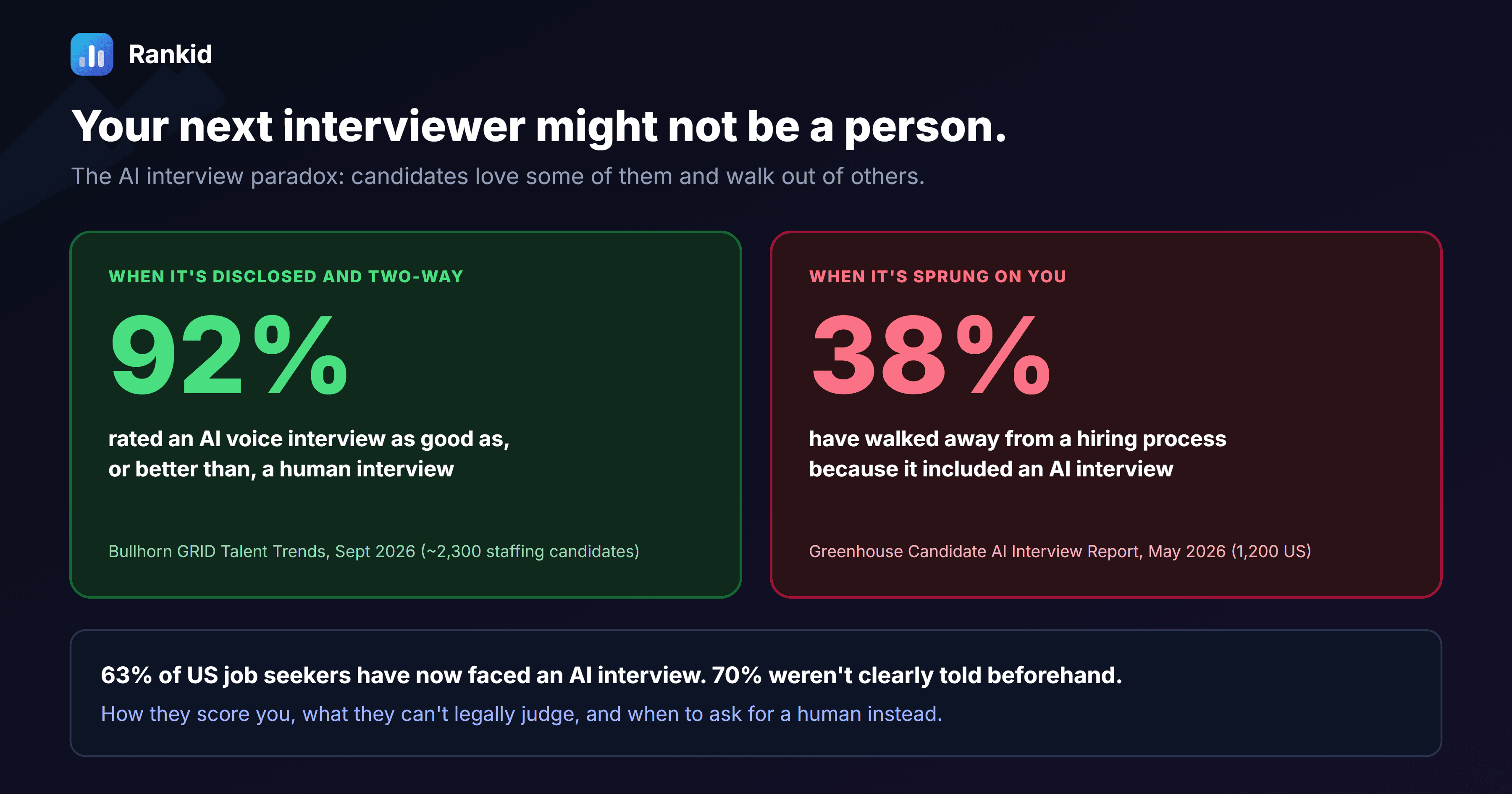
You click the link in the recruiter's email expecting a calendar invite. Instead a friendly voice introduces itself, explains that it will ask you a few questions about your experience, and asks if you're ready. It has no face, no bad days and no opinion about your shoes, and in about twenty minutes it will decide whether a human ever reads your application. Welcome to the AI interview. Nearly two in three US job seekers have now sat one, most were never properly warned, and the rules for how they are scored are nothing like the rules you learned for talking to people.
Quick answer
Quick answer: an AI interview is a hiring step where software asks the questions and usually scores the answers. 63% of US job seekers have faced one, and 70% weren't clearly told upfront. Most tools grade your transcriptagainst a rubric, not your face, so win by answering the exact question in your first sentence, giving one specific example with a measurable result, and saying the job description's skills out loud. Use a good microphone, never use a hidden AI helper, and ask in writing whether a human reviews the result. You can request an accommodation or a human alternative, and some places, including Illinois and New York City, give you legal rights to notice.
What an AI interview is
An AI interviewis any interview stage in which software, rather than a person, asks you the questions, adapts follow-ups, or evaluates your answers. It usually sits right after you apply, where a recruiter's screening interview used to be, and it exists for one reason: employers are receiving more applications than their teams can call back. When a single posting draws hundreds of applicants, an AI that interviews all of them at 2am looks attractive.
The spread has been fast. Greenhouse's 2026 Candidate AI Interview Report, based on a May 2026 survey of 1,200 US job seekers, found 63% had faced an AI interview, up 13 points in just six months. For many people, the first "interviewer" at a company is now a bot.
The AI interview paradox: loved and hated at the same time
Here is the strange part. Two big 2026 surveys seem to contradict each other. Bullhorn's GRID Talent Trends Report, covering about 2,300 people who had worked with staffing firms, found 92% rated AI voice interviews as good as or better than human interviews. Greenhouse, meanwhile, found 38% of candidates had walked away from a hiring process because it included an AI interview, with another 12% saying they would.
Both are true, because "AI interview" describes very different experiences. The ones candidates like are disclosed upfront, feel like a real conversation, and end with a human looking at the result. The ones they abandon are sprung on them, feel like talking to a countdown timer, and disappear into silence: 51% of people who completed an AI interview in the Greenhouse survey never heard back at all.
The three things that decide whether an AI interview feels fair
The four kinds of AI interview (and how to tell which one you got)
Preparation depends on the format, because each one measures something different.
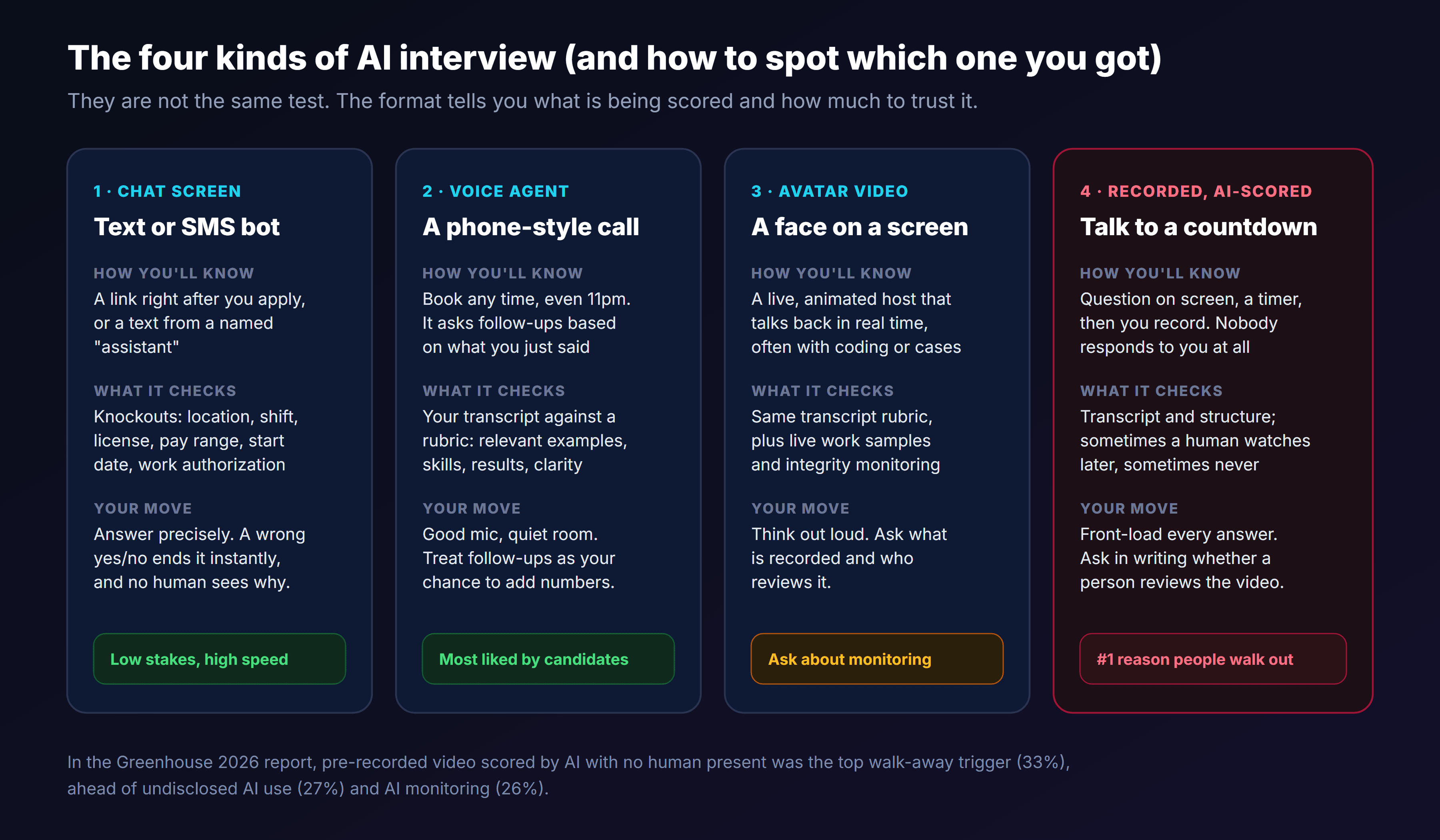
- Chat or SMS screen. A text conversation, often triggered the moment you apply. It mostly asks knockout questions: can you work these shifts, do you hold this license, is this pay range acceptable. A wrong answer ends things instantly, so read each one carefully.
- Voice agent. A phone-style conversation you can often book at any hour. It asks behavioral questions, listens, and follows up on what you said. This is the format candidates rate most highly, and follow-ups are your chance to add the detail you left out.
- Avatar video. A live, animated interviewer on screen, often paired with a coding exercise or case. It scores your answers the same way a voice agent does and may also monitor the session for integrity.
- Recorded, AI-scored video. A question appears, a timer counts down, you record, and no one responds. This is a one-way video interviewwith an algorithm grading it. It is the format candidates dislike most, so it's worth asking whether a human watches the recordings.
How an AI interviewer actually scores you
Forget the old rumors about software judging your smile. The mainstream approach in 2026 is much more literal: your speech becomes a transcript, and the transcript is graded against a rubric the employer wrote for each question. Many tools also write a short rationale for each score, which a recruiter reads alongside your application.
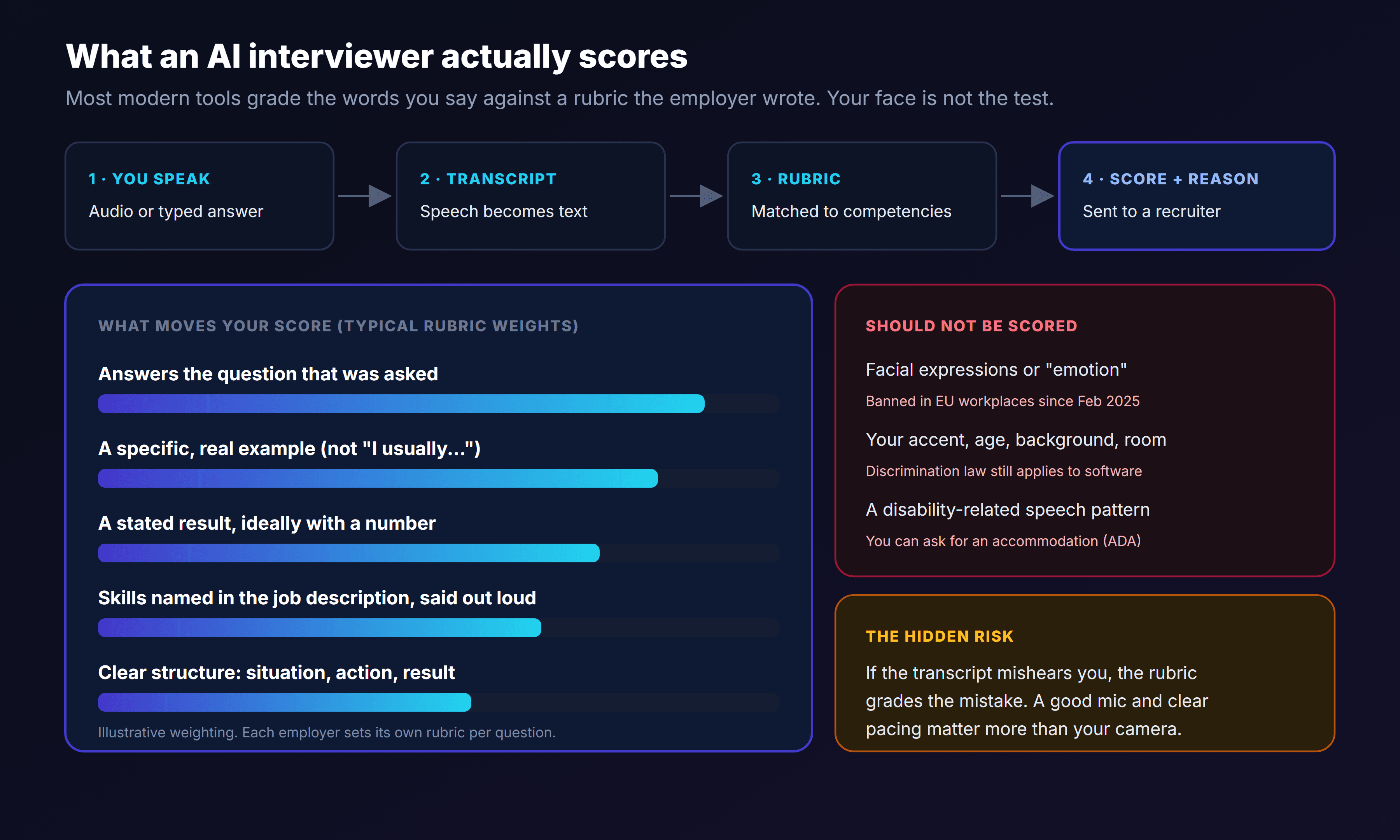
That has three big implications. First, relevance beats polish: a warm, confident answer to a slightly different question scores worse than a plain answer to the exact question. Second, specifics are everything: "I'm a strong communicator" contains nothing a rubric can credit, while "I rewrote our onboarding guide and cut support tickets from new customers by a third" hits example, action and result in one sentence. Third, the transcript is the test. If a poor microphone turns "Kubernetes" into "cooper nettys," the rubric grades the mistake.
What should notbe scored matters just as much. HireVue, one of the best-known vendors, dropped facial analysis from its assessments in 2021, and the EU AI Act has banned emotion recognition in the workplace since February 2025. Your accent, age, room and background aren't legitimate criteria, and anti-discrimination law applies to software decisions exactly as it does to human ones.
How to pass an AI interview: an eight-step plan
Find out which format it is, and ask two questions
Rebuild the rubric from the job description
Prepare one story per competency
Put the answer in your first sentence
Say the skill names out loud
Use follow-up questions to add numbers
Fix your audio before your lighting
Follow up with a human
Don't bring your own AI to the AI interview
Find out which skills the AI will be listening for
Paste your resume and the job posting into Rankid for a free 0-100 match score and a list of the requirements you match and the ones you're missing. The matched list is the stories you should rehearse. The missing list is what to address before the bot asks. No signup required.
Check your match score freeYour rights in an AI interview
There is no single law, but the patchwork is growing, and knowing it gives you leverage to ask good questions.
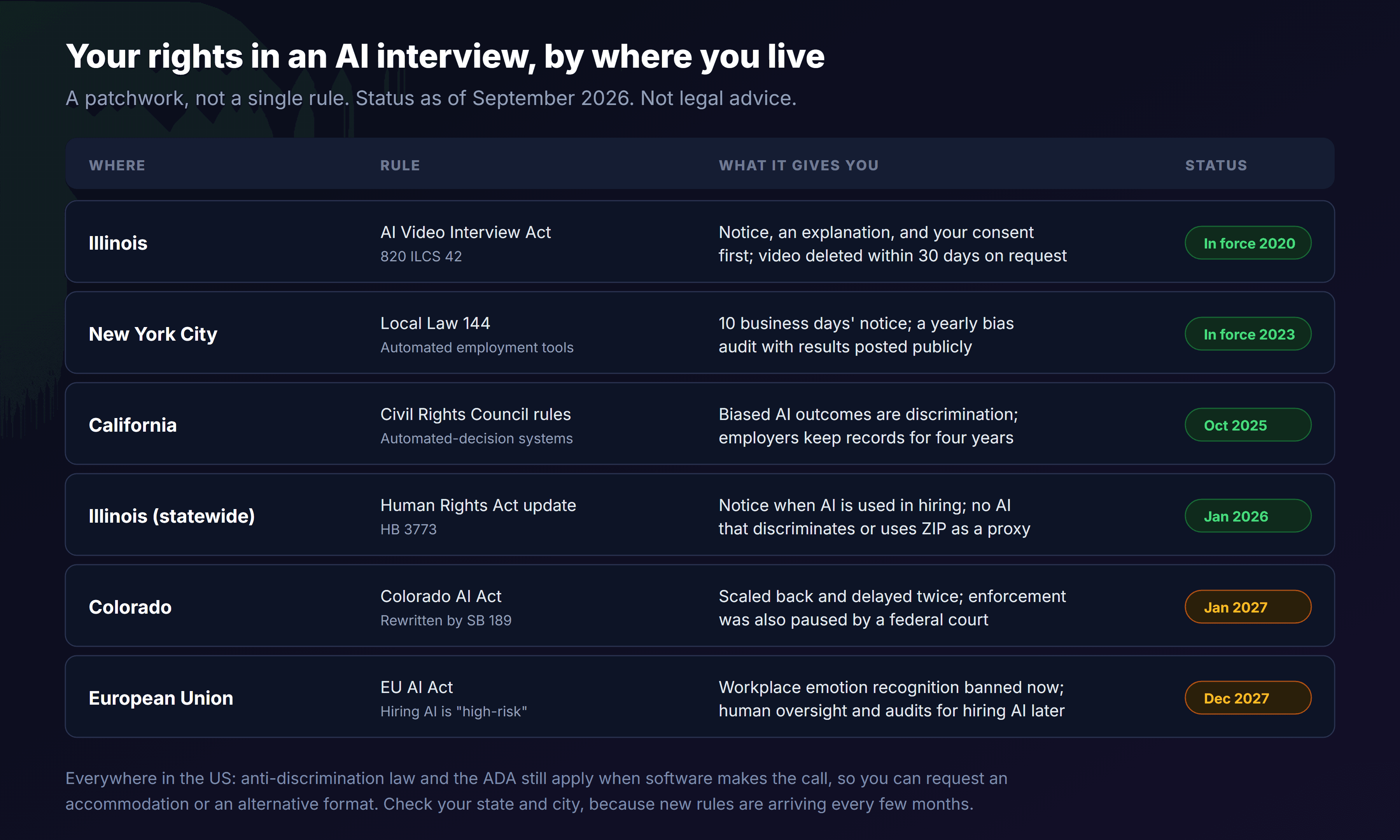
- Illinois has required notice, an explanation of how the AI works, and your consent before AI analyzes a video interview since 2020, and you can ask for the video to be deleted. A statewide amendment to the Illinois Human Rights Act, in effect from January 2026, adds notice requirements and bans AI that discriminates, including by using ZIP codes as a proxy.
- New York City's Local Law 144 requires employers using automated hiring tools to commission a yearly independent bias audit, publish a summary, and notify candidates at least ten business days in advance.
- California's civil rights regulations on automated-decision systems, in effect since October 2025, make clear that a discriminatory AI outcome is discrimination and require employers to keep related records for four years.
- Colorado's AI Act has been delayed twice and scaled back, and is now due in January 2027 after a federal court also paused enforcement.
- The EU AI Act classes hiring AI as high-risk. Emotion recognition at work is already banned, while the human-oversight and documentation duties were pushed back to December 2027 by the Digital Omnibus package.
Everywhere in the US, the Americans with Disabilities Act lets you request a reasonable accommodation, such as extra time, a text alternative, or a human interviewer, if an automated format disadvantages you because of a disability. For employers, a tool that screens out one group at a much higher rate can create adverse impact liability no matter who built the software.
Red flags: when to ask more questions, or walk
- You find out it's an AI interview only when it starts, with no prior notice.
- There's no way to reach a human recruiter, before or after.
- The tool asks for access to your camera, microphone, and screen with no explanation of what's recorded or how long it's kept.
- It asks for sensitive personal information, such as your date of birth, bank details, or ID documents, at the interview stage. That can be a sign of a scam rather than an employer; our guide to ghost jobs covers the warning signs.
- You can't find the company on its own careers site, or the role isn't listed there.
A disclosed, well-run AI interview is usually worth doing, especially if the alternative is never being screened at all. If the red flags stack up, check whether the posting is genuine using our guide to ghost jobs, and remember that walking away is a legitimate choice that plenty of candidates are making.
For employers: how to run an AI interview candidates don't resent
The same Greenhouse data is a design brief. When AI interviews went well, 38% of candidates came away with a more positive view of the employer. When they went badly, 34% came away with a more negative one. Five practices separate the two:
- Disclose early and plainly. Say in the job posting and the invitation that an AI interview is part of the process, what it measures, and who reviews the result. 44% of candidates want exactly that.
- Keep a human in the loop. Have a recruiter review AI scores before anyone is rejected, and say so. 38% of candidates want that assurance.
- Offer an alternative. Provide an accommodation process and, where you can, a human option. 46% of candidates want to be able to request one.
- Score job-related criteria only.Build rubrics from the role's real requirements, using the same discipline as an interview scorecard, and audit pass rates by group regularly.
- Close the loop. A 51% no-reply rate is a candidate experience failure, not an AI one. Automate a respectful outcome message for everyone. Our rejection email templates make that easy.
Finally, put AI where it earns trust. Screening resumes against a job description with transparent, explainable criteria is a lower-stakes, higher-value use than an unmonitored video score, and our guide to recruitment automation covers what to automate and what to leave to people.
Screen with AI you can explain to a candidate
Rankid scores every resume against your job description on a consistent 0-100 scale and shows the exact requirements each candidate matched and missed, so your shortlist rests on criteria you can defend, and a human makes the call. First 5 resumes free, no signup.
Try bulk screening freeFrequently asked questions
What is an AI interview?
An AI interview is a stage of the hiring process in which software, rather than a person, asks you questions and records, transcribes or evaluates your answers. It can be a text or SMS chatbot, a voice agent you speak to like a phone call, a live animated avatar on video, or a pre-recorded video interview that an algorithm scores. Most tools produce a score and a written summary that a recruiter uses to decide who moves forward.
How common are AI interviews in 2026?
Very. Greenhouse's 2026 Candidate AI Interview Report, based on a May 2026 survey of 1,200 US job seekers, found that 63% had faced an AI interview, up 13 percentage points in six months. They are most common in high-volume hiring, staffing agencies, customer service, retail, and early-stage screening for professional roles.
How does an AI interviewer score my answers?
Most current tools convert your speech into a transcript and grade it against a rubric the employer wrote for each question. Typical criteria are whether you answered the question asked, whether you gave a specific real example, whether you stated a result, whether you used the skills named in the job description, and how clearly your answer was structured. Many tools generate a short written rationale for each score so a recruiter can review it.
Do AI interviews analyze my facial expressions?
Most reputable tools no longer do. HireVue, one of the best-known vendors, publicly dropped facial analysis from its assessments in 2021, and the EU AI Act has banned emotion recognition in the workplace since February 2025. The industry has shifted to scoring what you say. That said, avatar and video tools may still monitor the session for integrity reasons, such as detecting a second person or a second screen, so ask what is recorded and why.
Can I ask for a human interviewer instead of an AI?
Yes, you can always ask, and 46% of candidates in Greenhouse's survey said they want that option. Whether you get it depends on the employer and the law where you live. If you have a disability or a speech-related condition that an automated tool may misjudge, you can request a reasonable accommodation under the Americans with Disabilities Act, and the employer should consider it. Ask politely in writing, before the interview if possible.
Is it legal for employers to use AI interviews?
Generally yes, but a growing set of rules limits how. Illinois requires notice, an explanation, and your consent before AI analyzes a video interview. New York City requires a yearly independent bias audit and advance notice for automated hiring tools. California's civil rights regulations, in effect since October 2025, treat discriminatory AI outcomes as discrimination. Illinois added statewide notice and anti-discrimination rules in January 2026. In the EU, hiring AI is classed as high-risk, with most obligations now due in December 2027. Anti-discrimination law applies everywhere, whether a person or software makes the decision.
Why do so many candidates walk out of AI interviews?
Mainly because of how they are run, not because AI is involved. In Greenhouse's 2026 report, 38% of candidates had abandoned a process because of an AI interview. The top triggers were pre-recorded video scored by AI with no human present (33%), not being told how AI would be used (27%), and AI monitoring (26%). Seventy percent said they were never clearly told upfront that AI would evaluate them, and 21% found out only when the interview started.
Why do some candidates prefer AI interviews?
Speed, availability, and a sense of fairness. You can often take a voice or chat interview at any hour, get a decision quickly, and answer the same questions as everyone else. Bullhorn's 2026 GRID Talent Trends Report, which surveyed about 2,300 people who had worked with staffing firms, found that 92% rated AI voice interviews as good as or better than human interviews. The difference between loved and hated AI interviews tends to come down to disclosure, a real two-way conversation, and human review of the result.
Should I use ChatGPT or another AI to help me during an AI interview?
No. Using a hidden tool to generate answers live is widely treated as cheating, many interview platforms monitor for it, and getting caught usually ends your candidacy and can follow you if the employer shares fraud signals. Use AI tools before the interview to practise, to predict questions from the job description, and to tighten your stories, then answer in your own words.
How long is an AI interview?
Chat screens usually take five to fifteen minutes. Voice and avatar interviews typically run fifteen to forty minutes, depending on how many follow-up questions the system asks. Recorded video interviews usually contain three to eight questions, each with thinking time of around thirty seconds and a response limit of one to three minutes.
What happens after an AI interview?
Usually your transcript, score and a short summary go to a recruiter, who decides who moves on. In Greenhouse's survey, 28% of candidates who completed an AI interview moved to the next round, 13% were formally rejected, and 51% never heard back. If you hear nothing within a week, send a short follow-up to a named human recruiter, not to the bot.
What is the difference between an AI interview and a one-way video interview?
A one-way video interview is simply pre-recorded: you answer questions on camera with no one on the other end, and a human may or may not watch it later. An AI interview can be recorded or live, and the defining feature is that software asks questions, adapts follow-ups, or scores your answers. A one-way video interview becomes an AI interview when an algorithm evaluates it.
Key takeaways
- An AI interview is a hiring step where software asks the questions and usually scores the answers. 63% of US job seekers have faced one (Greenhouse, May 2026).
- There are four formats: chat screens, voice agents, live avatar video, and recorded AI-scored video. Each measures something different.
- Candidates love some and walk out of others: 92% rated AI voice interviews as good as a human (Bullhorn), while 38% have abandoned a process over an AI interview (Greenhouse).
- The difference is disclosure, a real two-way conversation, and human review of the result. 70% of candidates weren't clearly told AI would evaluate them.
- Most tools score your transcript against a rubric built from the job description, not your face. Answer the exact question first, give a specific example, state a result, and name the skills.
- Audio quality protects your transcript, so fix your microphone before your lighting.
- Never use a hidden AI tool during the interview. Practise with AI beforehand instead.
- Illinois, New York City and California already give candidates rights around AI in hiring; Colorado's law is due in 2027 and the EU's high-risk rules in December 2027. You can request an ADA accommodation anywhere in the US.
- Employers who disclose early, keep a human in the loop, offer alternatives and close the loop turn AI interviews into a positive signal rather than a reason to walk.
Frequently asked questions
What is an AI interview?
An AI interview is a stage of the hiring process in which software, rather than a person, asks you questions and records, transcribes or evaluates your answers. It can be a text or SMS chatbot, a voice agent you speak to like a phone call, a live animated avatar on video, or a pre-recorded video interview that an algorithm scores. Most tools produce a score and a written summary that a recruiter uses to decide who moves forward.
How common are AI interviews in 2026?
Very. Greenhouse's 2026 Candidate AI Interview Report, based on a May 2026 survey of 1,200 US job seekers, found that 63% had faced an AI interview, up 13 percentage points in six months. They are most common in high-volume hiring, staffing agencies, customer service, retail, and early-stage screening for professional roles.
How does an AI interviewer score my answers?
Most current tools convert your speech into a transcript and grade it against a rubric the employer wrote for each question. Typical criteria are whether you answered the question asked, whether you gave a specific real example, whether you stated a result, whether you used the skills named in the job description, and how clearly your answer was structured. Many tools generate a short written rationale for each score so a recruiter can review it.
Do AI interviews analyze my facial expressions?
Most reputable tools no longer do. HireVue, one of the best-known vendors, publicly dropped facial analysis from its assessments in 2021, and the EU AI Act has banned emotion recognition in the workplace since February 2025. The industry has shifted to scoring what you say. That said, avatar and video tools may still monitor the session for integrity reasons, such as detecting a second person or a second screen, so ask what is recorded and why.
Can I ask for a human interviewer instead of an AI?
Yes, you can always ask, and 46% of candidates in Greenhouse's survey said they want that option. Whether you get it depends on the employer and the law where you live. If you have a disability or a speech-related condition that an automated tool may misjudge, you can request a reasonable accommodation under the Americans with Disabilities Act, and the employer should consider it. Ask politely in writing, before the interview if possible.
Is it legal for employers to use AI interviews?
Generally yes, but a growing set of rules limits how. Illinois requires notice, an explanation, and your consent before AI analyzes a video interview. New York City requires a yearly independent bias audit and advance notice for automated hiring tools. California's civil rights regulations, in effect since October 2025, treat discriminatory AI outcomes as discrimination. Illinois added statewide notice and anti-discrimination rules in January 2026. In the EU, hiring AI is classed as high-risk, with most obligations now due in December 2027. Anti-discrimination law applies everywhere, whether a person or software makes the decision.
Why do so many candidates walk out of AI interviews?
Mainly because of how they are run, not because AI is involved. In Greenhouse's 2026 report, 38% of candidates had abandoned a process because of an AI interview. The top triggers were pre-recorded video scored by AI with no human present (33%), not being told how AI would be used (27%), and AI monitoring (26%). Seventy percent said they were never clearly told upfront that AI would evaluate them, and 21% found out only when the interview started.
Why do some candidates prefer AI interviews?
Speed, availability, and a sense of fairness. You can often take a voice or chat interview at any hour, get a decision quickly, and answer the same questions as everyone else. Bullhorn's 2026 GRID Talent Trends Report, which surveyed about 2,300 people who had worked with staffing firms, found that 92% rated AI voice interviews as good as or better than human interviews. The difference between loved and hated AI interviews tends to come down to disclosure, a real two-way conversation, and human review of the result.
Should I use ChatGPT or another AI to help me during an AI interview?
No. Using a hidden tool to generate answers live is widely treated as cheating, many interview platforms monitor for it, and getting caught usually ends your candidacy and can follow you if the employer shares fraud signals. Use AI tools before the interview to practise, to predict questions from the job description, and to tighten your stories, then answer in your own words.
How long is an AI interview?
Chat screens usually take five to fifteen minutes. Voice and avatar interviews typically run fifteen to forty minutes, depending on how many follow-up questions the system asks. Recorded video interviews usually contain three to eight questions, each with thinking time of around thirty seconds and a response limit of one to three minutes.
What happens after an AI interview?
Usually your transcript, score and a short summary go to a recruiter, who decides who moves on. In Greenhouse's survey, 28% of candidates who completed an AI interview moved to the next round, 13% were formally rejected, and 51% never heard back. If you hear nothing within a week, send a short follow-up to a named human recruiter, not to the bot.
What is the difference between an AI interview and a one-way video interview?
A one-way video interview is simply pre-recorded: you answer questions on camera with no one on the other end, and a human may or may not watch it later. An AI interview can be recorded or live, and the defining feature is that software asks questions, adapts follow-ups, or scores your answers. A one-way video interview becomes an AI interview when an algorithm evaluates it.