One-Way Video Interview: How to Pass a Pre-Recorded Interview (2026)
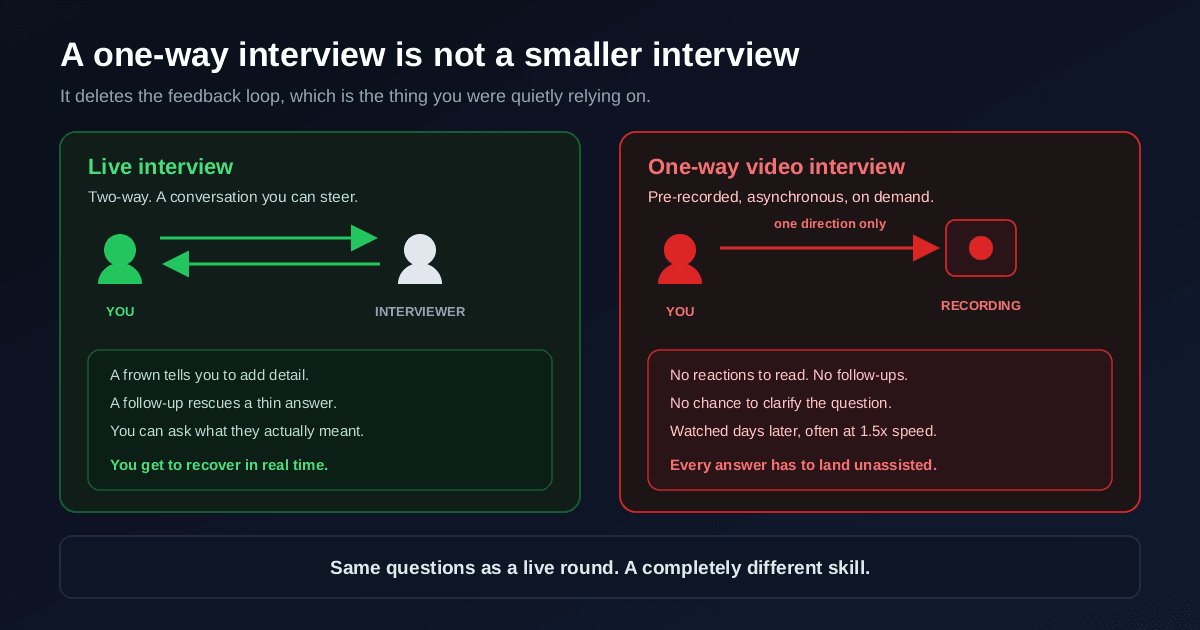
The invitation looks like an interview invitation, right up until you read it twice. There is no time on it, and no name. There is a link, a deadline, and a sentence explaining that you will be asked five questions and given two minutes to answer each one. Then you click through and find yourself looking at your own face, a question in a box, and a countdown that has already started. A one-way video interview is not a smaller version of a real interview. It has deleted the one thing you were quietly relying on, which is the other person.
Quick answer
Quick answer: a one-way video interview is a screening round where you record answers to a fixed set of questions with no interviewer present, and someone reviews the recording later. Also called a pre-recorded, asynchronous or on-demand interview. Expect three to six questions, about 30 seconds of preparation and 90 to 180 seconds of recording per answer, and a three to seven day deadline. Three things decide how you prepare, and all three are on screen before you start: preparation time, time limit and how many retakes you get. The one rule that matters most: answer first, context second, because the timer cuts off the end.
What is a one-way video interview?
A one-way video interview is a hiring stage in which you record video answers to a set list of questions on your own, without an interviewer, and submit them for review later. The software shows you a question, gives you a fixed amount of preparation time, then records you answering against a countdown. When the last answer is done, it submits itself.
The same format goes by a lot of names, which is mostly a marketing artefact: pre-recorded interview, asynchronous video interview, on-demand interview, recorded interview, or just digital interview. HireVue, Spark Hire, Willo and VidCruiter all sell versions of it, and candidates often refer to the round by the vendor's name rather than the format. They are the same thing, and the advice in this article applies to all of them.
It normally sits exactly where a recruiter phone call would sit: after the resume screen, before you meet a hiring manager. In other words it has replaced the screening interview, and it is doing the same job of confirming the basics before anyone spends real time on you.
The defining feature is not the camera. Live interviews use cameras too. It is the absence of a second person. Nobody reacts, nobody asks a follow-up, nobody tells you the question meant something narrower than you assumed. Every answer has to be complete, on its own, first time.
One-way video interview vs live video interview
People prepare for a recorded round the way they would prepare for a Zoom call, and then find that most of what they practised does not apply. Nine things change, and each one changes a habit.
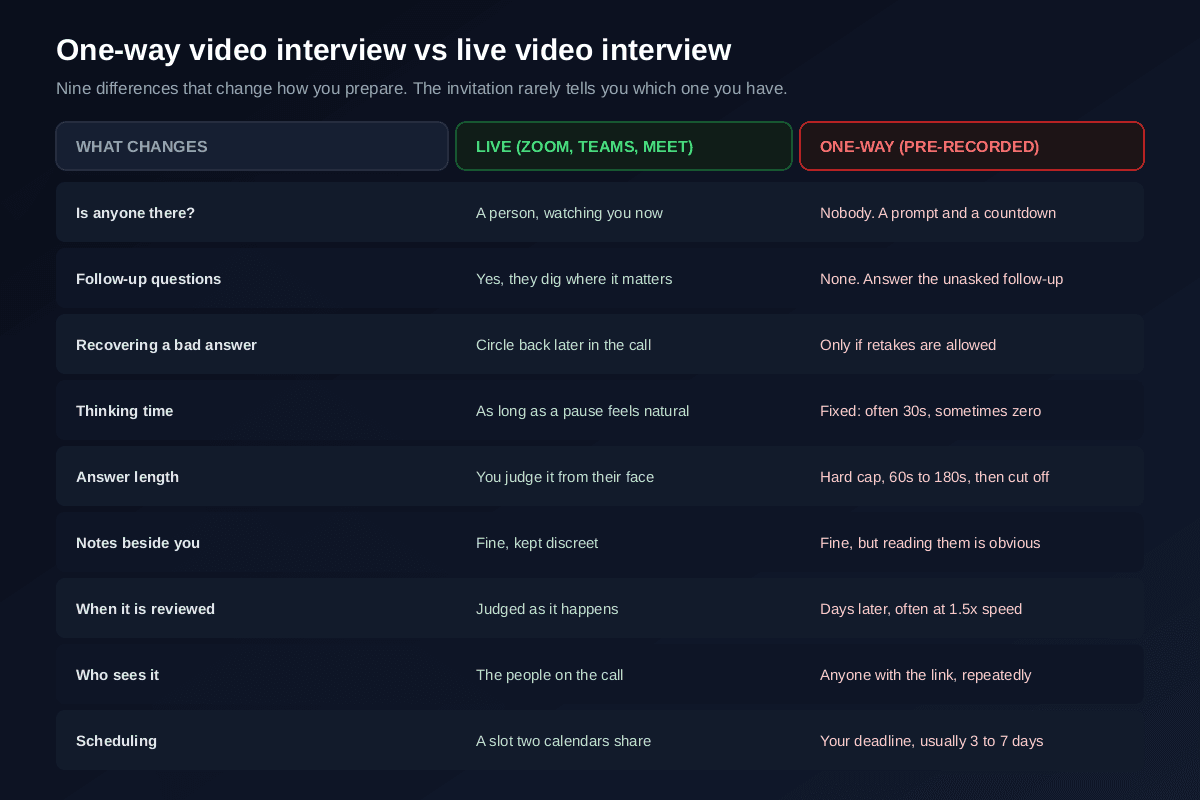
Two rows on that table do most of the damage. The first is no follow-up questions. In a live interview, a thin answer gets rescued: the interviewer hears that you skipped the interesting part and asks about it. In a recording, a thin answer is simply a thin answer forever. So you have to answer the follow-up nobody is going to ask. If you say you improved a process, the unasked follow-up is always some version of "by how much, and how do you know?", so answer that in the same breath.
The second is when it gets reviewed. Your recording is not watched in the moment. It is watched several days later, in a batch, at 1.25x or 1.5x speed, by a recruiter with a queue. That single fact explains most of the good advice about the format, and we come back to it repeatedly below.
Ask one question before you start
How a one-way video interview actually works
Almost all of the anxiety about this format comes from not knowing the sequence. It is the same sequence nearly everywhere, and three of the steps are settings the employer chose, which means you can find out what they are before you commit to anything.
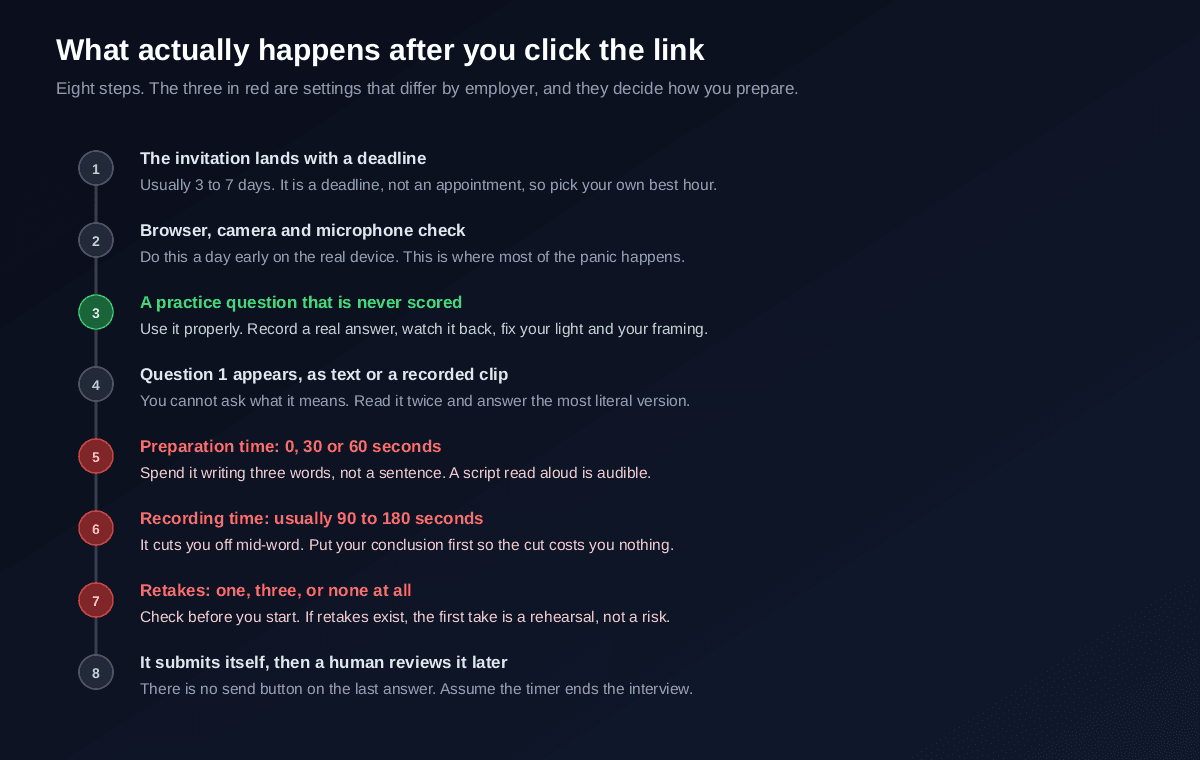
The three red steps are the ones worth reading twice, because they vary by employer and they change your strategy completely.
- Preparation time (0 to 60 seconds). Spend it writing three words, not a sentence. The temptation is to draft an opening line, and a drafted line read aloud sounds drafted.
- Recording time (usually 90 to 180 seconds). It cuts you off mid-word without warning. This is the entire argument for putting your conclusion first.
- Retakes (none, one, three, or unlimited). Check the number before you answer question one. If retakes are generous, your first take is a free rehearsal. If there are none, slow down and use every second of preparation time.
Do not skip the practice question. It is unscored, and it is the only chance you get to see what the camera actually does with your lighting, your framing and your voice. Record a real answer on it, watch it back once, then fix whatever you see. Most people click past it in four seconds and then discover at question three that they are backlit.
Why employers use one-way interviews, and what it tells you
Recorded rounds exist because of a scheduling problem, not because of a candidate-assessment problem. At a hundred applications per role, a recruiter running fifteen-minute phone screens spends the entire week on the calendar rather than on the hiring. A recorded round removes scheduling from the stage completely, and that is the whole value proposition. It is the same pressure that produces every other tool in high-volume recruiting and recruitment automation.
Which tells you something useful as a candidate: a recorded round usually means a large pool. That is not a reason to care less. It is a reason to be more specific, because specificity is what separates submissions in a queue where forty answers to "why this role" sound the same.
It also tells you the round is a filter, not an evaluation. Nobody is deciding to hire you from a recording. They are deciding whether to spend an hour on you. The bar is "no reason to say no" plus one genuine reason to say yes, and answers built for that bar do better than answers built to be impressive.
One-way video interview questions and answers
Recorded rounds reuse a very short list, for a structural reason: a question that needs a follow-up to be useful cannot be asked in this format. That constraint makes the round unusually predictable, which is the single biggest advantage you have.
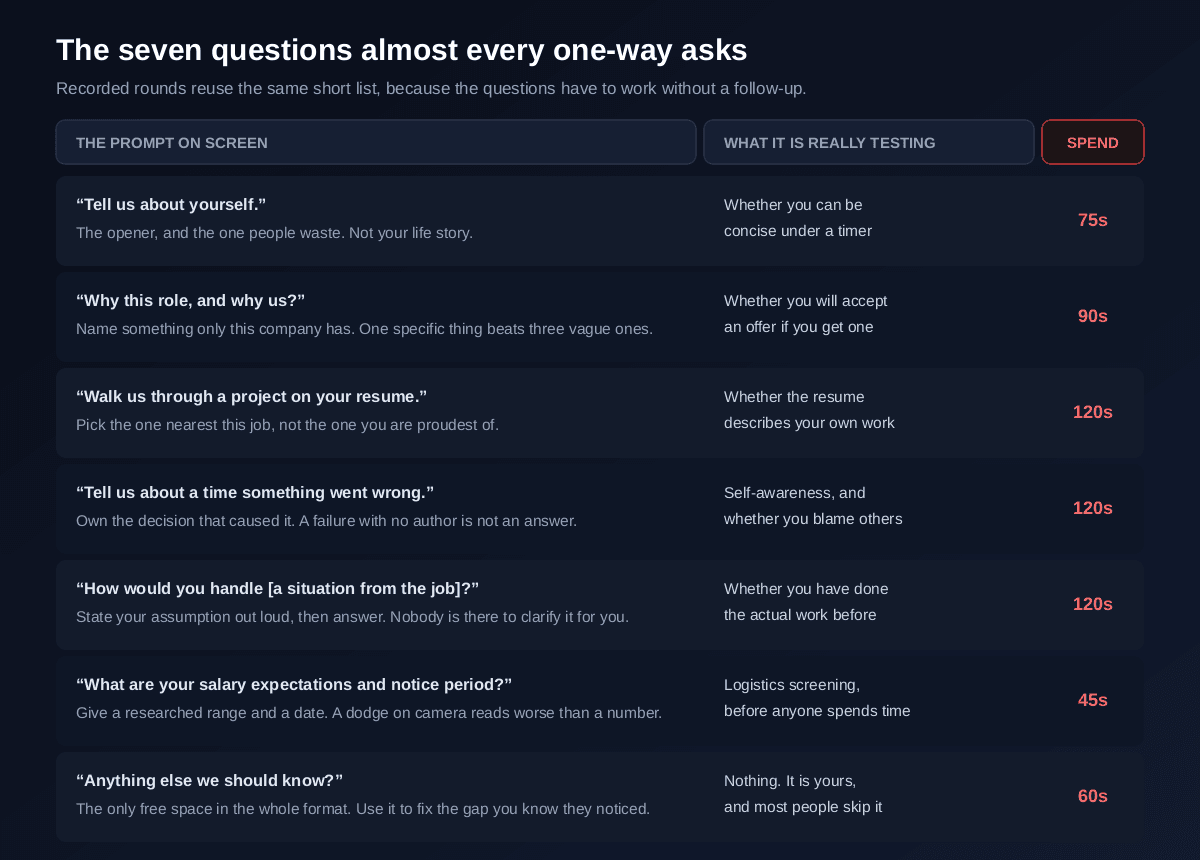
Three of those deserve extra attention, because they are where recorded answers most often go wrong.
"Tell us about yourself" is not a biography and it is not your resume read aloud. In 75 seconds: what you do now, the two things you have done that are closest to this job, and why you are looking. The version of this answer that works live is usually too long for a recording, because live you can watch the interviewer and cut. Here you cannot, so write the short one. how to answer common interview questions has the fuller treatment.
"How would you handle this situation?" is the question the format handles worst, because situational questions almost always contain an ambiguity that you would normally resolve by asking. You cannot ask. So say the assumption out loudand then answer: "I am assuming this is a customer already live rather than one in onboarding, so I would...". Stating the assumption converts your biggest disadvantage into visible evidence of judgment, and it is the single highest-value habit in this whole format.
"Anything else we should know?"is free space, and most people say "no, I think we covered it", which in a recording covers nothing. Use it for the objection you know exists: the employment gap, the industry switch, the missing certification, the answer you fumbled at question three. Forty seconds addressing the thing a reviewer would otherwise wonder about is worth more than anything else you say.
Structure the behavioural ones with the STAR method, but weight it for a countdown: situation and task get one sentence between them, action gets the bulk, and the result needs an actual number. quantifying achievements applies to spoken answers exactly as it does to a resume, and it matters more here, because a number is the one thing that survives being watched at 1.5x.
How to prepare for a one-way video interview
Preparation splits cleanly into two halves, and people reliably do the first and skip the second. The second is the one that loses rounds.
Find out the three settings before you start
Build five or six stories, not answers
Map each story to a line in the job description
Pick your hour, and protect it
Set the room up and test it a day early
Record one answer and watch it back
Everything in preparing for a job interview still applies underneath this, particularly the company research, and what to wear to an interview covers the wardrobe question in full, including the colours that misbehave on a webcam.
Your recording setup: what the lens actually sees
None of this costs money, all of it is visible in the first two seconds of your recording, and it is the half of preparation that people treat as optional. A reviewer who cannot hear you clearly will not rewind, and a candidate who is a silhouette reads as a candidate who did not try.
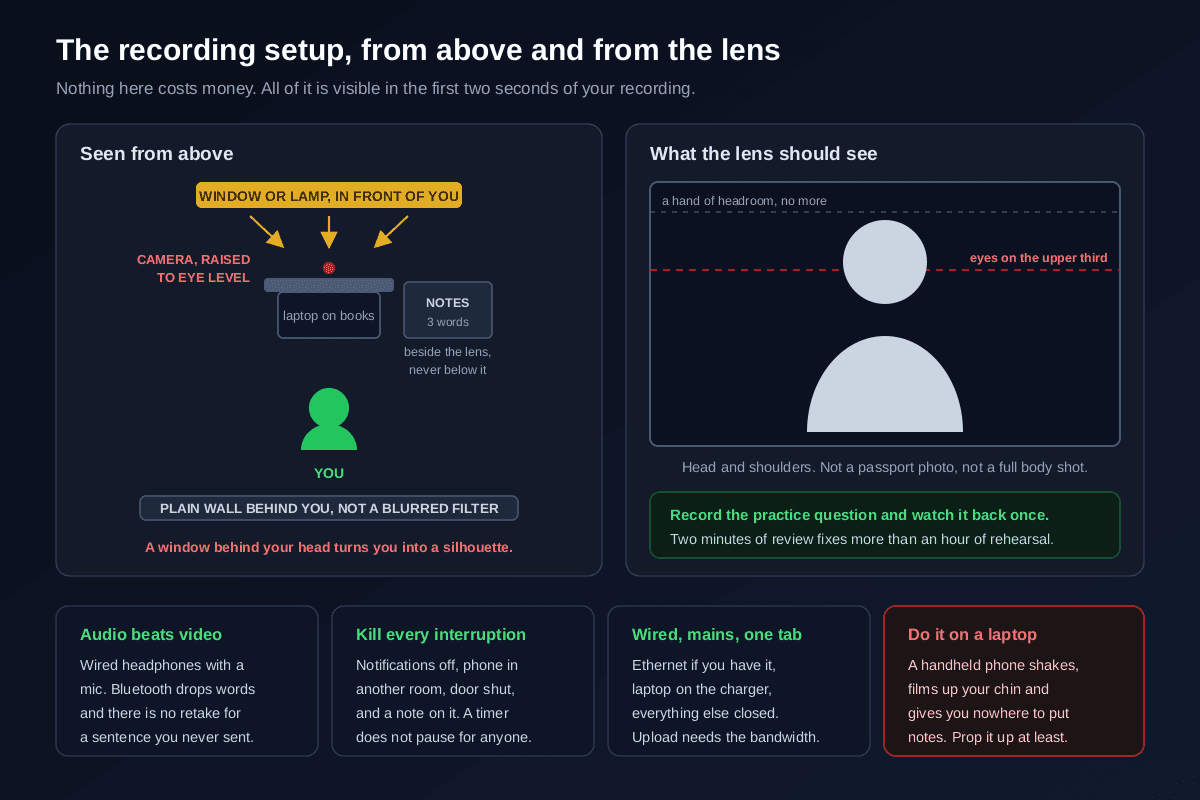
The two mistakes that account for most bad recordings are both about direction. Light belongs in front of your face: a window behind your head turns you into a shape, and automatic exposure will make it worse by correcting for the bright background. Notes belong beside the lens at the same height, never below the keyboard, because notes below the keyboard pull your eyes and your chin down for the whole answer.
Prioritise audio over video if you have to choose. A slightly soft picture costs you nothing. A dropped word costs you a sentence you cannot resend. Wired headphones with a microphone beat both a laptop microphone and anything Bluetooth.
The two-second test
How to structure an answer against a countdown
This is the mechanical skill the format demands, and it is genuinely different from live interviewing. In a live interview you can watch a face and adjust your length. Against a timer you have to get the shape right in advance, because the timer edits your answer for you and it always edits from the end.
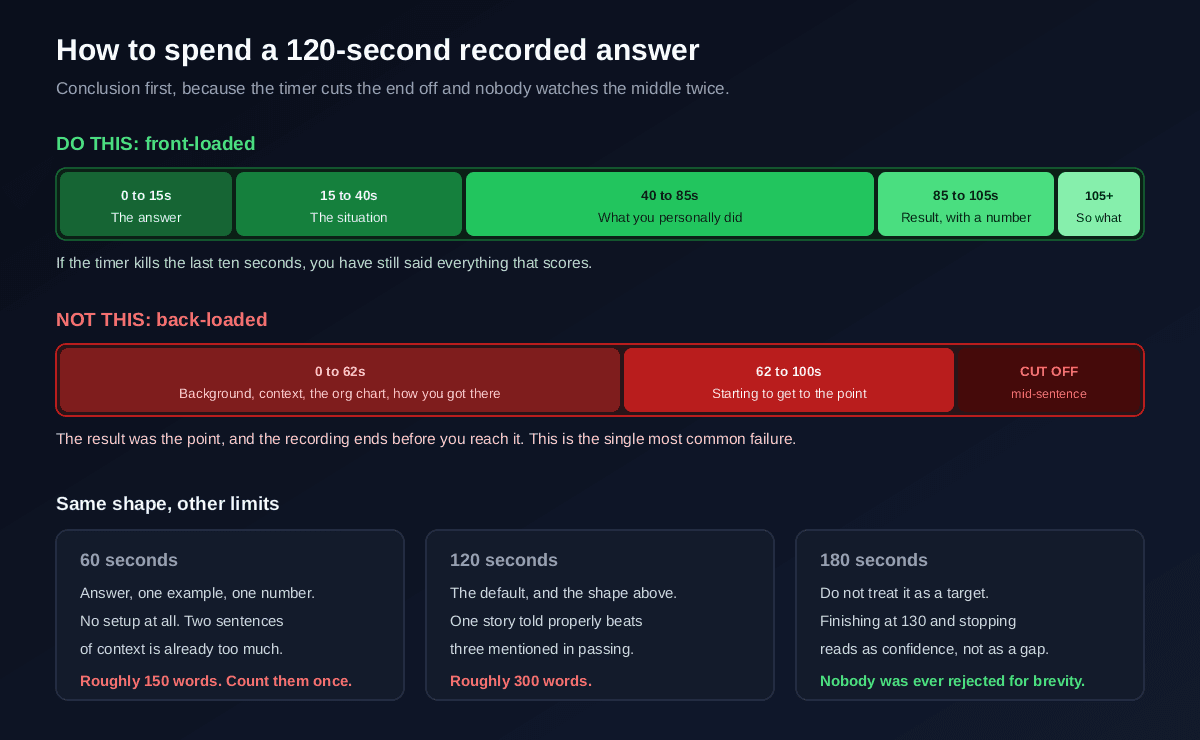
The rule is conclusion first. Answer the question in the first fifteen seconds, then earn it for the remaining ninety. If the timer takes your last ten seconds, a front-loaded answer loses a flourish and a back-loaded answer loses its entire point.
Aim to fill about 70 to 85 percent of the limit. On 120 seconds that is 90 to 100 seconds, or roughly 300 spoken words, which is worth timing once so you know what it feels like. And stop when you are finished: a good answer that ends at 130 of an available 180 reads as confidence, while padding to the buzzer reads as padding. Nobody has ever been rejected from a recorded round for being brief.
The mistakes that lose recorded rounds
- Reading a script. Unmistakable on camera, because reading has a flatter rhythm and the pauses land in the wrong places. Three words per question, not sentences.
- Burning six takes on question one. Recordings get worse after the third attempt, because you stop thinking and start reciting. Take three, then move on.
- Running out of time before the result. The most common failure in the format, and entirely fixed by putting the answer first.
- Answering the question you expected. Read the prompt twice. Recorded prompts are often narrower than the live equivalent, and nobody will redirect you.
- Treating it as informal because nobody is watching. A recording is more permanent than a call, not less. It gets rewatched, shared internally, and kept.
- Recording against the deadline. Late-night final-day submissions are worse, technically and vocally, than the same person at 10am two days earlier.
- Skipping "anything else we should know". The only free space in the round, and most candidates hand it back unused.
- Never watching yourself back. Two minutes of review beats an hour of rehearsal, because the problems are the ones you cannot feel while talking.
Does AI score one-way video interviews?
Sometimes, and considerably less than the internet believes. Most platforms transcribe your answers. Some score keywords or rank submissions to set review order. A smaller number have offered scoring based on tone, word choice or facial expression, and that category has been in retreat for years: HireVue publicly dropped facial analysis in 2021, and the evidence base for expression-based scoring has not aged well.
Regulation now addresses it directly, which is the practical reason you are usually told. Illinois has a dedicated Artificial Intelligence Video Interview Act requiring disclosure, an explanation of what is evaluated, consent, and deletion on request. Maryland requires consent for facial recognition in interviews. New York City's Local Law 144 requires an annual bias audit and candidate notice for automated employment decision tools. The EU AI Act treats hiring systems as high risk with transparency and human oversight obligations. So read the consent screen instead of clicking past it. It usually tells you exactly what is happening to your recording.
Meanwhile, a human almost certainly does watch, days later, at speed, with a queue behind you. Answer for that person. A clear, specific, front-loaded answer with a number in it scores well with every system that exists, automated or human, which is a rare thing to be able to say. Our view on where automation belongs in hiring at all is in AI resume screening, and the short version is the same as the legal consensus: a machine may rank and summarise, a person decides.
What to do after you submit
Two things, and then genuinely stop. First, send a short note to the recruiter confirming the submission and restating your interest in one line. It is the recorded-round equivalent of a thank you email after an interview, and it matters slightly more here, because it is the only human contact in the entire stage.
Second, expect it to be slow. Recorded rounds are slower than live interviews for a structural reason: nothing is scheduled, so nothing forces a decision. A live interview has a slot and a debrief attached to it. Your recording sits in a queue that gets reviewed when the recruiter has a free hour, and that hour keeps getting taken. Ten to fourteen days is normal, and silence at day eight usually means unwatched rather than rejected. how long it takes to hear back after applying has the wider timeline.
Follow up once at seven to ten days, asking specifically when they expect to make decisions, because a question with a concrete answer gets replied to more often than a general check-in. Then keep applying. A submission in a review queue is not a stage in a process, whatever it feels like, and if a company has gone quiet it is worth knowing that some postings were never live at all: ghost jobs covers how to spot those, and why you are not getting interviews covers the stage before this one, which is where most applications actually stop.
If it goes well, the next round is live, and it is often a panel interview. Salary usually comes up in the recorded round as a filter rather than as a negotiation, so give a researched range there and save the real conversation for a person: how to negotiate salary covers that, and questions to ask in an interview covers the part of a live round that a recording never gives you.
Get past the resume screen that comes before this
A recorded round only reaches you if your resume cleared the screen first, and that is where most applications die. Paste your resume and the job description into Rankid for a 0-100 match score, the requirements you have evidenced, and the exact keywords you are missing. One check free, no signup.
Check your resume freeFor employers: running one-way interviews without losing your best candidates
The format solves a real problem and charges a real price, and the price is paid disproportionately by the candidates you most want. Someone with two live processes running will not spend forty minutes recording answers into a void, so every question you add past the fifth is a filter that selects against having other options.
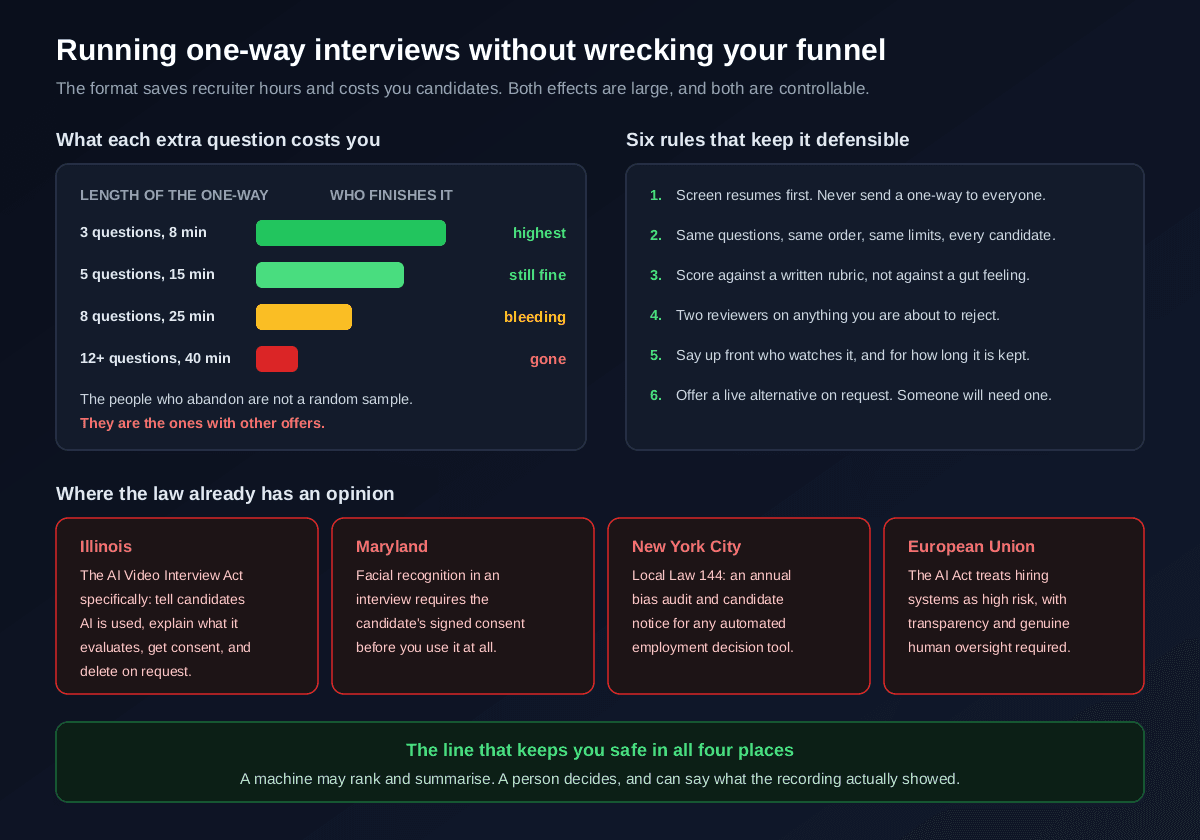
The most important line on that chart is the small one at the bottom: the people who abandon are not a random sample. Drop-off is not neutral attrition, it is a selection effect pointed directly at candidates with alternatives. Which makes the length of your recorded round a hiring decision rather than an administrative one.
Two rules carry most of the weight. Screen resumes properly first, so recordings only ever go to a real shortlist: sending a one-way to every applicant converts a scheduling saving into a brand cost, and it is the most common way this tool gets misused. shortlisting candidates from resumes and resume screening criteria cover the stage that has to come first. And score against a written rubric rather than an impression, with the same questions in the same order for everyone. An interview scorecard is the instrument, and it is what makes the round comparable, defensible, and worth having run at all.
Two more things worth taking seriously. Recorded video puts a candidate's face, accent, home and background in front of a reviewer before any assessment of their work, which is a well-understood route to bias, so check outcomes for adverse impact exactly as you would any other selection step and keep the criteria tied to the job as in skills-based hiring. And treat the round as part of your candidate experience rather than as a pre-process: tell people who will watch it, whether anything automated is involved, how long it is kept, and offer a live alternative to anyone who asks. Where a recorded screen fits in the sequence overall is covered in the hiring process.
Only send recorded rounds to a shortlist worth watching
Upload your applicants and the job description. Rankid scores every candidate against the real requirements and shows the evidence behind each score, so your recorded round goes to the people worth reviewing instead of to everyone who applied. First 5 resumes free, no signup.
Try bulk screening freeFrequently asked questions
What is a one-way video interview?
A one-way video interview is a screening round in which you record video answers to questions on your own, with no interviewer present, and submit them for someone to review later. The platform shows you a question, gives you a fixed amount of preparation time, then records you answering against a countdown. You will also see it called a pre-recorded interview, an asynchronous video interview, an on-demand interview or simply a digital interview, and vendors such as HireVue, Spark Hire, Willo and VidCruiter all sell versions of the same thing. It normally sits exactly where a recruiter phone screen would sit, after the resume review and before you meet a hiring manager, and it usually contains three to six questions and takes 15 to 30 minutes end to end. The defining feature is not the camera, since live interviews use cameras too. It is the absence of a second person. Nobody reacts, nobody asks a follow-up, and nobody clarifies what a question meant, so every answer has to be complete on its own the first time.
How long does a one-way video interview take?
Most take 15 to 30 minutes of actual recording, and you should budget an hour of uninterrupted time. The typical structure is three to six questions, each with 30 seconds of preparation time and 90 to 180 seconds of recording time, plus a system check and an unscored practice question at the start. Anything longer than about eight questions is a warning sign about the employer rather than about you, because completion rates fall sharply past that point. Separately from the length of the interview itself, you normally get a deadline of three to seven days to complete it. That deadline is the part people misread: it is not an appointment, so you get to choose your own hour. Do not record it at 11pm on the last day because the link is expiring, and do not record it in a car park between meetings. Pick the time of day when you speak best, which for most people is mid-morning, and treat that slot as seriously as you would treat a booked call.
Can you retake a one-way video interview?
Sometimes, and it is the single most important thing to check before you begin. Platforms are configured per employer, so the same software might allow unlimited retakes for one company, exactly one retake for another, and none at all for a third. The number is almost always shown on screen next to each question, and it is often in the invitation email as well. Check it before you start rather than discovering it after your first answer, because it changes your whole strategy. If retakes are unlimited or generous, your first take is a free rehearsal: record it, watch it back, then do a better one. If you get one retake, save it, and only spend it on an answer that genuinely failed rather than one you merely dislike. If there are none, slow down and take the full preparation time on every question. One warning either way: do not burn nine takes chasing a perfect answer. Recordings get worse after about the third attempt, because you start reciting instead of thinking, and reciting is audible.
Do humans actually watch one-way video interviews?
Yes, at almost every company, but not the way you imagine while you are recording. A person does review it, usually a recruiter, usually days after you submitted, usually at 1.25x or 1.5x speed, and usually while doing something else. That reality should shape how you answer far more than any worry about being judged frame by frame. It means your first fifteen seconds carry disproportionate weight, because that is where the reviewer decides how carefully to watch the rest. It means the point of your answer has to arrive early, since a viewer at 1.5x will not wait through ninety seconds of background for it. And it means clear audio matters more than a flattering camera angle, because a reviewer who cannot hear you will not rewind. Where full automation exists, it is usually mechanical rather than evaluative: transcription, keyword matching, or ordering the queue. The candidates who do well are the ones who answer as if a busy person will watch this once, because that is exactly what happens.
Is AI used to score one-way video interviews?
Sometimes, and much less than the internet suggests. Most platforms will transcribe your answers, and some will score keywords or rank submissions to decide review order. A smaller number have offered scoring based on tone, word choice or facial expression, and that category has been retreating for years under legal and evidential pressure: HireVue publicly dropped facial analysis in 2021, and the research behind expression-based scoring has not held up well. Regulation now targets it directly. Illinois has a dedicated Artificial Intelligence Video Interview Act requiring employers to disclose AI use, explain what it evaluates, obtain consent and delete recordings on request. Maryland requires consent for facial recognition in interviews. New York City's Local Law 144 requires a bias audit and candidate notice for automated employment decision tools, and the EU AI Act classifies hiring systems as high risk with human oversight obligations. Practically, if AI is being used on you, the employer is usually required to tell you, so read the consent screen instead of clicking past it. And answer for the human, since a clear, specific, well-structured answer scores well with every system that exists, automated or not.
How do you prepare for a one-way video interview?
Prepare a story set and a physical setup, not a script. Build five or six concrete stories from your own work, each covering a different theme: a hard problem you solved, a project you led, something that went wrong and what you did about it, a time you worked across teams, a time you changed your mind. Each should be tellable in about two minutes, with a number in the result. Then reread the job description and map each story to a requirement in it, because recorded rounds score against the posting almost mechanically. Next, do the physical half, which is the part people skip and the part that actually loses rounds: test the platform on the real device a day early, get a light source in front of your face rather than behind your head, raise the camera to eye level, and use wired headphones with a microphone. Finally, rehearse out loud into your own webcam and watch one recording back. Two minutes of watching yourself will fix more than an hour of rehearsing in your head, because the problems are almost always things you cannot feel: looking down, trailing off, or spending a third of the answer on setup.
What questions are asked in a one-way video interview?
Recorded rounds reuse a short and predictable list, because each question has to work without a follow-up. Expect some subset of these seven. Tell us about yourself, which is the opener and should run about 75 seconds, not five minutes. Why this role and why us, which is really an offer-acceptance question and needs one specific thing only this company has. Walk us through a project on your resume, where you should pick the project nearest this job rather than the one you are proudest of. Tell us about a time something went wrong, where owning the decision that caused it scores far better than a failure with no author. How would you handle a specific situation from the job, where you should state your assumption out loud before answering, since nobody is there to clarify it. What are your salary expectations and notice period, which is pure logistics screening and deserves a researched range and a real date rather than a dodge. And finally, is there anything else we should know, which is the only free space in the entire format and the one most candidates waste by saying no.
How long should your answers be in a one-way video interview?
Fill roughly 70 to 85 percent of the time limit, and put your conclusion first. On a 120-second cap, that means aiming for about 90 to 100 seconds, or roughly 300 spoken words. The structure that survives a countdown is front-loaded: answer the question directly in the first ten or fifteen seconds, give the minimum context needed to make sense of it, spend the middle on what you personally did, then land a result with a number in it. That way, if the timer cuts your last sentence off, you have still said everything that scores. The most common failure in the whole format is the opposite shape: sixty seconds of background, org chart and how you came to be on the project, and then the recording ends just as you reach the outcome that was the entire point. Also stop when you are finished. Filling 180 seconds because 180 seconds were offered reads as padding, whereas finishing a good answer at 130 and stopping reads as confidence. Nobody has ever been rejected for brevity in a recorded interview.
Can you use notes in a one-way video interview?
Yes, and almost everyone does, but where you put them decides whether they help or hurt. Notes should be three or four words per question on a single sheet placed immediately beside the camera lens, at the same height, so that glancing at them barely moves your eyes. Notes below the keyboard are the mistake: they pull your eyes and your chin down, and on camera that reads as unprepared even when the opposite is true. Full sentences are the other mistake. A script read aloud is unmistakable on a recording, because reading has a flatter rhythm than speaking and the pauses fall in the wrong places, and it is one of the few things a reviewer will comment on explicitly. Keywords prompt you and let you sound like a person. Sentences make you sound like a voicemail. The same applies to sticky notes around the screen bezel, which work well precisely because they sit in the same plane as the lens.
What should you wear for a one-way video interview?
Exactly what you would wear to a live interview for the same role, and check it on camera rather than in a mirror. The camera-specific rules matter more here than in a live call, because your recording will be watched on a small window on someone else's screen. Mid-tone solid colours work best: pure white blows out under automatic exposure, black loses all detail against a dark room, and fine stripes or small checks can strobe on a webcam. A blazer or a structured collar gives your shoulders a defined line at a small size. Skip anything that catches light or moves, such as large earrings or a shiny watch face. Dress properly from the waist down as well, partly because you may need to stand and partly because it genuinely changes how you carry yourself. The one extra step for a recorded round: film ten seconds of yourself in the outfit under the actual lighting you will use, and watch it back. Lighting changes colours in ways a mirror will never show you.
What happens if the technology fails during a one-way video interview?
Email the recruiter immediately, describe what happened in two sentences, and ask for a reset. Platforms log failures, resets are routine, and recruiters deal with this weekly, so a calm and prompt message is treated as a technical problem rather than as a character flaw. The mistake is silence: an abandoned or half-complete submission with no explanation looks identical to a candidate who lost interest, and that is how it gets recorded. Send the message the same day, ideally within the hour, and include the role, the question number and what the platform did. You can prevent most of it, though. Run the system check a full day early on the exact device you will use, not on your phone the morning of. Use a wired connection if you have one, keep the laptop on mains power, close every other application so nothing competes for bandwidth or pops a notification into your recording, and have the recruiter's email open in another window before you start so that sending the message costs you no time if you need it.
Is a one-way video interview a bad sign?
It is a neutral sign about you and a mildly informative sign about the employer. Being sent one means you cleared the resume screen, which is the biggest filter in the process, so it is progress. What it tells you about the company is a matter of scale rather than of respect: recorded rounds are used most heavily where one recruiter faces hundreds of applications, so seeing one usually means you are in a large pool. That is worth knowing, because it should raise how specific your answers are rather than lower your effort. Two things do reasonably read as red flags. A one-way with twelve or more questions is asking you to spend forty minutes on a company that will not spend fifteen on you, and it is fair to weigh that. So is a recorded round used at final stage rather than as a screen, or one where no human will speak to you before an offer decision, since at that point the format has replaced the interview rather than filtered for it. A short recorded screen is normal practice. A hiring process made entirely of them is a real signal.
What should you do if you hear nothing after a one-way video interview?
Follow up once at the seven to ten day mark, then move on without stopping your search. Recorded rounds are slower to hear back on than live interviews, for a structural reason worth understanding: nothing is scheduled, so nothing forces a decision. A live interview has a slot on someone's calendar and a debrief attached to it, whereas your recording sits in a queue that gets reviewed when the recruiter has an hour, and that hour keeps getting taken. Ten to fourteen days is normal, and silence at day eight usually means unwatched rather than rejected. Send one short email to the recruiter, confirm your submission landed, restate your interest in one line, and ask when they expect to make decisions. Asking about the timeline gives them something concrete to answer, which gets a reply more often than a general check-in. Then stop. A second follow-up rarely changes an outcome, and a third never does. Keep applying elsewhere, because a submission in a review queue is not a stage in a process, whatever it feels like.
Should employers use one-way video interviews?
Use them as a narrow screen, never as a broad one, and never as the whole process. They genuinely solve one problem: they remove scheduling from a stage that does not need it, which at a hundred applications per role saves a recruiter a very large number of hours. The cost is real too, and it is paid disproportionately by your strongest candidates, because someone with two other live processes running will simply not spend forty minutes recording answers into a void. Six rules keep the trade sensible. Screen resumes properly first, so recordings only ever go to a genuine shortlist rather than to everyone who applied. Keep it to three to five questions and under fifteen minutes. Ask every candidate the same questions in the same order with the same limits, which is what makes the results comparable and defensible. Score against a written rubric rather than an impression. Require two reviewers before any rejection. And tell candidates up front who will watch the recording, whether any automated analysis is involved, and how long it is kept, which is a legal requirement in a growing number of jurisdictions and good practice everywhere else.
Key takeaways
- A one-way video interview is a recorded screen with no interviewer: a question, a preparation timer, a recording timer, and a review that happens days later. It has replaced the recruiter phone screen, not the real interview.
- Find the three settings before you answer question one: preparation time, recording limit, and how many retakes you get. The retake count in particular changes your entire approach.
- Answer first, context second. The timer cuts from the end, so a front-loaded answer loses a flourish and a back-loaded answer loses its whole point.
- Fill 70 to 85 percent of the limit, roughly 300 words on a two-minute cap, and stop when you are finished. Nobody has ever been rejected from a recorded round for brevity.
- There are no follow-up questions, so answer the one nobody will ask. If you improved something, say by how much and how you know, in the same breath.
- Situational questions carry an ambiguity you cannot ask about. State your assumption out loud, then answer. It turns the format's biggest weakness into visible judgment.
- Use the unscored practice question properly: record a real answer, watch it back, fix your light and framing. It is the only free feedback in the format.
- Notes go beside the lens at eye height, three words per question. Below the keyboard pulls your eyes down, and full sentences read aloud are unmistakable.
- Light in front of your face, camera at eye level, wired headphones. Prioritise audio over video: a soft picture costs nothing, a dropped word costs a sentence.
- Never leave 'anything else we should know' unused. It is the only free space in the round, and the place to address the gap a reviewer would otherwise wonder about.
- A human almost certainly watches, days later, at 1.5x, with a queue behind you. Write for that person. Where AI is involved, disclosure is legally required in a growing number of places, so read the consent screen.
- Expect ten to fourteen days of silence, because nothing is scheduled so nothing forces a decision. Follow up once at seven to ten days asking when decisions are expected, then keep applying.
- Employers: three to five questions, under fifteen minutes, same questions for everyone, written rubric, two reviewers before any rejection.
- Employers: drop-off is not random attrition. The candidates who abandon a long recorded round are the ones with other offers, which makes its length a hiring decision.
Frequently asked questions
What is a one-way video interview?
A one-way video interview is a screening round in which you record video answers to questions on your own, with no interviewer present, and submit them for someone to review later. The platform shows you a question, gives you a fixed amount of preparation time, then records you answering against a countdown. You will also see it called a pre-recorded interview, an asynchronous video interview, an on-demand interview or simply a digital interview, and vendors such as HireVue, Spark Hire, Willo and VidCruiter all sell versions of the same thing. It normally sits exactly where a recruiter phone screen would sit, after the resume review and before you meet a hiring manager, and it usually contains three to six questions and takes 15 to 30 minutes end to end. The defining feature is not the camera, since live interviews use cameras too. It is the absence of a second person. Nobody reacts, nobody asks a follow-up, and nobody clarifies what a question meant, so every answer has to be complete on its own the first time.
How long does a one-way video interview take?
Most take 15 to 30 minutes of actual recording, and you should budget an hour of uninterrupted time. The typical structure is three to six questions, each with 30 seconds of preparation time and 90 to 180 seconds of recording time, plus a system check and an unscored practice question at the start. Anything longer than about eight questions is a warning sign about the employer rather than about you, because completion rates fall sharply past that point. Separately from the length of the interview itself, you normally get a deadline of three to seven days to complete it. That deadline is the part people misread: it is not an appointment, so you get to choose your own hour. Do not record it at 11pm on the last day because the link is expiring, and do not record it in a car park between meetings. Pick the time of day when you speak best, which for most people is mid-morning, and treat that slot as seriously as you would treat a booked call.
Can you retake a one-way video interview?
Sometimes, and it is the single most important thing to check before you begin. Platforms are configured per employer, so the same software might allow unlimited retakes for one company, exactly one retake for another, and none at all for a third. The number is almost always shown on screen next to each question, and it is often in the invitation email as well. Check it before you start rather than discovering it after your first answer, because it changes your whole strategy. If retakes are unlimited or generous, your first take is a free rehearsal: record it, watch it back, then do a better one. If you get one retake, save it, and only spend it on an answer that genuinely failed rather than one you merely dislike. If there are none, slow down and take the full preparation time on every question. One warning either way: do not burn nine takes chasing a perfect answer. Recordings get worse after about the third attempt, because you start reciting instead of thinking, and reciting is audible.
Do humans actually watch one-way video interviews?
Yes, at almost every company, but not the way you imagine while you are recording. A person does review it, usually a recruiter, usually days after you submitted, usually at 1.25x or 1.5x speed, and usually while doing something else. That reality should shape how you answer far more than any worry about being judged frame by frame. It means your first fifteen seconds carry disproportionate weight, because that is where the reviewer decides how carefully to watch the rest. It means the point of your answer has to arrive early, since a viewer at 1.5x will not wait through ninety seconds of background for it. And it means clear audio matters more than a flattering camera angle, because a reviewer who cannot hear you will not rewind. Where full automation exists, it is usually mechanical rather than evaluative: transcription, keyword matching, or ordering the queue. The candidates who do well are the ones who answer as if a busy person will watch this once, because that is exactly what happens.
Is AI used to score one-way video interviews?
Sometimes, and much less than the internet suggests. Most platforms will transcribe your answers, and some will score keywords or rank submissions to decide review order. A smaller number have offered scoring based on tone, word choice or facial expression, and that category has been retreating for years under legal and evidential pressure: HireVue publicly dropped facial analysis in 2021, and the research behind expression-based scoring has not held up well. Regulation now targets it directly. Illinois has a dedicated Artificial Intelligence Video Interview Act requiring employers to disclose AI use, explain what it evaluates, obtain consent and delete recordings on request. Maryland requires consent for facial recognition in interviews. New York City's Local Law 144 requires a bias audit and candidate notice for automated employment decision tools, and the EU AI Act classifies hiring systems as high risk with human oversight obligations. Practically, if AI is being used on you, the employer is usually required to tell you, so read the consent screen instead of clicking past it. And answer for the human, since a clear, specific, well-structured answer scores well with every system that exists, automated or not.
How do you prepare for a one-way video interview?
Prepare a story set and a physical setup, not a script. Build five or six concrete stories from your own work, each covering a different theme: a hard problem you solved, a project you led, something that went wrong and what you did about it, a time you worked across teams, a time you changed your mind. Each should be tellable in about two minutes, with a number in the result. Then reread the job description and map each story to a requirement in it, because recorded rounds score against the posting almost mechanically. Next, do the physical half, which is the part people skip and the part that actually loses rounds: test the platform on the real device a day early, get a light source in front of your face rather than behind your head, raise the camera to eye level, and use wired headphones with a microphone. Finally, rehearse out loud into your own webcam and watch one recording back. Two minutes of watching yourself will fix more than an hour of rehearsing in your head, because the problems are almost always things you cannot feel: looking down, trailing off, or spending a third of the answer on setup.
What questions are asked in a one-way video interview?
Recorded rounds reuse a short and predictable list, because each question has to work without a follow-up. Expect some subset of these seven. Tell us about yourself, which is the opener and should run about 75 seconds, not five minutes. Why this role and why us, which is really an offer-acceptance question and needs one specific thing only this company has. Walk us through a project on your resume, where you should pick the project nearest this job rather than the one you are proudest of. Tell us about a time something went wrong, where owning the decision that caused it scores far better than a failure with no author. How would you handle a specific situation from the job, where you should state your assumption out loud before answering, since nobody is there to clarify it. What are your salary expectations and notice period, which is pure logistics screening and deserves a researched range and a real date rather than a dodge. And finally, is there anything else we should know, which is the only free space in the entire format and the one most candidates waste by saying no.
How long should your answers be in a one-way video interview?
Fill roughly 70 to 85 percent of the time limit, and put your conclusion first. On a 120-second cap, that means aiming for about 90 to 100 seconds, or roughly 300 spoken words. The structure that survives a countdown is front-loaded: answer the question directly in the first ten or fifteen seconds, give the minimum context needed to make sense of it, spend the middle on what you personally did, then land a result with a number in it. That way, if the timer cuts your last sentence off, you have still said everything that scores. The most common failure in the whole format is the opposite shape: sixty seconds of background, org chart and how you came to be on the project, and then the recording ends just as you reach the outcome that was the entire point. Also stop when you are finished. Filling 180 seconds because 180 seconds were offered reads as padding, whereas finishing a good answer at 130 and stopping reads as confidence. Nobody has ever been rejected for brevity in a recorded interview.
Can you use notes in a one-way video interview?
Yes, and almost everyone does, but where you put them decides whether they help or hurt. Notes should be three or four words per question on a single sheet placed immediately beside the camera lens, at the same height, so that glancing at them barely moves your eyes. Notes below the keyboard are the mistake: they pull your eyes and your chin down, and on camera that reads as unprepared even when the opposite is true. Full sentences are the other mistake. A script read aloud is unmistakable on a recording, because reading has a flatter rhythm than speaking and the pauses fall in the wrong places, and it is one of the few things a reviewer will comment on explicitly. Keywords prompt you and let you sound like a person. Sentences make you sound like a voicemail. The same applies to sticky notes around the screen bezel, which work well precisely because they sit in the same plane as the lens.
What should you wear for a one-way video interview?
Exactly what you would wear to a live interview for the same role, and check it on camera rather than in a mirror. The camera-specific rules matter more here than in a live call, because your recording will be watched on a small window on someone else's screen. Mid-tone solid colours work best: pure white blows out under automatic exposure, black loses all detail against a dark room, and fine stripes or small checks can strobe on a webcam. A blazer or a structured collar gives your shoulders a defined line at a small size. Skip anything that catches light or moves, such as large earrings or a shiny watch face. Dress properly from the waist down as well, partly because you may need to stand and partly because it genuinely changes how you carry yourself. The one extra step for a recorded round: film ten seconds of yourself in the outfit under the actual lighting you will use, and watch it back. Lighting changes colours in ways a mirror will never show you.
What happens if the technology fails during a one-way video interview?
Email the recruiter immediately, describe what happened in two sentences, and ask for a reset. Platforms log failures, resets are routine, and recruiters deal with this weekly, so a calm and prompt message is treated as a technical problem rather than as a character flaw. The mistake is silence: an abandoned or half-complete submission with no explanation looks identical to a candidate who lost interest, and that is how it gets recorded. Send the message the same day, ideally within the hour, and include the role, the question number and what the platform did. You can prevent most of it, though. Run the system check a full day early on the exact device you will use, not on your phone the morning of. Use a wired connection if you have one, keep the laptop on mains power, close every other application so nothing competes for bandwidth or pops a notification into your recording, and have the recruiter's email open in another window before you start so that sending the message costs you no time if you need it.
Is a one-way video interview a bad sign?
It is a neutral sign about you and a mildly informative sign about the employer. Being sent one means you cleared the resume screen, which is the biggest filter in the process, so it is progress. What it tells you about the company is a matter of scale rather than of respect: recorded rounds are used most heavily where one recruiter faces hundreds of applications, so seeing one usually means you are in a large pool. That is worth knowing, because it should raise how specific your answers are rather than lower your effort. Two things do reasonably read as red flags. A one-way with twelve or more questions is asking you to spend forty minutes on a company that will not spend fifteen on you, and it is fair to weigh that. So is a recorded round used at final stage rather than as a screen, or one where no human will speak to you before an offer decision, since at that point the format has replaced the interview rather than filtered for it. A short recorded screen is normal practice. A hiring process made entirely of them is a real signal.
What should you do if you hear nothing after a one-way video interview?
Follow up once at the seven to ten day mark, then move on without stopping your search. Recorded rounds are slower to hear back on than live interviews, for a structural reason worth understanding: nothing is scheduled, so nothing forces a decision. A live interview has a slot on someone's calendar and a debrief attached to it, whereas your recording sits in a queue that gets reviewed when the recruiter has an hour, and that hour keeps getting taken. Ten to fourteen days is normal, and silence at day eight usually means unwatched rather than rejected. Send one short email to the recruiter, confirm your submission landed, restate your interest in one line, and ask when they expect to make decisions. Asking about the timeline gives them something concrete to answer, which gets a reply more often than a general check-in. Then stop. A second follow-up rarely changes an outcome, and a third never does. Keep applying elsewhere, because a submission in a review queue is not a stage in a process, whatever it feels like.
Should employers use one-way video interviews?
Use them as a narrow screen, never as a broad one, and never as the whole process. They genuinely solve one problem: they remove scheduling from a stage that does not need it, which at a hundred applications per role saves a recruiter a very large number of hours. The cost is real too, and it is paid disproportionately by your strongest candidates, because someone with two other live processes running will simply not spend forty minutes recording answers into a void. Six rules keep the trade sensible. Screen resumes properly first, so recordings only ever go to a genuine shortlist rather than to everyone who applied. Keep it to three to five questions and under fifteen minutes. Ask every candidate the same questions in the same order with the same limits, which is what makes the results comparable and defensible. Score against a written rubric rather than an impression. Require two reviewers before any rejection. And tell candidates up front who will watch the recording, whether any automated analysis is involved, and how long it is kept, which is a legal requirement in a growing number of jurisdictions and good practice everywhere else.