Interview Feedback: Examples, Templates, and How to Ask After a Rejection (2026)
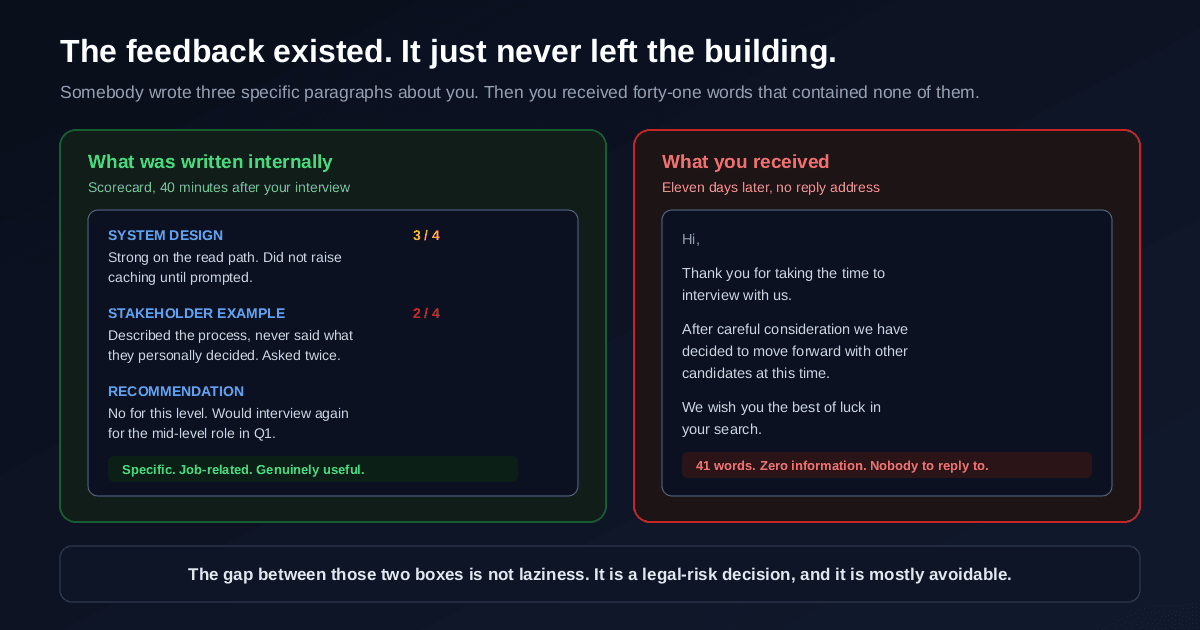
Forty minutes after your interview, somebody sat down and wrote three specific paragraphs about you. Which competencies you cleared, which one you did not, what you said that showed it, and whether they would interview you again for something else. That document exists. Eleven days later you received forty-one words containing none of it, from an address that does not accept replies. The gap between those two things is not laziness, and understanding what it actually is tells you how to get across it.
Quick answer
Quick answer: most companies withhold interview feedback because of perceived legal risk, not indifference, and the concern over-corrects: specific, job-related, documented feedback is more defensible than silence. As a candidate, ask within 48 hours, ask the person who was in the room, and ask about one named competency rather than the whole interview. Expect nothing after an application and good odds after a work sample. As an employer, use four parts: the decision, one gap, the evidence, one action. Never "culture fit".
Why you got nothing back
There are four reasons, they are not equally honest, and knowing which one you are dealing with changes what you should do about it.
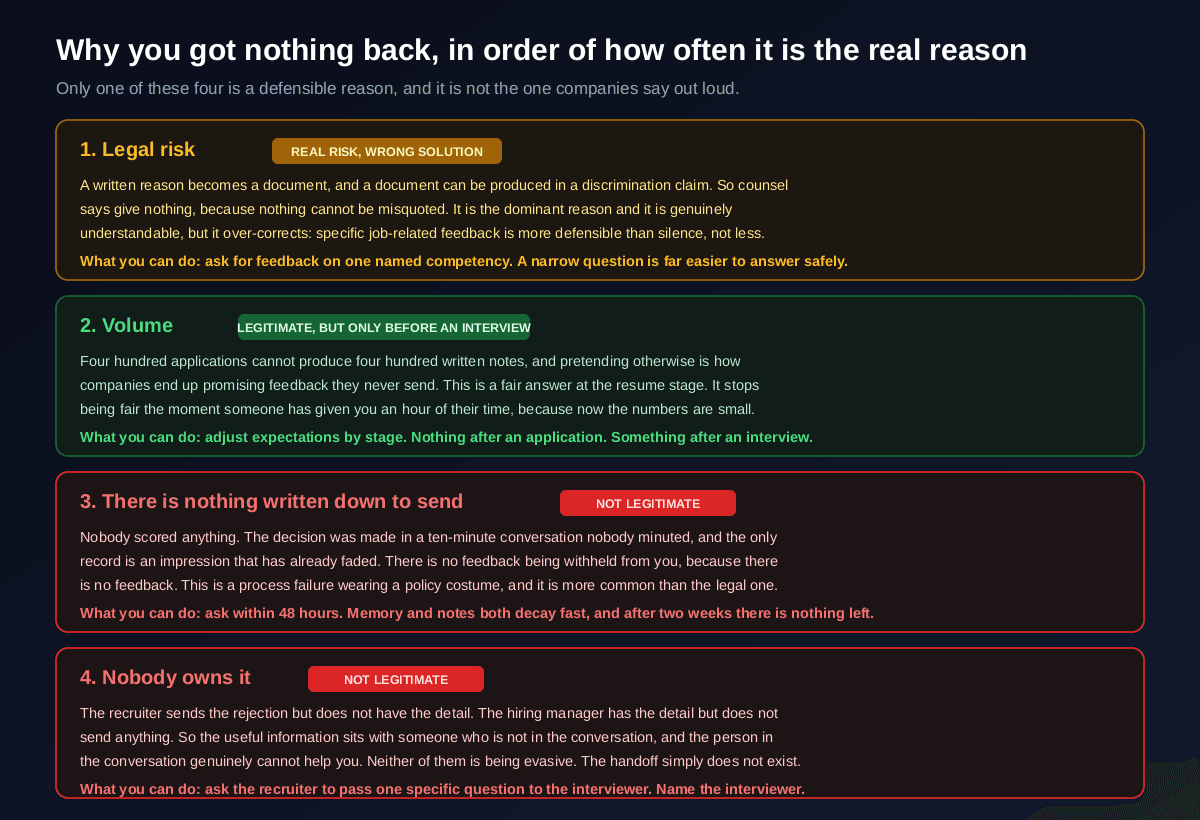
The legal one deserves unpacking, because it drives most of the silence and it rests on a mistake. The fear is that a written reason becomes a document, and a document can be produced in a claim. True. But a claim turns on whether the decision was made for a lawful, job-related reason, and the strongest possible defence is a contemporaneous record showing exactly that. An employer holding a written rubric, independent scores and a reason tied to a requirement is in a far better position than one holding nothing at all.
What actually creates exposure is vagueness: a reason invented after the fact, a reason that differs from the internal notes, or a subjective phrase that could plausibly stand in for something unlawful. Which means the risk-minimising move is not silence. It is scoring against an interview scorecard before you meet anyone, and then saying out loud only what the notes already say.
The third reason is more common than the first
What feedback actually exists, by stage
Asking at the wrong stage is most of why people conclude that nobody gives feedback. The odds are not uniform, they vary enormously, and the best stage is not the one most people pick.
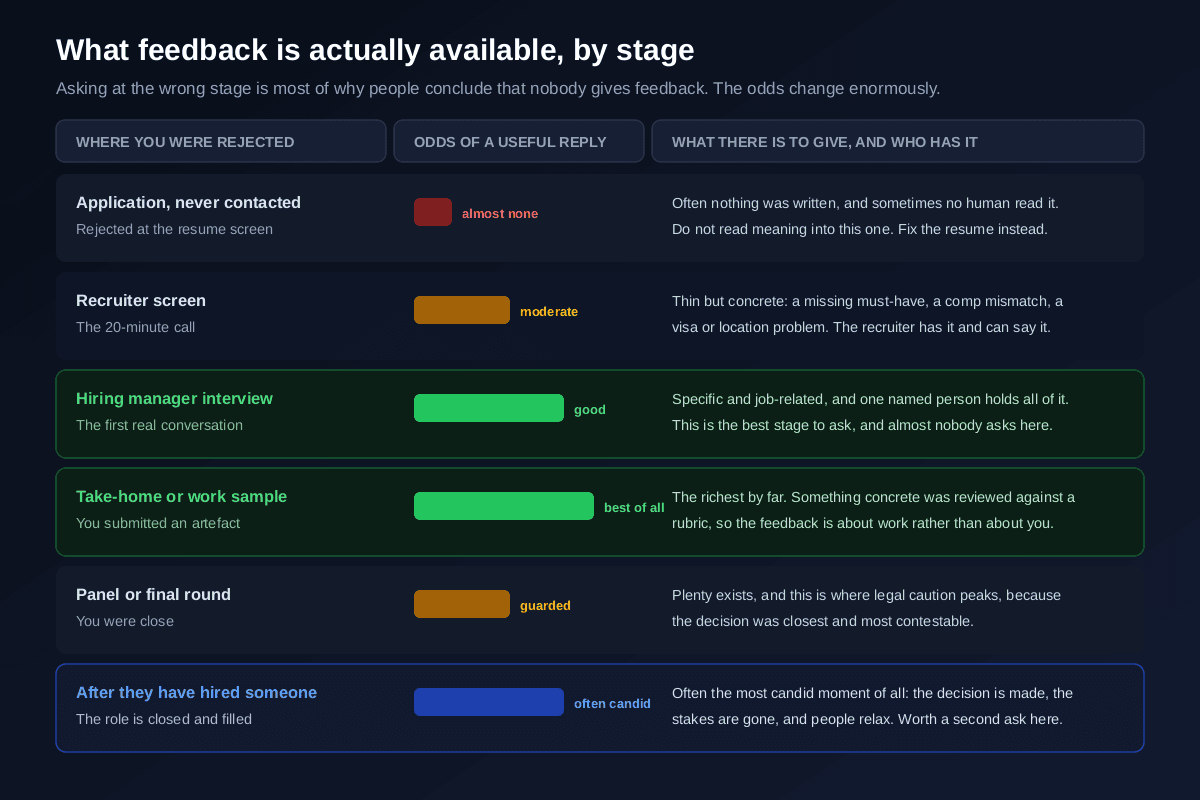
The work sample stage is the best place to spend a request, and for three reasons that compound: a concrete artefact was reviewed rather than a conversation remembered, it was assessed against a rubric so written observations already exist, and feedback about a piece of work is far safer to give than feedback about a person. If you did a take-home assignment, ask.
The counterintuitive one is the final round, where plenty exists and caution peaks, because the decision was closest and most contestable. And the application stage genuinely has nothing: why your resume gets rejected and why you are not getting interviews are more useful than any request you could send there.
How to ask so that someone can answer
Most requests fail for a reason that has nothing to do with willingness: they are impossible to answer safely in under five minutes, so they get deferred and then forgotten.
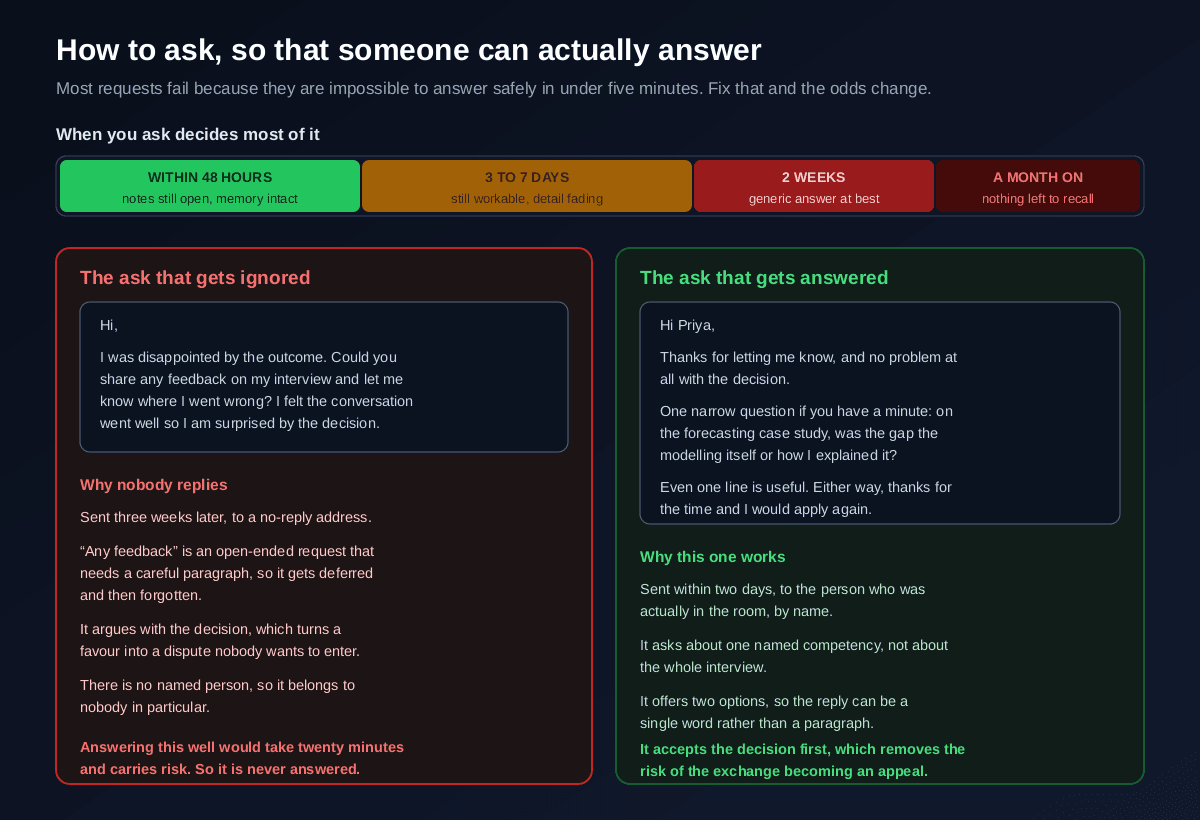
Template: the narrow ask, within 48 hours
Hi [Interviewer name], thanks for letting me know, and no problem at all with the decision.
One narrow question if you have a minute: on [the specific exercise or topic], was the gap [option A] or [option B]? Even one line is useful.
Either way, thank you for the time, and I would happily apply again if something closer comes up.
Template: when you only have the recruiter
Hi [Recruiter], thanks for the update and for the process, which was well run.
Would you be able to pass one question to [Interviewer name]? I would find it useful to know whether the concern on the [specific] competency was the approach or the way I explained it. A one-line answer is plenty, and no problem at all if it is not possible.
Naming the interviewer matters here. It converts an impossible request into a forwardable one, and it fixes the ownership gap that causes most of the silence.
The four things that make a request answerable: it accepts the decision first so the exchange cannot become an appeal, it asks about one named competency, it offers two options so the reply can be a single word, and it goes to a named person who has the information. Send it within two days, follow up once after a week, then stop. This is the same discipline as a thank you email after an interview: short, specific, and asking for something small.
What they said, and what it usually means
Some of what you receive is an empty template and some of it is genuinely informative. Telling them apart saves a lot of pointless re-reading.
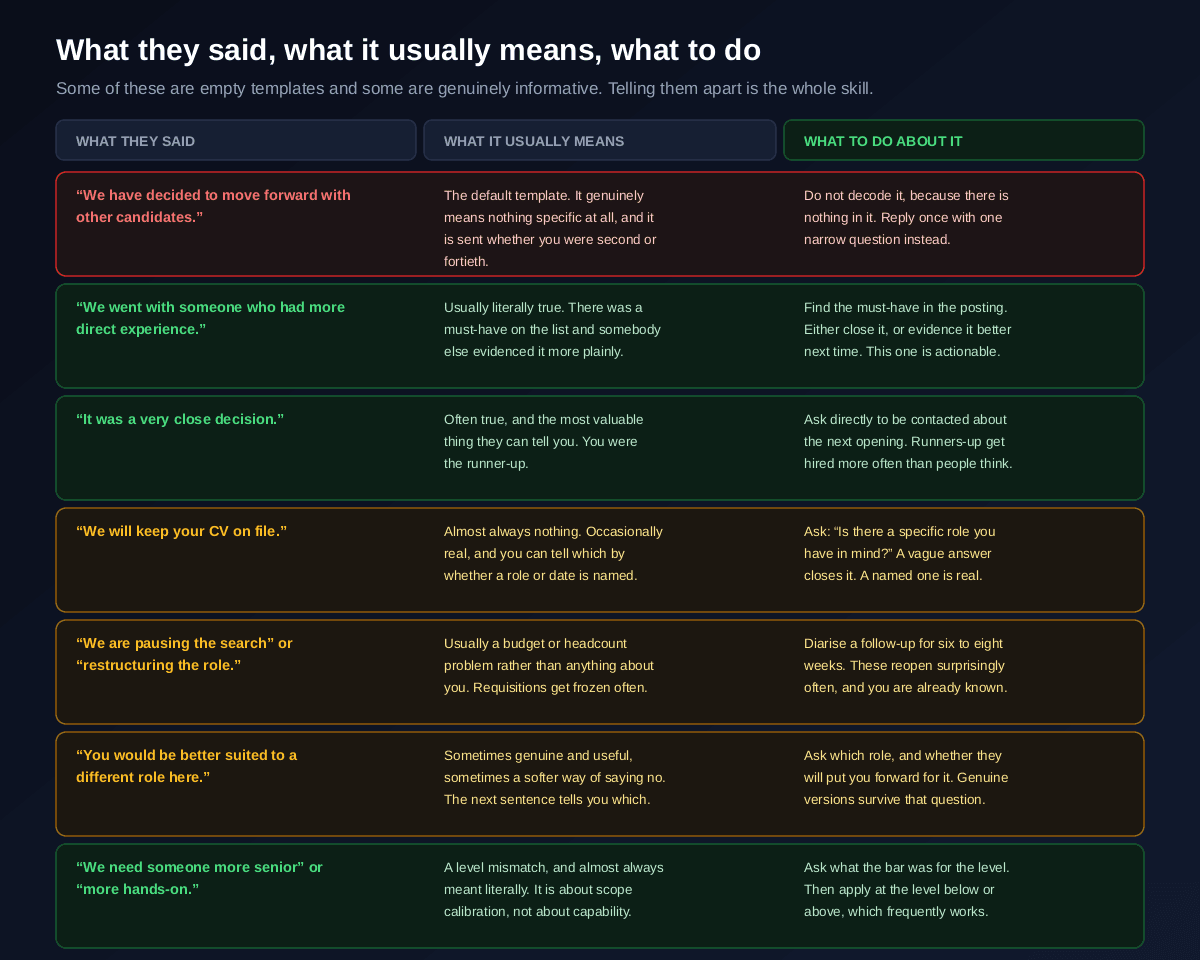
The rule underneath the whole table: the template carries no information, and the sentences a human added around it carry all of it. "We have decided to move forward with other candidates" goes identically to the runner-up and to the fortieth applicant. But "it was a very close decision" is usually true, and it means you should explicitly ask to be contacted about the next opening, because runners-up get hired more often than candidates assume.
Two of those rows are worth acting on immediately. "More direct experience" is nearly always literal: there was a must-have and someone evidenced it more plainly, so go back to the posting and find it, which is the same exercise as tailoring your resume to a job description. And "we are pausing the search" is usually about headcount rather than about you, so diarise a follow-up for six to eight weeks, though it is also worth checking whether the role was ever real: ghost jobs covers the tells.
What to do with feedback once you have it
- Do not argue, even when it is wrong. The decision cannot be reopened, so the only thing still in play is whether this person considers you for something else. An argumentative reply closes that.
- Correct a factual error in one sentence, then stop."For what it is worth I led that migration rather than supported it, though I can see the write-up did not make that clear" corrects the record, takes responsibility for the ambiguity, and asks for nothing.
- Wait for the second instance before you rebuild anything. One piece of feedback is a datapoint from one panel. The same feedback from two different companies is a pattern, and that is the genuinely valuable signal.
- Separate delivery problems from substance problems."The recommendation came last so the reasoning was hard to follow" is a structure problem, and the STAR method fixes it in an afternoon. A missing must-have is a different kind of work.
- Ask to be kept in mind, specifically.Not "keep me posted" but "if the mid-level version of this opens, I would like to hear about it". Then save the details, as in how to respond to a recruiter.
Get the answer nobody will give you about your resume
Most rejections happen before any human could give you feedback, at the resume screen. Paste your resume and the job description into Rankid for a 0-100 match score, the requirements you have actually evidenced, and the exact keywords you are missing. One check free, no signup.
Check your resume freeFor employers: the four-part structure
About ninety words, roughly ten minutes, and the single most important constraint is the one that feels wrong: one reason, not three.
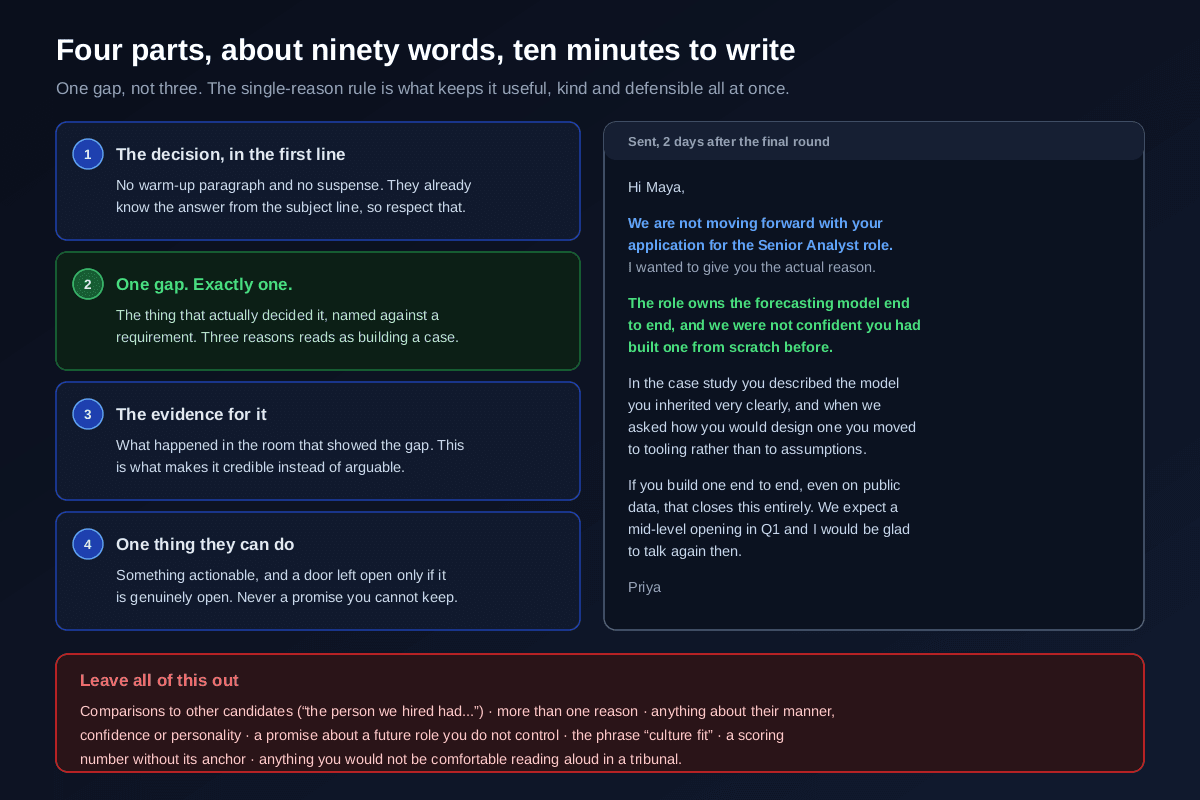
The single-reason rule matters for two reasons. Three reasons reads as building a case, which invites the candidate to dispute the two weakest and turns a kindness into a negotiation. And in practice one reason was decisive, so listing three is less accurate rather than more thorough.
The phrases to stop using, and what to say instead
Almost every risky phrase has a safe version that says the same thing more usefully, because the safe version points at evidence rather than at a person.
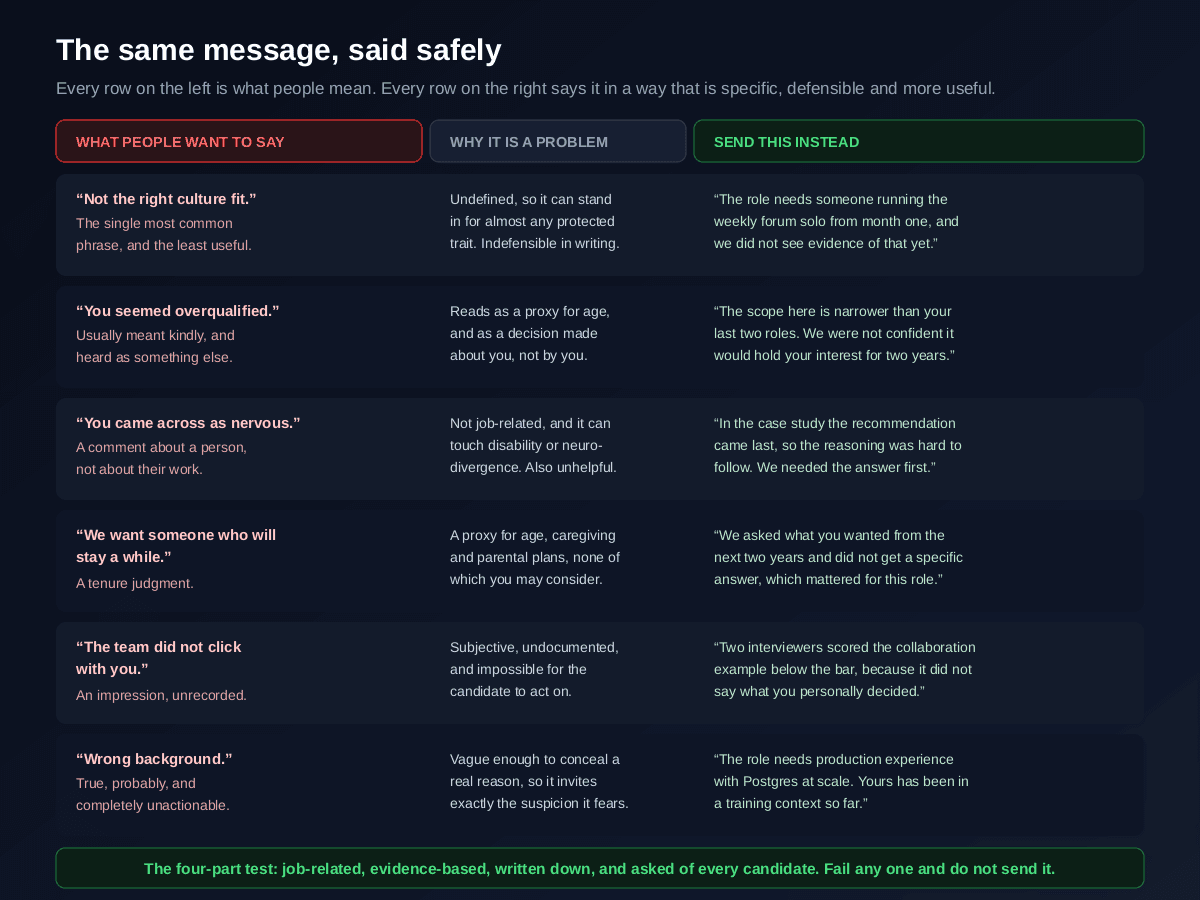
"Culture fit" is the one to eliminate entirely. It is undefined, which means it can stand in for almost any protected characteristic, and it is indefensible in writing precisely because it points at nothing. It is also useless to the candidate, which makes it the worst of both worlds. The alternative is always available: name the behaviour the role requires and say what evidence was missing.
Apply a four-part test to every sentence before it goes out: job-related, evidence-based, written down, and asked of every candidate. The last one is the one people forget, and it is the one that matters most for adverse impact: giving specific feedback to some candidates and the template to others creates exactly the pattern that no-feedback policies were trying to avoid. Keeping criteria tied to the work, as in skills-based hiring, is what makes all of this straightforward.
Making it sustainable at scale
Feedback programmes usually fail because they treat feedback as a separate task, performed later, by someone who was not in the room. That is slow, inaccurate, and the first thing dropped in a busy week.
Write it once, at the point of decision
Require one sentence per criterion, in plain language that could be sent to the candidate as written, within a day of the interview. Then the rejection message is assembly rather than composition, and it costs a recruiter two minutes instead of twenty. This is a small addition to the debrief you should already be running, covered in the interview scorecard.
Tier it honestly
Everyone who reached an interview gets a specific reason. Applicants get a fast, honest, templated no that names the stage, so they know whether a human saw it. Do not promise individual feedback on applications, because at four hundred applicants that promise will fail and a broken promise costs more than a clean silence. The candidate rejection email covers the message itself, and high-volume recruiting covers the numbers problem.
Name one owner per stage
The most common failure is structural rather than cultural: the person with the information is not the person sending the message. Decide who owns feedback at each stage and make it explicit, because "the recruiter will handle it" when the recruiter was not in the interview produces exactly the empty template that started this article.
Then measure it. Track what proportion of interviewed candidates received a specific reason, and check that the proportion does not vary by group, which is the same discipline as any other recruitment metric. Done properly this is a candidate experience advantage rather than a cost: the rejected candidate who got a real reason is the one who applies again, refers a friend, and does not write about you publicly. Where a recorded round or an automated screen contributed, disclosure may also be a legal requirement rather than a courtesy, which is covered in the one-way video interview guide and AI resume screening.
Feedback is easy when the reasons are already written down
Rankid scores every candidate against the real requirements of the role and shows the evidence behind each score. That record is what makes a specific, defensible reason a two-minute job instead of a twenty-minute one. First 5 resumes free, no signup.
Try bulk screening freeFrequently asked questions
Why don't companies give interview feedback?
Four reasons, and only one of them is defensible. The dominant one is legal risk: a written reason becomes a document, and a document can be produced in a discrimination claim, so counsel frequently advises saying nothing on the theory that nothing cannot be misquoted. That concern is genuine but it over-corrects, because specific job-related feedback is more defensible than silence, not less. The second is volume, which is a fair answer at the resume screening stage where hundreds of applications cannot produce hundreds of written notes, and stops being fair once someone has given you an hour of their time. The third is that there is genuinely nothing to send, because nobody scored anything and the decision was made in a conversation nobody minuted, which is a process failure rather than a policy. The fourth is ownership: the recruiter sends the rejection but does not hold the detail, while the hiring manager holds the detail but does not send anything, so the useful information sits with someone who is not in the conversation. Only the volume reason, and only before an interview, holds up.
Do companies have to give interview feedback?
In most places, no. There is generally no legal obligation to explain why a candidate was rejected, and that is true across the United States and most other jurisdictions. There are narrow exceptions worth knowing about. Where an automated tool contributed to the decision, disclosure duties can apply: New York City's Local Law 144 requires candidate notice for automated employment decision tools, Illinois regulates AI use in video interviews, and the EU AI Act imposes transparency and human oversight obligations on hiring systems. Data protection law also matters in some regions: under the UK and EU GDPR a candidate can make a subject access request for the personal data an employer holds about them, which can include interview notes, and that is a right to your data rather than a right to feedback, but it exists. Some public sector and unionised processes have their own disclosure rules. Outside those cases it is a choice, which is why the quality of feedback varies so wildly between companies doing the same thing.
How do you ask for feedback after a job rejection?
Ask within 48 hours, ask the person who was actually in the room, and ask about one named thing rather than about the whole interview. The request that works looks like this: 'Hi Priya, thanks for letting me know, and no problem at all with the decision. One narrow question if you have a minute: on the forecasting case study, was the gap the modelling itself or how I explained it? Even one line is useful. Either way, thanks for the time and I would apply again.' That succeeds because it does four things. It accepts the decision first, which removes any risk of the exchange becoming an appeal. It asks about a single competency instead of requesting a general assessment. It offers two options, so the reply can be one word rather than a paragraph. And it is addressed to a named person who has the information. Compare that to 'could you share any feedback on my interview and let me know where I went wrong', sent three weeks later to a no-reply address, which would take twenty minutes to answer carefully and carries risk, which is why it is never answered.
What are good interview feedback examples for candidates?
Good feedback names a requirement, gives evidence from the interview, and suggests one action. For example: 'The role owns the forecasting model end to end and we were not confident you had built one from scratch. In the case study you described the model you inherited very clearly, but when we asked how you would design one you moved to tooling rather than to assumptions. Building one end to end, even on public data, would close this.' Another: 'Two interviewers scored the collaboration example below the bar because it described the process without saying what you personally decided. The content was there, the ownership was not.' A third: 'The scope here is narrower than your last two roles and we were not confident it would hold your interest for two years.' What all three share is that they point at something observable and actionable. Bad feedback does the opposite: 'not the right culture fit', 'you came across as nervous', 'the team did not click with you' are all impressions rather than observations, and none of them tells a candidate anything they can change.
How do you give interview feedback to candidates?
Four parts, about ninety words, and roughly ten minutes to write. Part one is the decision in the first line, with no warm-up paragraph, because they already know from the subject line and suspense is unkind. Part two is one gap, exactly one, named against a requirement of the role. The single-reason rule matters more than it looks: three reasons reads as building a case, and it invites the candidate to dispute the two weakest. Part three is the evidence, meaning what actually happened in the interview that showed the gap, which is what makes it credible rather than arguable. Part four is one thing they can do about it, plus a door left open only if it is genuinely open. What to leave out: comparisons to the person you hired, more than one reason, anything about the candidate's manner or confidence or personality, promises about future roles you do not control, the phrase 'culture fit', and a score without its anchor. A practical test for the whole message: would you be comfortable reading it aloud in a tribunal?
What does 'we decided to move forward with other candidates' mean?
Nothing specific, and that is genuinely the answer rather than an evasion. It is the standard template sentence, and it is sent identically to the person who came second and the person who came fortieth, which means there is no information encoded in it to extract. People spend a lot of energy re-reading it for signals and there are none there. Two things follow from that. First, do not try to decode it, because the variance is entirely in what the sender chose not to write rather than in the words they used. Second, it is worth exactly one reply: a short, narrow question aimed at a named person, which occasionally converts an empty template into something specific. What does carry information is any sentence a human added around the template. 'It was a very close decision' is usually true and means you were the runner-up. 'We went with someone with more direct experience' is usually literally true and points at a specific must-have. 'We are pausing the search' is usually about budget rather than about you. The added sentences are the signal. The template is not.
How long should you wait for interview feedback?
Ask within 48 hours of the rejection, and if you get no answer, follow up once after about a week and then stop. The reason speed matters so much is mechanical rather than about eagerness. Interview notes are written within a day or two while impressions are fresh, and then nobody looks at them again. After two weeks the interviewer is three candidates and two projects further on, so a request that arrives then produces a generic answer at best, because the specific detail genuinely no longer exists in anyone's memory. That is also why a request sent a month later almost never gets a substantive reply: there is nothing left to recall, and reconstructing it from notes is work nobody has time for. One useful exception runs the other way. Once the role is filled and closed, some people become noticeably more candid, because the decision is made and the stakes are gone. So if a first ask went nowhere, a short second ask after they announce the hire is occasionally the one that works.
Is it worth asking for interview feedback at all?
Yes at the interview stages, and no at the application stage, and the difference is large enough that treating them the same is why people conclude feedback is a myth. If you were rejected after applying without ever being contacted, expect nothing: often no note was written and sometimes no human read the application, so there is no feedback being withheld. If you were rejected after a hiring manager interview, a take-home or a final round, the odds are genuinely good, because specific job-related observations exist and a named person holds them. The best single stage to ask is after a take-home or work sample, because someone reviewed a concrete artefact against a rubric, so the feedback is about work rather than about you, and it is both easier and safer to give. Even when the answer is thin, the request costs you two minutes and has a second benefit: a short, gracious reply that accepts the decision is remembered, and runners-up get contacted about the next opening more often than most candidates expect.
How should you respond to interview feedback you disagree with?
Thank them, ask one clarifying question if you genuinely need it, and do not argue. This is difficult because feedback is sometimes wrong, and the temptation to correct the record is strong. It is still the wrong move, for a practical reason rather than a diplomatic one: the decision has already been made and cannot be reopened, so the only thing still in play is whether this person would consider you for something else. An argumentative reply closes that, and it is the most common way candidates convert a rejection into a permanent no. If the feedback rests on a factual error, one calm sentence is acceptable: 'That is useful, thank you. For what it is worth I did lead that migration rather than support it, though I can see the write-up did not make that clear.' Note the shape: it corrects the fact, accepts responsibility for the ambiguity, and does not ask for reconsideration. Then let it go. If the same feedback appears twice from different companies, that is no longer a disagreement, it is a pattern, and it is the most valuable information you will get.
What phrases should employers avoid in interview feedback?
Any phrase that describes a person rather than their work, and any phrase that is undefined enough to stand in for a protected characteristic. 'Culture fit' is the worst offender, because it is undefined, it can substitute for almost anything, and it is indefensible in writing. 'You seemed overqualified' is usually meant kindly and reads as a proxy for age. 'You came across as nervous' is not job-related and can touch disability or neurodivergence. 'We want someone who will stay a while' is a proxy for age, caregiving and parental plans. 'The team did not click with you' is subjective and undocumented, so the candidate cannot act on it and you cannot defend it. Each of those has a safe version that says the same thing more usefully, because the safe version points at evidence: instead of culture fit, 'the role needs someone running the weekly forum solo from month one and we did not see evidence of that yet'. The test to apply is four-part: job-related, evidence-based, written down, and asked of every candidate. If a sentence fails any one of the four, do not send it.
Should you give feedback to candidates rejected at the resume stage?
No, and promising it is worse than not offering it. At the application stage the numbers make individual feedback impossible: a role with four hundred applicants cannot generate four hundred written notes, and any process that promises it will quietly fail, which damages trust more than a clean silence would. What you can do instead is set expectations honestly and be fast. Say in the job posting or the acknowledgement that you cannot give individual feedback on applications but that everyone who reaches an interview will get a specific reason, and then actually do that. Speed substitutes for feedback surprisingly well at this stage, because most of the frustration candidates report is about waiting three weeks in silence rather than about the absence of detail. Two other things help at volume. Publish the actual must-haves in the posting so candidates can self-assess before applying, and make your rejection message name the stage so people know whether a human ever saw their application. Beyond that, spend the feedback budget where the numbers are small and the effort lands.
Does giving interview feedback increase legal risk?
Vague feedback increases risk. Specific, job-related, documented feedback generally reduces it, which is the opposite of the assumption behind most no-feedback policies. The reason is that a claim turns on whether a decision was made for a lawful, job-related reason, and the strongest defence is a contemporaneous record showing exactly that: a written rubric agreed before candidates were seen, independent scores, and a reason tied to a requirement. An employer holding that record is in a much stronger position than one holding nothing. What creates exposure is the opposite: a reason invented after the fact, a reason that differs from the internal notes, a subjective phrase like 'culture fit' that could plausibly stand in for something unlawful, or feedback given to some candidates and not others in a pattern that correlates with a protected characteristic. So the practical answer is not to stay silent, it is to score against written criteria before you meet anyone, keep the notes, and say out loud only what the notes already say. Consistency is the control that matters most.
What is the best stage to ask for interview feedback?
After a take-home assignment or work sample, and it is not close. Three things make that stage unusually productive. A concrete artefact was reviewed, so there is something objective to talk about rather than an impression of a conversation. It was usually assessed against a rubric, so specific observations already exist in writing. And feedback about a piece of work is far safer to give than feedback about a person, so the legal caution that suppresses everything else applies much more weakly. The second best stage is the hiring manager interview, because one named person holds the whole picture and very few candidates think to ask them directly rather than going through the recruiter. The worst stages are the application, where nothing was written, and, slightly counterintuitively, the final round, where plenty exists but legal caution peaks because the decision was closest and most contestable. If you are choosing where to spend one polite request in a process, spend it on the work sample.
How can employers make interview feedback sustainable at scale?
Write it once, at the point of decision, and reuse the words. Most feedback programmes fail because they treat it as a separate task performed later by someone who was not there, which is both slow and impossible to do accurately. The fix is to collapse the two: have interviewers score against the rubric within a day, and require one sentence per criterion in plain language that could be sent to the candidate as written. Then the rejection message is assembly rather than composition, and it takes a recruiter two minutes instead of twenty. Three further things keep it sustainable. Tier it, so everyone who reached an interview gets a specific reason while applicants get a fast, honest, templated no. Set one owner per stage, since the most common failure is that the person with the information is not the person sending the message. And check consistency periodically by looking at who received specific feedback and who received the template, because a pattern there is exactly the exposure that no-feedback policies were trying to avoid in the first place.
Key takeaways
- The feedback usually exists. It was written within a day of your interview and never left the building, and the reason is perceived legal risk rather than indifference.
- That fear over-corrects: specific, job-related, documented feedback is more defensible than silence, because a claim turns on whether the reason was lawful and job-related.
- The most common reason of all is that there is genuinely nothing to send. Nobody scored anything, so nothing is being withheld. This is why speed beats eloquence.
- Ask within 48 hours. Interview notes are written in a day or two and never revisited, so after two weeks the specific detail no longer exists in anyone's memory.
- Ask the person who was in the room, by name. If you only have the recruiter, ask them to forward one question and name the interviewer.
- Ask about one named competency and offer two options, so the reply can be a single word rather than a paragraph.
- Accept the decision in the first line. The fastest way to get no reply is to make the exchange feel like an appeal.
- Expect nothing after an application, and good odds after a work sample. A reviewed artefact is the safest and richest thing to give feedback on.
- 'We decided to move forward with other candidates' carries no information and goes identically to the runner-up and the fortieth applicant. The sentences a human added around it are the signal.
- 'It was a close decision' usually means you were runner-up. Ask explicitly to be told about the next opening.
- Never argue with feedback, even when it is wrong. Correct a factual error in one sentence, then stop. Act on it only when a second company says the same thing.
- Employers: four parts, ninety words. The decision, one gap, the evidence, one action. One reason, never three.
- Eliminate 'culture fit'. It is undefined, so it can stand in for a protected characteristic, it is indefensible in writing, and it is useless to the candidate.
- The four-part test for any sentence: job-related, evidence-based, written down, and asked of every candidate. Giving specific feedback to some and the template to others is itself the risk.
- Employers: write the feedback at the point of decision, in sendable language, and the rejection becomes assembly rather than composition. Then name one owner per stage.
Frequently asked questions
Why don't companies give interview feedback?
Four reasons, and only one of them is defensible. The dominant one is legal risk: a written reason becomes a document, and a document can be produced in a discrimination claim, so counsel frequently advises saying nothing on the theory that nothing cannot be misquoted. That concern is genuine but it over-corrects, because specific job-related feedback is more defensible than silence, not less. The second is volume, which is a fair answer at the resume screening stage where hundreds of applications cannot produce hundreds of written notes, and stops being fair once someone has given you an hour of their time. The third is that there is genuinely nothing to send, because nobody scored anything and the decision was made in a conversation nobody minuted, which is a process failure rather than a policy. The fourth is ownership: the recruiter sends the rejection but does not hold the detail, while the hiring manager holds the detail but does not send anything, so the useful information sits with someone who is not in the conversation. Only the volume reason, and only before an interview, holds up.
Do companies have to give interview feedback?
In most places, no. There is generally no legal obligation to explain why a candidate was rejected, and that is true across the United States and most other jurisdictions. There are narrow exceptions worth knowing about. Where an automated tool contributed to the decision, disclosure duties can apply: New York City's Local Law 144 requires candidate notice for automated employment decision tools, Illinois regulates AI use in video interviews, and the EU AI Act imposes transparency and human oversight obligations on hiring systems. Data protection law also matters in some regions: under the UK and EU GDPR a candidate can make a subject access request for the personal data an employer holds about them, which can include interview notes, and that is a right to your data rather than a right to feedback, but it exists. Some public sector and unionised processes have their own disclosure rules. Outside those cases it is a choice, which is why the quality of feedback varies so wildly between companies doing the same thing.
How do you ask for feedback after a job rejection?
Ask within 48 hours, ask the person who was actually in the room, and ask about one named thing rather than about the whole interview. The request that works looks like this: 'Hi Priya, thanks for letting me know, and no problem at all with the decision. One narrow question if you have a minute: on the forecasting case study, was the gap the modelling itself or how I explained it? Even one line is useful. Either way, thanks for the time and I would apply again.' That succeeds because it does four things. It accepts the decision first, which removes any risk of the exchange becoming an appeal. It asks about a single competency instead of requesting a general assessment. It offers two options, so the reply can be one word rather than a paragraph. And it is addressed to a named person who has the information. Compare that to 'could you share any feedback on my interview and let me know where I went wrong', sent three weeks later to a no-reply address, which would take twenty minutes to answer carefully and carries risk, which is why it is never answered.
What are good interview feedback examples for candidates?
Good feedback names a requirement, gives evidence from the interview, and suggests one action. For example: 'The role owns the forecasting model end to end and we were not confident you had built one from scratch. In the case study you described the model you inherited very clearly, but when we asked how you would design one you moved to tooling rather than to assumptions. Building one end to end, even on public data, would close this.' Another: 'Two interviewers scored the collaboration example below the bar because it described the process without saying what you personally decided. The content was there, the ownership was not.' A third: 'The scope here is narrower than your last two roles and we were not confident it would hold your interest for two years.' What all three share is that they point at something observable and actionable. Bad feedback does the opposite: 'not the right culture fit', 'you came across as nervous', 'the team did not click with you' are all impressions rather than observations, and none of them tells a candidate anything they can change.
How do you give interview feedback to candidates?
Four parts, about ninety words, and roughly ten minutes to write. Part one is the decision in the first line, with no warm-up paragraph, because they already know from the subject line and suspense is unkind. Part two is one gap, exactly one, named against a requirement of the role. The single-reason rule matters more than it looks: three reasons reads as building a case, and it invites the candidate to dispute the two weakest. Part three is the evidence, meaning what actually happened in the interview that showed the gap, which is what makes it credible rather than arguable. Part four is one thing they can do about it, plus a door left open only if it is genuinely open. What to leave out: comparisons to the person you hired, more than one reason, anything about the candidate's manner or confidence or personality, promises about future roles you do not control, the phrase 'culture fit', and a score without its anchor. A practical test for the whole message: would you be comfortable reading it aloud in a tribunal?
What does 'we decided to move forward with other candidates' mean?
Nothing specific, and that is genuinely the answer rather than an evasion. It is the standard template sentence, and it is sent identically to the person who came second and the person who came fortieth, which means there is no information encoded in it to extract. People spend a lot of energy re-reading it for signals and there are none there. Two things follow from that. First, do not try to decode it, because the variance is entirely in what the sender chose not to write rather than in the words they used. Second, it is worth exactly one reply: a short, narrow question aimed at a named person, which occasionally converts an empty template into something specific. What does carry information is any sentence a human added around the template. 'It was a very close decision' is usually true and means you were the runner-up. 'We went with someone with more direct experience' is usually literally true and points at a specific must-have. 'We are pausing the search' is usually about budget rather than about you. The added sentences are the signal. The template is not.
How long should you wait for interview feedback?
Ask within 48 hours of the rejection, and if you get no answer, follow up once after about a week and then stop. The reason speed matters so much is mechanical rather than about eagerness. Interview notes are written within a day or two while impressions are fresh, and then nobody looks at them again. After two weeks the interviewer is three candidates and two projects further on, so a request that arrives then produces a generic answer at best, because the specific detail genuinely no longer exists in anyone's memory. That is also why a request sent a month later almost never gets a substantive reply: there is nothing left to recall, and reconstructing it from notes is work nobody has time for. One useful exception runs the other way. Once the role is filled and closed, some people become noticeably more candid, because the decision is made and the stakes are gone. So if a first ask went nowhere, a short second ask after they announce the hire is occasionally the one that works.
Is it worth asking for interview feedback at all?
Yes at the interview stages, and no at the application stage, and the difference is large enough that treating them the same is why people conclude feedback is a myth. If you were rejected after applying without ever being contacted, expect nothing: often no note was written and sometimes no human read the application, so there is no feedback being withheld. If you were rejected after a hiring manager interview, a take-home or a final round, the odds are genuinely good, because specific job-related observations exist and a named person holds them. The best single stage to ask is after a take-home or work sample, because someone reviewed a concrete artefact against a rubric, so the feedback is about work rather than about you, and it is both easier and safer to give. Even when the answer is thin, the request costs you two minutes and has a second benefit: a short, gracious reply that accepts the decision is remembered, and runners-up get contacted about the next opening more often than most candidates expect.
How should you respond to interview feedback you disagree with?
Thank them, ask one clarifying question if you genuinely need it, and do not argue. This is difficult because feedback is sometimes wrong, and the temptation to correct the record is strong. It is still the wrong move, for a practical reason rather than a diplomatic one: the decision has already been made and cannot be reopened, so the only thing still in play is whether this person would consider you for something else. An argumentative reply closes that, and it is the most common way candidates convert a rejection into a permanent no. If the feedback rests on a factual error, one calm sentence is acceptable: 'That is useful, thank you. For what it is worth I did lead that migration rather than support it, though I can see the write-up did not make that clear.' Note the shape: it corrects the fact, accepts responsibility for the ambiguity, and does not ask for reconsideration. Then let it go. If the same feedback appears twice from different companies, that is no longer a disagreement, it is a pattern, and it is the most valuable information you will get.
What phrases should employers avoid in interview feedback?
Any phrase that describes a person rather than their work, and any phrase that is undefined enough to stand in for a protected characteristic. 'Culture fit' is the worst offender, because it is undefined, it can substitute for almost anything, and it is indefensible in writing. 'You seemed overqualified' is usually meant kindly and reads as a proxy for age. 'You came across as nervous' is not job-related and can touch disability or neurodivergence. 'We want someone who will stay a while' is a proxy for age, caregiving and parental plans. 'The team did not click with you' is subjective and undocumented, so the candidate cannot act on it and you cannot defend it. Each of those has a safe version that says the same thing more usefully, because the safe version points at evidence: instead of culture fit, 'the role needs someone running the weekly forum solo from month one and we did not see evidence of that yet'. The test to apply is four-part: job-related, evidence-based, written down, and asked of every candidate. If a sentence fails any one of the four, do not send it.
Should you give feedback to candidates rejected at the resume stage?
No, and promising it is worse than not offering it. At the application stage the numbers make individual feedback impossible: a role with four hundred applicants cannot generate four hundred written notes, and any process that promises it will quietly fail, which damages trust more than a clean silence would. What you can do instead is set expectations honestly and be fast. Say in the job posting or the acknowledgement that you cannot give individual feedback on applications but that everyone who reaches an interview will get a specific reason, and then actually do that. Speed substitutes for feedback surprisingly well at this stage, because most of the frustration candidates report is about waiting three weeks in silence rather than about the absence of detail. Two other things help at volume. Publish the actual must-haves in the posting so candidates can self-assess before applying, and make your rejection message name the stage so people know whether a human ever saw their application. Beyond that, spend the feedback budget where the numbers are small and the effort lands.
Does giving interview feedback increase legal risk?
Vague feedback increases risk. Specific, job-related, documented feedback generally reduces it, which is the opposite of the assumption behind most no-feedback policies. The reason is that a claim turns on whether a decision was made for a lawful, job-related reason, and the strongest defence is a contemporaneous record showing exactly that: a written rubric agreed before candidates were seen, independent scores, and a reason tied to a requirement. An employer holding that record is in a much stronger position than one holding nothing. What creates exposure is the opposite: a reason invented after the fact, a reason that differs from the internal notes, a subjective phrase like 'culture fit' that could plausibly stand in for something unlawful, or feedback given to some candidates and not others in a pattern that correlates with a protected characteristic. So the practical answer is not to stay silent, it is to score against written criteria before you meet anyone, keep the notes, and say out loud only what the notes already say. Consistency is the control that matters most.
What is the best stage to ask for interview feedback?
After a take-home assignment or work sample, and it is not close. Three things make that stage unusually productive. A concrete artefact was reviewed, so there is something objective to talk about rather than an impression of a conversation. It was usually assessed against a rubric, so specific observations already exist in writing. And feedback about a piece of work is far safer to give than feedback about a person, so the legal caution that suppresses everything else applies much more weakly. The second best stage is the hiring manager interview, because one named person holds the whole picture and very few candidates think to ask them directly rather than going through the recruiter. The worst stages are the application, where nothing was written, and, slightly counterintuitively, the final round, where plenty exists but legal caution peaks because the decision was closest and most contestable. If you are choosing where to spend one polite request in a process, spend it on the work sample.
How can employers make interview feedback sustainable at scale?
Write it once, at the point of decision, and reuse the words. Most feedback programmes fail because they treat it as a separate task performed later by someone who was not there, which is both slow and impossible to do accurately. The fix is to collapse the two: have interviewers score against the rubric within a day, and require one sentence per criterion in plain language that could be sent to the candidate as written. Then the rejection message is assembly rather than composition, and it takes a recruiter two minutes instead of twenty. Three further things keep it sustainable. Tier it, so everyone who reached an interview gets a specific reason while applicants get a fast, honest, templated no. Set one owner per stage, since the most common failure is that the person with the information is not the person sending the message. And check consistency periodically by looking at who received specific feedback and who received the template, because a pattern there is exactly the exposure that no-feedback policies were trying to avoid in the first place.