Job Offer Rescinded? What to Do in the First 48 Hours (and Whether You Can Get Paid) (2026)
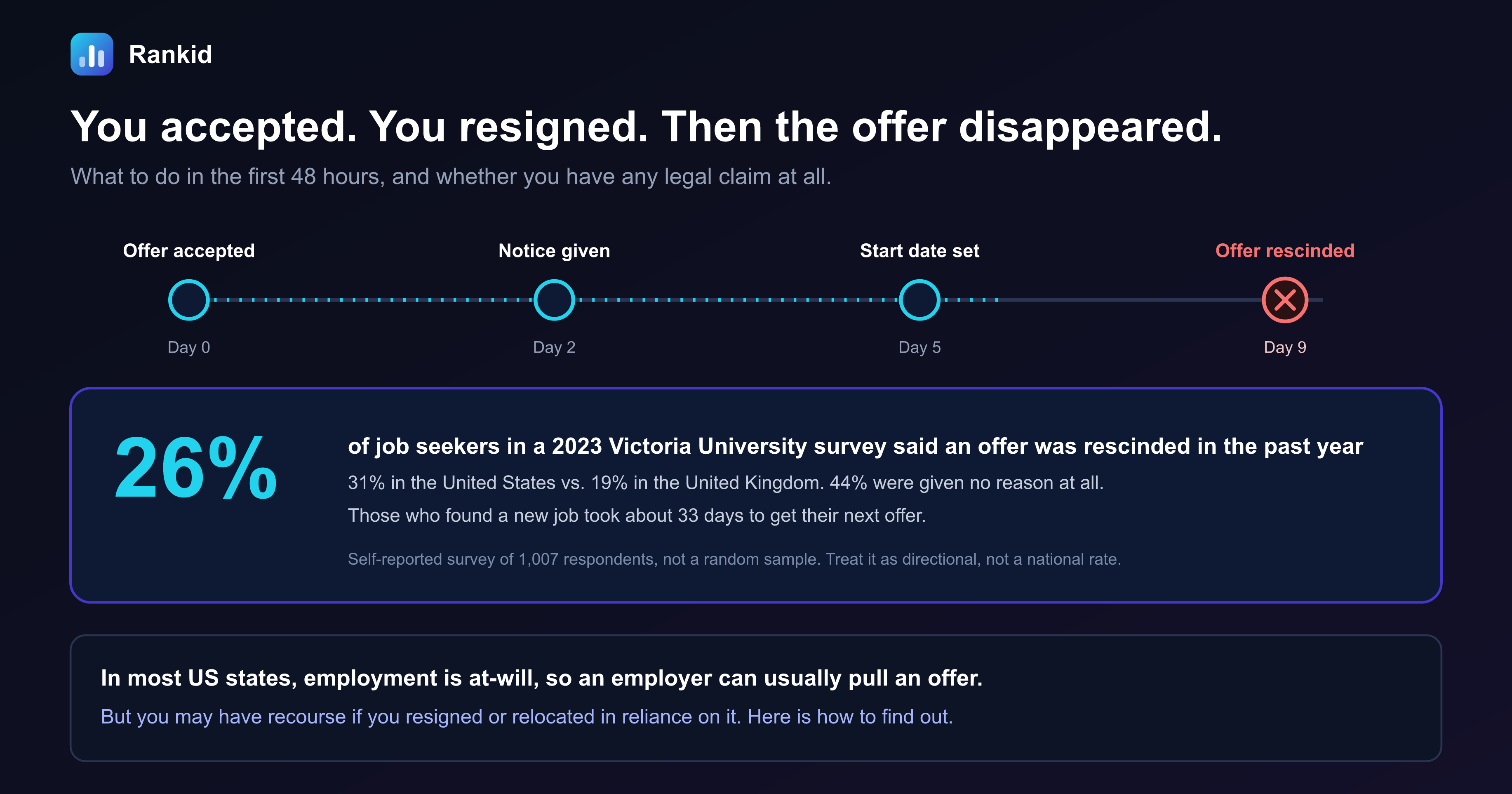
You said yes. You emailed your manager. Maybe you gave notice, told your team, even started house hunting. Then a message arrives that opens with "Unfortunately." A rescinded job offer is one of the worst moments in a job search precisely because you did everything right. The good news is that what you do in the next 48 hours matters far more than what happened, and that most of the damage is avoidable if you know the order of operations. Better still, a short checklist completed before you ever resign prevents most of it in the first place.
Quick answer
Quick answer: in most US states an employer can legally withdraw an offer, even an accepted one, for any lawful reason. But you are not without options. In the first 48 hours, ask for the reason in writing, save every document, stay professional, work out the real reason, restart your search, and get legal advice if you resigned or relocated. If the reason was a background check, the FCRA gives you rights to see the report and dispute errors. If you relied on the offer to your cost, a promissory estoppel claim may be possible. And next time, don't hand in notice until six boxes are ticked.
How common are rescinded offers?
More common than most people assume, though there is no official count. The most widely cited figure comes from a 2023 Victoria University survey of 1,007 people: 26% said an offer had been rescinded in the past year, with 31% of US respondents reporting it versus 19% in the UK. Among those affected, the average person had been job hunting for about 92 days when it happened, 44% were never told why, and of those who found another job, the next offer took an average of about 33 days to arrive.
A caution on the data: it is a self-reported survey rather than a random sample, so read it as directional. The signal is still useful. An accepted offer is not a guarantee, and the period between "yes" and your first day is riskier than it feels.
Is it even legal for them to do this?
Usually, yes, and understanding why will save you a lot of frustration. Most US employment is at-will, which means an employer can end the relationship, or decline to start it, for any reason that isn't unlawful. Offer letters typically add language saying the offer is contingent on background and reference checks and that employment is at-will. That is why a rescinded offer is often legal even when it feels deeply unfair.
The protections that do exist are specific:
- Discrimination. An offer cannot be withdrawn because of a protected characteristic such as race, religion, sex, national origin, age, disability, or pregnancy. If the timing coincides with you disclosing a pregnancy, a disability, or a need for an accommodation, talk to an employment lawyer promptly. Deadlines for filing a charge with the EEOC are short: generally 180 days, extended to 300 in many states.
- Background-check procedure.If the decision rests on a screening company's report, the Fair Credit Reporting Act requires the employer to follow a defined process before finalizing it (details below).
- Reliance. If you reasonably relied on a clear promise of a job by quitting or moving and were harmed, some states allow a claim under promissory estoppel.
- Contract terms.A signed agreement for a defined term, or one that limits the employer's right to withdraw, is different from a standard at-will offer letter. Read yours.
None of this is legal advice, and rules differ by state and country. Think of it as a map of where to look.
Your first 48 hours: six moves, in order
Emotion is the enemy in the first hour. Structure is the antidote. Work through these in sequence.
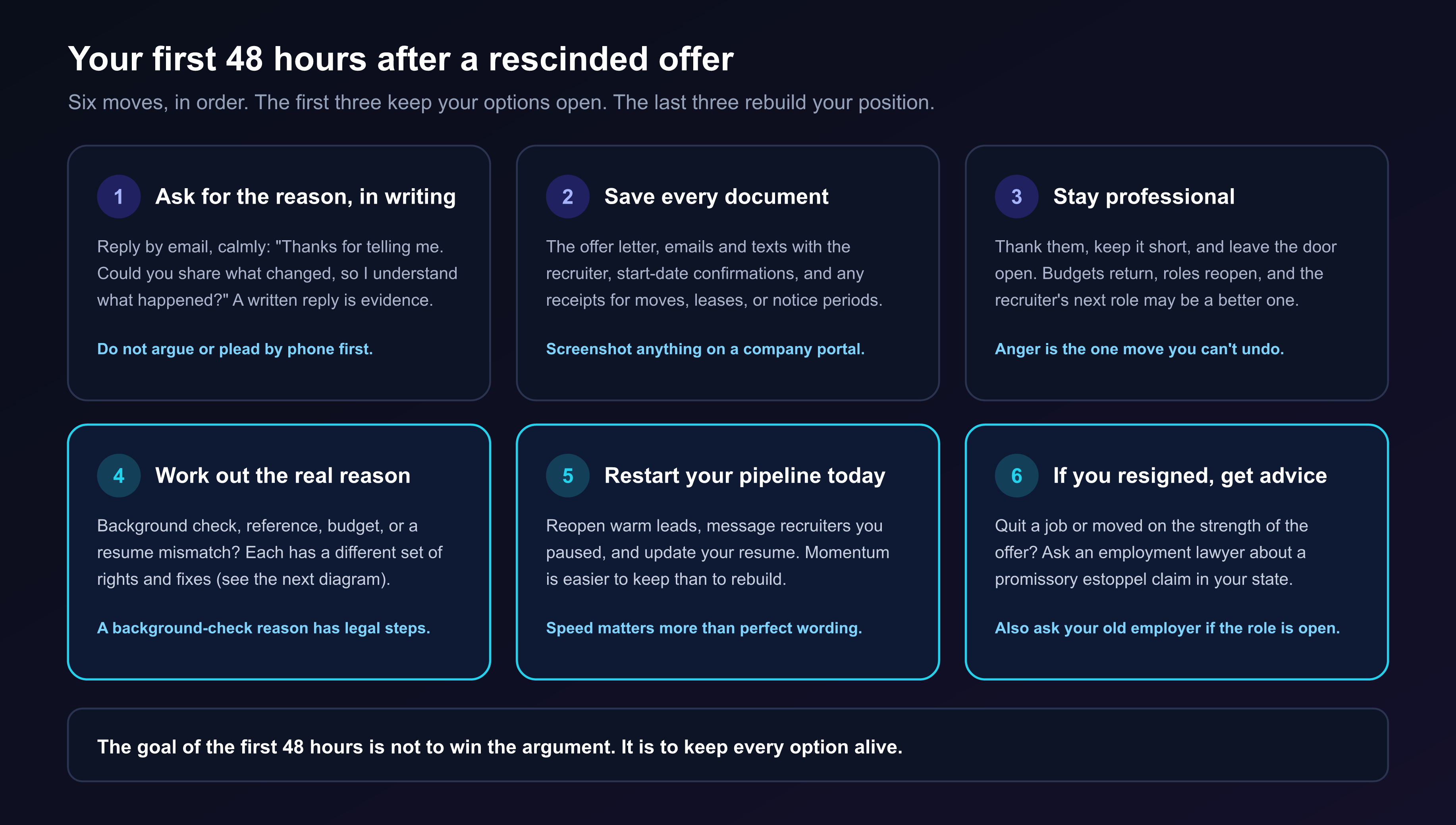
Ask for the reason, in writing
Save every document
Stay professional
Work out the real reason
Restart your pipeline today
If you resigned or relocated, get advice
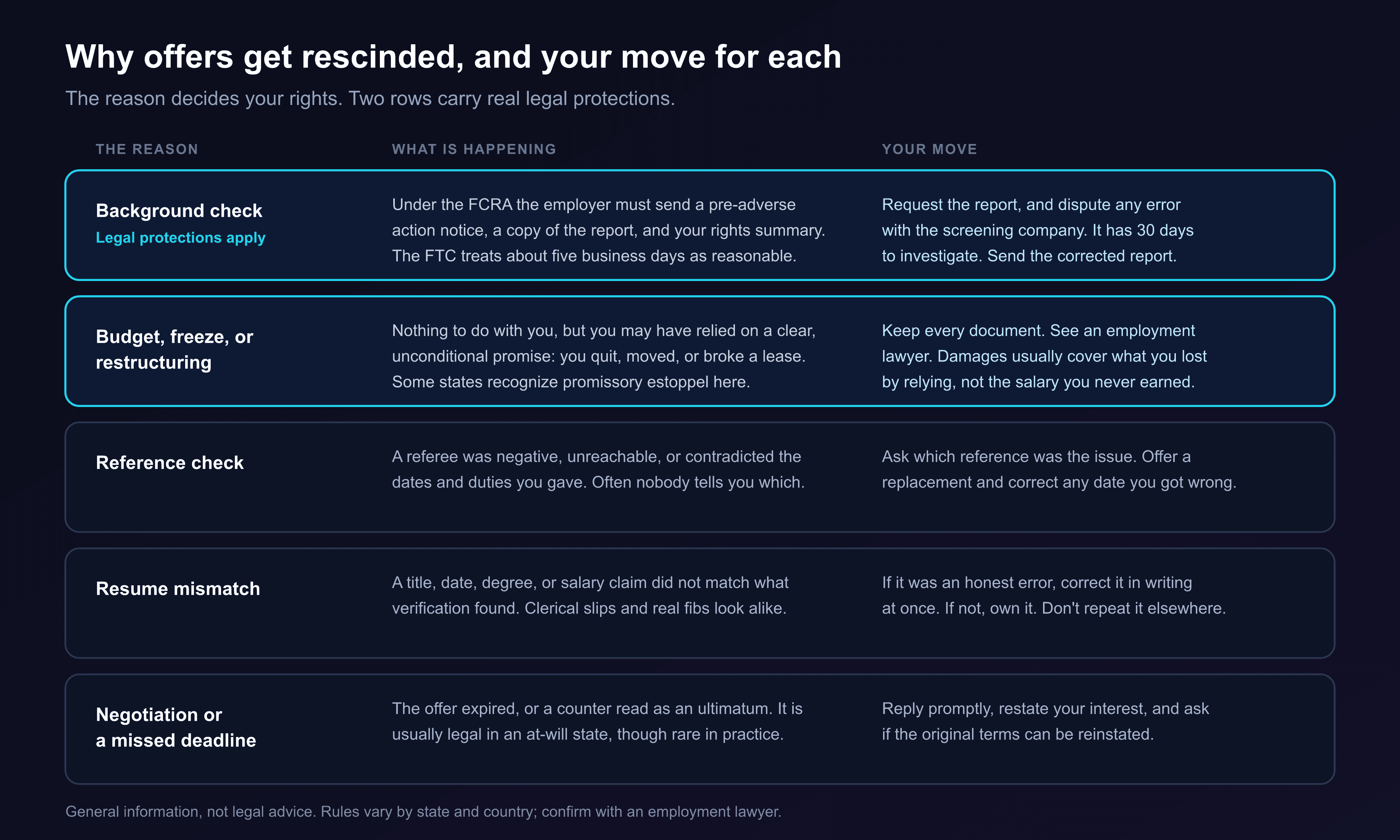
Why offers get rescinded, and your move for each
The reason determines your rights. Two of the five common ones carry real legal protections.
If it was a background check: the FCRA process
When an employer relies on a report from a screening company to withdraw an offer, US federal law requires a two-step process. First, a pre-adverse action notice: the employer must give you a copy of the report and a summary of your rights under the FCRA before making the decision final. The FTC has said that a "reasonable" wait is about five business days, and that window exists so you can catch errors, which are more common than employers expect. Second, if they proceed, a final adverse action notice that identifies the screening company and tells you that you can dispute the report and request a free copy.
If you find an error, dispute it with the screening company, which generally has 30 days to investigate, and send the corrected report to the employer immediately, asking them to reconsider. Some states and cities add "fair chance" rules requiring an individualized assessment of criminal history. If you never received a pre-adverse notice, that is worth raising with a lawyer. To understand what turns up and how long it takes, see our guides on how long a background check takes and job references.
Can you get paid? Promissory estoppel, explained plainly
If you quit a job or moved because of an offer that was then withdrawn, the doctrine to know about is promissory estoppel. In simple terms it asks: did the employer make a clear and unconditional promise of a job, did you reasonably rely on it, and were you harmed when it was pulled? If so, a court in a state that recognizes the doctrine may award damages. Three realities keep expectations honest:
- Damages usually cover reliance, not the dream salary. Typical recoveries are the pay you lost from the job you left and documented out-of-pocket costs like moving expenses or a broken lease. Courts generally do not award the higher salary you expected to earn at the new job.
- Reasonableness matters.If the offer was clearly contingent on a background check that hadn't cleared, a court may find that resigning early was not reasonable reliance. That is why the checklist below matters so much.
- Paper helps. An offer letter with the basic terms and a start date is generally enough evidence of the promise. Verbal assurances are much harder to prove.
If you resigned or relocated, move fast
What to say: three short emails
Asking for the reason."Thank you for letting me know. I'm disappointed, but I appreciate the update. Could you share what changed, so I understand what happened and can address it if it's something on my side?"
Disputing a background-check finding."I received notice that the offer may be withdrawn based on the report from [company]. I've identified an error and have filed a dispute; a corrected report will follow. Could you hold the decision open until it's resolved?"
Leaving the door open."I understand, and I appreciate your time. I remain interested in the team, so please keep me in mind if the role or a similar one reopens."
How to explain it in your next interview
Keep it short, factual, and free of blame. "I accepted a role that was eliminated before my start date, so I'm looking for my next opportunity" is honest and doesn't invite follow-up. Don't list the offer as a job on your resume, because you never worked there. If you left a role because of it and now have a gap, our guides to explaining your reason for leaving and employment gaps cover how to present it confidently. Hiring managers tend to react to how you talk about a setback more than to the setback itself.
The prevention checklist: don't give notice until all six are ticked
The best fix is not needing one. An accepted offer is not the finish line, and resigning is the one step you can't take back. Before you hand in notice, confirm all six.
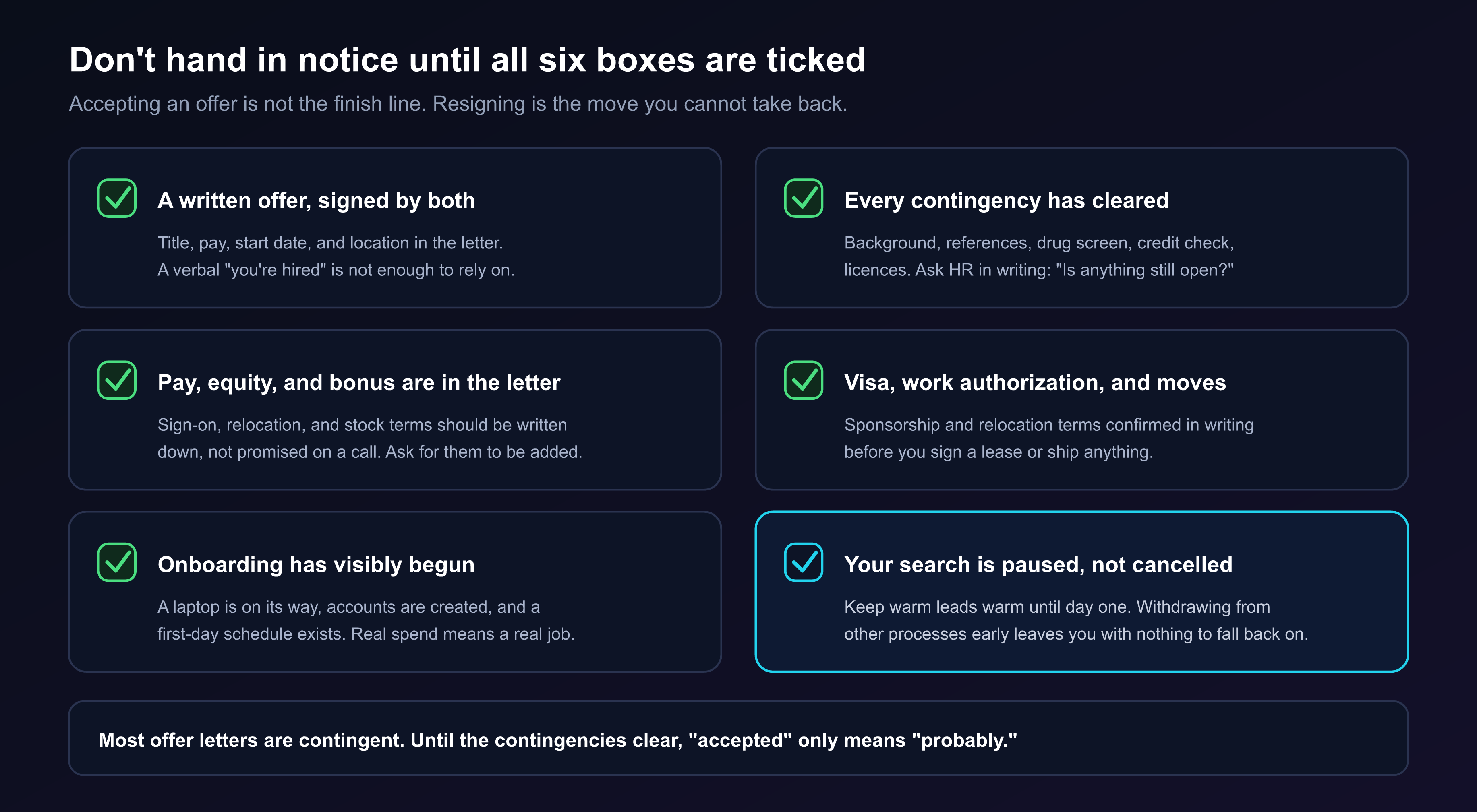
- A written offer, signed by both sides. See our offer letter guide for what should be in it.
- Every contingency has cleared.Ask HR in writing: "Is anything still open before my start date?"
- Pay, equity, and bonus are in the letter. Not promised on a call.
- Visa, work authorization, and relocation terms are confirmed in writing before you sign a lease or ship anything.
- Onboarding has visibly begun. Hardware is on its way, accounts exist, a first-day schedule exists.
- Your search is paused, not cancelled. Keep warm leads warm until day one. If you have more than one offer, our guide to handling multiple job offers explains how to buy time gracefully, and the guide to writing a resignation letter and notice periods covers the timing itself.
Rebuilding your pipeline after a setback? Start with the roles that match you best
Paste your resume and any job posting into Rankid to get a free 0-100 match score and the exact requirements you meet or miss, so you spend this week applying where you are strongest. No signup required.
Check your match score freeFor employers: how to rescind an offer without creating a lawsuit
Sometimes an offer has to be withdrawn: a failed check, a real budget change, a lie discovered. How you do it decides whether it stays a business decision or becomes a legal and reputational problem.
- Decide fast. Every extra day lets the candidate rely further and raises the harm.
- Confirm the reason is lawful and consistent. Would you make the same decision for a different candidate in the same position? If not, stop and get advice.
- Follow the FCRA steps exactly if the decision rests on a screening report: pre-adverse notice with the report and rights summary, a reasonable wait, then a final notice. Cutting this short is one of the most common and avoidable compliance failures.
- Tell them personally, then in writing. A call or video meeting followed by a short email is more respectful and creates a clear record.
- Be honest and brief about why. Vague or shifting explanations invite suspicion.
- Consider covering documented reliance costs. Reimbursing moving expenses or a notice period is often far cheaper than a dispute, and it protects your employer brand. For candidates who have already resigned, involve counsel before you send anything.
Prevention helps employers too: run background and reference checks before the offer becomes final, or make the contingency explicit and keep the candidate informed, so that no one resigns on a promise you can't yet keep. Our guides to the hiring process and candidate experience show how to sequence these steps so surprises stay rare. And if a candidate stops responding rather than the reverse, see our guide to interview ghosting.
Reduce late-stage surprises by screening consistently from the start
A disciplined first screen reduces the chance that a mismatch surfaces at the offer stage. Upload your resumes and job description to Rankid for a 0-100 match score per candidate and a clear list of matched and missing requirements. First 5 resumes free, no signup.
Try bulk screening freeFrequently asked questions
Can an employer legally rescind a job offer after I accept it?
In most US states, yes. Employment is at-will, which means an employer can generally withdraw an offer, even an accepted one, for any lawful reason before you start. What they cannot do is rescind it for an unlawful reason such as your race, religion, sex, national origin, age, disability, or pregnancy, or in retaliation for asserting a legal right. Withdrawing an offer can also expose the employer to a claim if you reasonably relied on it, for example by resigning or relocating. Rules vary by state and country, so treat this as general information rather than legal advice.
How common are rescinded job offers?
There is no official national statistic. One widely cited figure comes from a 2023 Victoria University survey of 1,007 people, in which 26 percent said an offer had been rescinded in the past year, with 31 percent in the United States and 19 percent in the United Kingdom. Because it is a self-reported survey and not a random sample, treat it as directional rather than a precise rate. It does suggest rescinded offers are common enough that you should protect yourself before you resign.
What are the most common reasons an offer gets rescinded?
The usual reasons are a failed or problematic background check, a negative or unreachable reference, a business change such as a budget cut, hiring freeze, or restructuring, a discrepancy between what a resume says and what verification found, and occasionally a missed acceptance deadline or a negotiation that went badly. In the 2023 survey, 44 percent of people said they were given no reason at all, which is why asking for one in writing is the first thing to do.
What should I do first when my offer is rescinded?
Reply in writing, calmly, and ask what changed. Save every document related to the offer. Stay professional, since roles and budgets reopen. Work out the real reason, because a background-check reason has legal steps and a budget reason may support a reliance claim. Restart your job search the same day. And if you resigned or relocated because of the offer, speak with an employment lawyer about your options. The goal of the first 48 hours is to keep every option alive.
What is promissory estoppel and does it apply to my situation?
Promissory estoppel is a legal doctrine that can make a promise enforceable when someone reasonably relied on it to their detriment. In a job-offer context, you may have a claim if the employer made a clear and unconditional promise of a job, you reasonably relied on it by, say, quitting your job or moving, and you were harmed when it was withdrawn. Courts that recognize it usually award reliance damages, such as lost pay from the job you gave up and documented moving costs, rather than the salary you expected from the new job. It is not recognized the same way in every state, and offer letters often include at-will and contingency language that weakens a claim, so get advice from an employment lawyer.
Can a company rescind an offer because of a background check?
Yes, if the offer was contingent on it, but in the United States the Fair Credit Reporting Act requires a process when the decision is based on a consumer report from a screening company. The employer must first send a pre-adverse action notice with a copy of the report and a summary of your rights, then allow a reasonable time, which the FTC has said is about five business days, before finalizing, and then send a final adverse action notice. During that window you can dispute errors with the screening company, which generally has 30 days to investigate. Some states and cities add further requirements.
Can they rescind my offer because I negotiated?
Legally, in an at-will state, an employer can withdraw an offer for almost any lawful reason, including a negotiation that felt unreasonable to them. In practice it is uncommon when the request is polite, specific, and framed as a question rather than an ultimatum. If you are worried, negotiate about the total package in a collaborative tone, ask rather than demand, and avoid deadlines you can't back up. Our guide to negotiating salary covers scripts that keep the conversation friendly.
What if the offer was rescinded after I already started giving notice or quit?
This is the highest-stakes version, and it is where legal advice is most valuable. Save the offer letter, all emails and texts, and documentation of any costs you incurred in reliance, such as moving expenses or a broken lease. Ask your former employer, professionally, whether your old role or a similar one is still open, since many will help. Contact an employment lawyer about whether a reliance claim is viable in your state. Also check with your state workforce agency about unemployment benefits, since rules vary.
Should I explain a rescinded offer in future interviews?
Only if it comes up, and keep it short and neutral. Something like "I accepted a role that was eliminated before my start date, so I'm looking for my next opportunity" is honest and doesn't blame anyone. Do not criticize the company, and do not list the offer as a job on your resume, since you never worked there. If you left a job in reliance on it, our guide to explaining your reason for leaving covers how to frame the gap clearly.
Is a verbal offer enough to rely on?
It is a weak thing to rely on. A verbal offer is harder to prove, and even a written offer letter is usually contingent on background checks, references, and other conditions. Before you resign, get the offer in writing with your title, pay, and start date, confirm that every contingency has cleared, and ask HR in writing whether anything is still open. The more your reliance is documented, the stronger your position if the offer is later withdrawn.
As an employer, how should I rescind an offer without creating legal risk?
Decide quickly, because delay increases the candidate's reliance and any resulting harm. Confirm the reason is lawful and consistent with how you treat other candidates. If it is based on a background report, follow the pre-adverse and adverse action steps exactly. Communicate by phone or video first and follow up in writing, be honest and brief about the reason, and consider reimbursing documented out-of-pocket costs the candidate incurred in reliance, such as moving expenses. Keep records of the decision, and involve counsel when the candidate has already resigned or relocated.
Can an offer be rescinded after the first day of work?
Once someone has started, ending the relationship is generally treated as a termination rather than a rescinded offer, and different rules and protections may apply. Some employers include a probationary period, which shortens neither your legal protections nor the employer's obligations under discrimination law. If you are dismissed shortly after starting, our guide to probation periods explains what that stage usually means.
Key takeaways
- In most US states an employer can legally rescind an offer, even an accepted one, for any lawful reason. Protections apply for discrimination, background-check procedure, and reliance.
- A 2023 Victoria University survey of 1,007 people found 26% had an offer rescinded in the past year (31% US, 19% UK) and 44% were given no reason. It is directional, not a national rate.
- In the first 48 hours: ask for the reason in writing, save every document, stay professional, work out the real reason, restart your search, and get advice if you resigned or relocated.
- If a background check was the reason, the FCRA requires a pre-adverse action notice with the report and your rights, a reasonable wait of about five business days, and a final notice. Dispute any errors.
- Promissory estoppel may help if you reasonably relied on a clear promise by quitting or moving. Damages usually cover reliance losses, not the salary you expected.
- Don't hand in notice until you have a signed written offer, cleared contingencies, pay terms in the letter, confirmed relocation terms, visible onboarding, and a paused (not cancelled) search.
- Keep your explanation in future interviews short and blame-free, and don't list a role you never started.
- Employers should decide fast, follow FCRA steps exactly, communicate personally and in writing, and consider covering documented reliance costs.
Frequently asked questions
Can an employer legally rescind a job offer after I accept it?
In most US states, yes. Employment is at-will, which means an employer can generally withdraw an offer, even an accepted one, for any lawful reason before you start. What they cannot do is rescind it for an unlawful reason such as your race, religion, sex, national origin, age, disability, or pregnancy, or in retaliation for asserting a legal right. Withdrawing an offer can also expose the employer to a claim if you reasonably relied on it, for example by resigning or relocating. Rules vary by state and country, so treat this as general information rather than legal advice.
How common are rescinded job offers?
There is no official national statistic. One widely cited figure comes from a 2023 Victoria University survey of 1,007 people, in which 26 percent said an offer had been rescinded in the past year, with 31 percent in the United States and 19 percent in the United Kingdom. Because it is a self-reported survey and not a random sample, treat it as directional rather than a precise rate. It does suggest rescinded offers are common enough that you should protect yourself before you resign.
What are the most common reasons an offer gets rescinded?
The usual reasons are a failed or problematic background check, a negative or unreachable reference, a business change such as a budget cut, hiring freeze, or restructuring, a discrepancy between what a resume says and what verification found, and occasionally a missed acceptance deadline or a negotiation that went badly. In the 2023 survey, 44 percent of people said they were given no reason at all, which is why asking for one in writing is the first thing to do.
What should I do first when my offer is rescinded?
Reply in writing, calmly, and ask what changed. Save every document related to the offer. Stay professional, since roles and budgets reopen. Work out the real reason, because a background-check reason has legal steps and a budget reason may support a reliance claim. Restart your job search the same day. And if you resigned or relocated because of the offer, speak with an employment lawyer about your options. The goal of the first 48 hours is to keep every option alive.
What is promissory estoppel and does it apply to my situation?
Promissory estoppel is a legal doctrine that can make a promise enforceable when someone reasonably relied on it to their detriment. In a job-offer context, you may have a claim if the employer made a clear and unconditional promise of a job, you reasonably relied on it by, say, quitting your job or moving, and you were harmed when it was withdrawn. Courts that recognize it usually award reliance damages, such as lost pay from the job you gave up and documented moving costs, rather than the salary you expected from the new job. It is not recognized the same way in every state, and offer letters often include at-will and contingency language that weakens a claim, so get advice from an employment lawyer.
Can a company rescind an offer because of a background check?
Yes, if the offer was contingent on it, but in the United States the Fair Credit Reporting Act requires a process when the decision is based on a consumer report from a screening company. The employer must first send a pre-adverse action notice with a copy of the report and a summary of your rights, then allow a reasonable time, which the FTC has said is about five business days, before finalizing, and then send a final adverse action notice. During that window you can dispute errors with the screening company, which generally has 30 days to investigate. Some states and cities add further requirements.
Can they rescind my offer because I negotiated?
Legally, in an at-will state, an employer can withdraw an offer for almost any lawful reason, including a negotiation that felt unreasonable to them. In practice it is uncommon when the request is polite, specific, and framed as a question rather than an ultimatum. If you are worried, negotiate about the total package in a collaborative tone, ask rather than demand, and avoid deadlines you can't back up. Our guide to negotiating salary covers scripts that keep the conversation friendly.
What if the offer was rescinded after I already started giving notice or quit?
This is the highest-stakes version, and it is where legal advice is most valuable. Save the offer letter, all emails and texts, and documentation of any costs you incurred in reliance, such as moving expenses or a broken lease. Ask your former employer, professionally, whether your old role or a similar one is still open, since many will help. Contact an employment lawyer about whether a reliance claim is viable in your state. Also check with your state workforce agency about unemployment benefits, since rules vary.
Should I explain a rescinded offer in future interviews?
Only if it comes up, and keep it short and neutral. Something like "I accepted a role that was eliminated before my start date, so I'm looking for my next opportunity" is honest and doesn't blame anyone. Do not criticize the company, and do not list the offer as a job on your resume, since you never worked there. If you left a job in reliance on it, our guide to explaining your reason for leaving covers how to frame the gap clearly.
Is a verbal offer enough to rely on?
It is a weak thing to rely on. A verbal offer is harder to prove, and even a written offer letter is usually contingent on background checks, references, and other conditions. Before you resign, get the offer in writing with your title, pay, and start date, confirm that every contingency has cleared, and ask HR in writing whether anything is still open. The more your reliance is documented, the stronger your position if the offer is later withdrawn.
As an employer, how should I rescind an offer without creating legal risk?
Decide quickly, because delay increases the candidate's reliance and any resulting harm. Confirm the reason is lawful and consistent with how you treat other candidates. If it is based on a background report, follow the pre-adverse and adverse action steps exactly. Communicate by phone or video first and follow up in writing, be honest and brief about the reason, and consider reimbursing documented out-of-pocket costs the candidate incurred in reliance, such as moving expenses. Keep records of the decision, and involve counsel when the candidate has already resigned or relocated.
Can an offer be rescinded after the first day of work?
Once someone has started, ending the relationship is generally treated as a termination rather than a rescinded offer, and different rules and protections may apply. Some employers include a probationary period, which shortens neither your legal protections nor the employer's obligations under discrimination law. If you are dismissed shortly after starting, our guide to probation periods explains what that stage usually means.