Job Title Inflation: What It Is, Why It's Spreading, and How to Tell If Your Title Is Inflated
A front desk clerk is listed as "Director of First Impressions." A 26-year-old at a bank is a Vice President, alongside several thousand colleagues. A startup's only marketer is Head of Marketing. None of these people is lying about their job. Their employers chose the titles. This is job title inflation, and it has a cost that usually arrives later, when you apply for your next role.
Quick answer
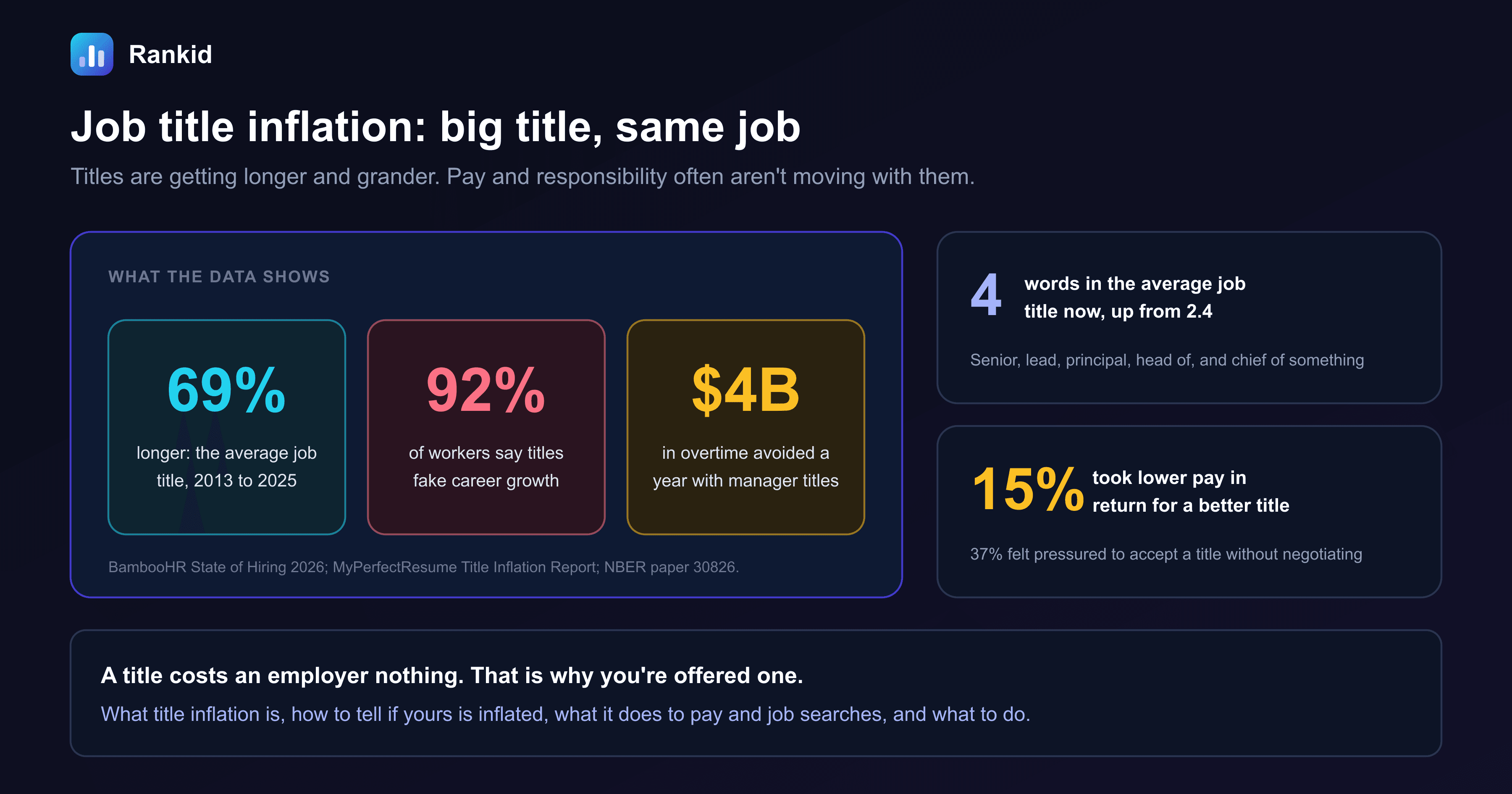
Quick answer: job title inflation is giving a job a bigger title than its pay, duties and authority justify. Employers do it because titles are free. The average job title is 69% longer than in 2013, and 92%of workers in one survey said companies use titles to create the appearance of career growth. An inflated title can make you look overqualified for jobs you could do and underqualified for jobs at the title's level. Keep the official title on your resume and state your real scope next to it.
What is job title inflation?
Job title inflation is a gap between what a job is called and what it involves. The title moves up a level or two. The pay, the responsibilities and the authority stay where they were.
Common examples:
- Vice President with no direct reports and no budget.
- Head of a function that has one person in it.
- Senior or Lead added after a year, with the same work and the same pay.
- Manager for someone who manages a process, not people.
- Chief of something, at a company of twelve.
Not every big title is inflated. A Head of Marketing who owns the strategy, the budget and the hiring plan has the job the title describes, even as a team of one. The test is whether the scope is there.
How common is it?
- Titles are getting longer.BambooHR's State of Hiring 2026 found the average job title grew from 2.4 words in 2013 to 4 words in 2025, an increase of 69%. The extra words are mostly level markers.
- Workers have noticed.In MyPerfectResume's Title Inflation Report, a survey of 1,000 US workers, 92% said companies use job titles to give the appearance of career growth, and 66% said impressive titles are being handed out more often without a change in pay or duties.
- Many have one. In the same survey, 39% had received a more senior title without a raise, and 38% had held a title that overstated their role.
- Some paid for it. 15% had accepted a lower salary for a better-sounding title, and 37% had felt pressured to accept a title without negotiating pay.
The three kinds of title inflation
The term covers three different practices. They have different motives and different costs.
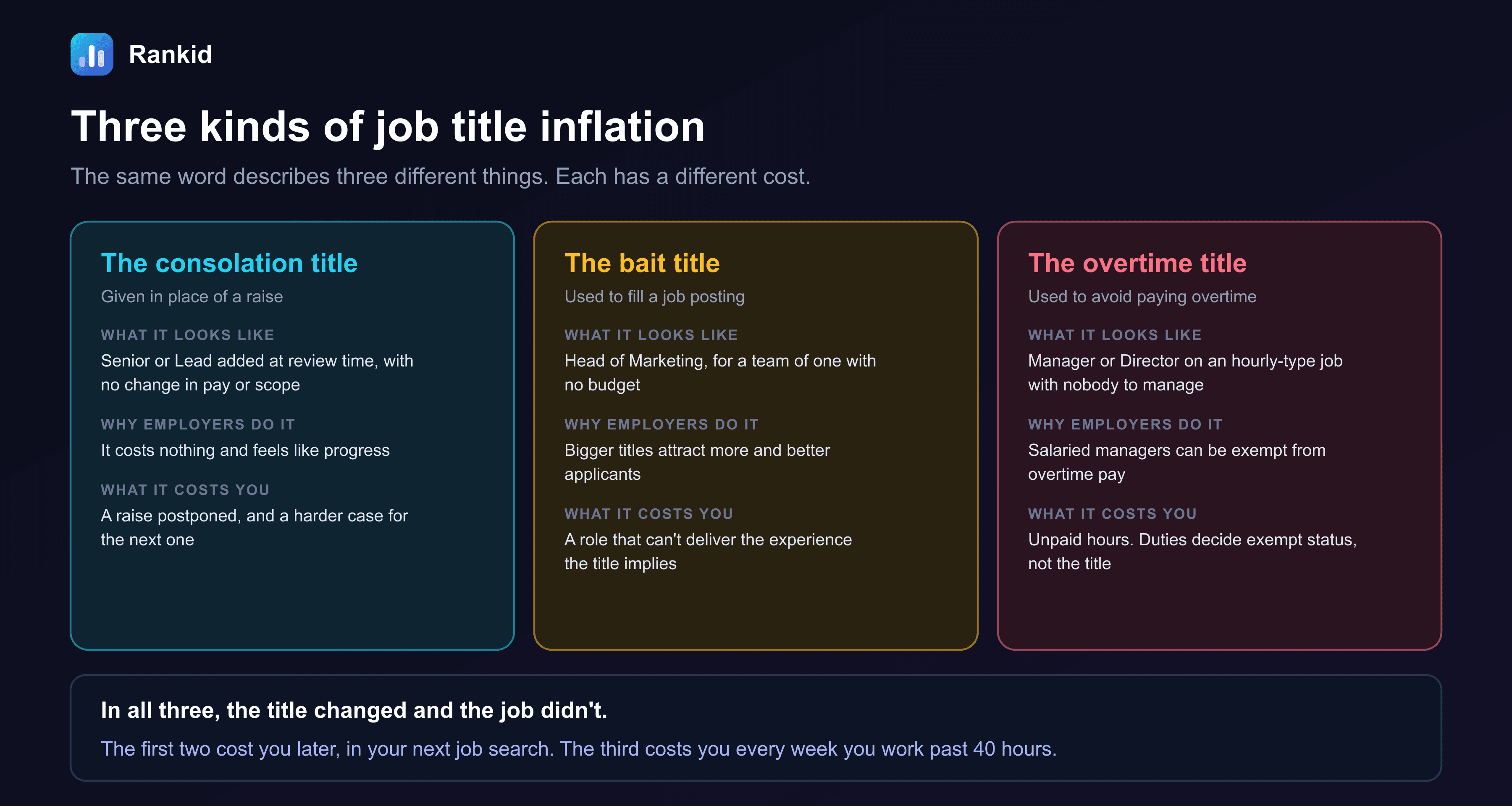
- The consolation title.Given at review time when there's no budget for a raise. Where new duties come with it, it is a dry promotion.
- The bait title. Written into a posting to attract stronger applicants than the role or salary would. You find out the real scope after you start.
- The overtime title.A manager title put on a job that isn't management, so the employer can treat it as exempt from overtime.
The overtime title: when inflation costs you wages
This is the least known kind and the only one with a direct effect on your pay packet.
Under US federal law, most employees are owed overtime for hours over 40 a week. Salaried employees can be exempt if they earn above a set threshold and do executive, administrative or professional work. A 2023 study from the National Bureau of Economic Research, "Too Many Managers: The Strategic Use of Titles to Avoid Overtime Payments," looked at what employers do around that threshold. It found:
- Postings for salaried jobs with managerial titles rose almost fivefold just above the threshold, which was $455 a week during the period studied.
- The titles included "Director of First Impressions" for front desk work.
- The overtime avoided was worth about 13.5% of salary for each such position.
- In total, about $4 billion in overtime went unpaid in 2019 alone.
The federal threshold is now $684 a week, or $35,568 a year, and some states set a higher one. The legal point is the same at any level: a title doesn't make a job exempt. Your actual duties do. If you are called a manager, earn close to the threshold, manage nobody and regularly work past 40 hours without overtime, your classification is worth checking. See exempt vs non-exempt employees. This is general information, not legal advice.
Why an inflated title can hurt you
A bigger title feels like a gain. These are the ways it works against you:
- It replaces the raise.In the MyPerfectResume survey, 91% of workers believed employers change titles to avoid pay increases. Once you've been "promoted," the next pay conversation is easier to defer. See how to ask for a raise.
- It confuses recruiters. 41% said a title had made them look overqualified or underqualified. Recruiters search by title, so an inflated one puts you in the wrong results.
- It raises the bar in interviews. A director is asked about team size, budget and strategy. If you had none of them, the interview goes badly for reasons unrelated to your ability.
- It prices you out. Employers hiring at your real level may assume a Vice President will want more money than they have.
- It can leave you stuck.34% said they feel "title trapped": the title is already as high as the company goes, so there is nothing left to be promoted into.
- It hides pay differences. 57% said coworkers with the same title were paid differently. Loose titles make that hard to challenge. See pay compression.
Is your title inflated? Four checks
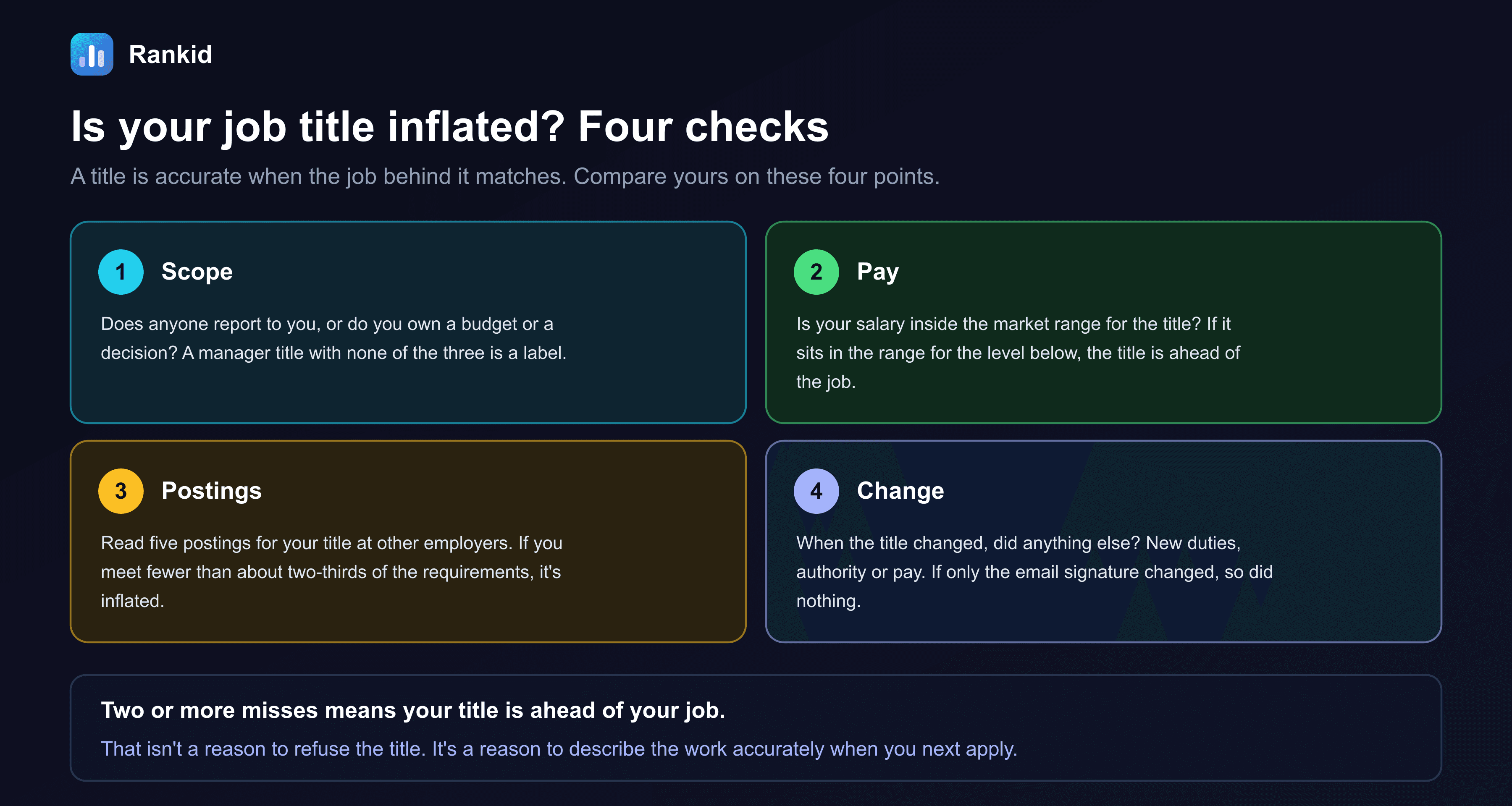
Scope
Pay
Postings
Change
Two or more misses means your title is ahead of your job. That isn't a reason to hand it back. It tells you how to present yourself next time you apply.
The opposite problem: title deflation
How to handle an inflated title on your resume
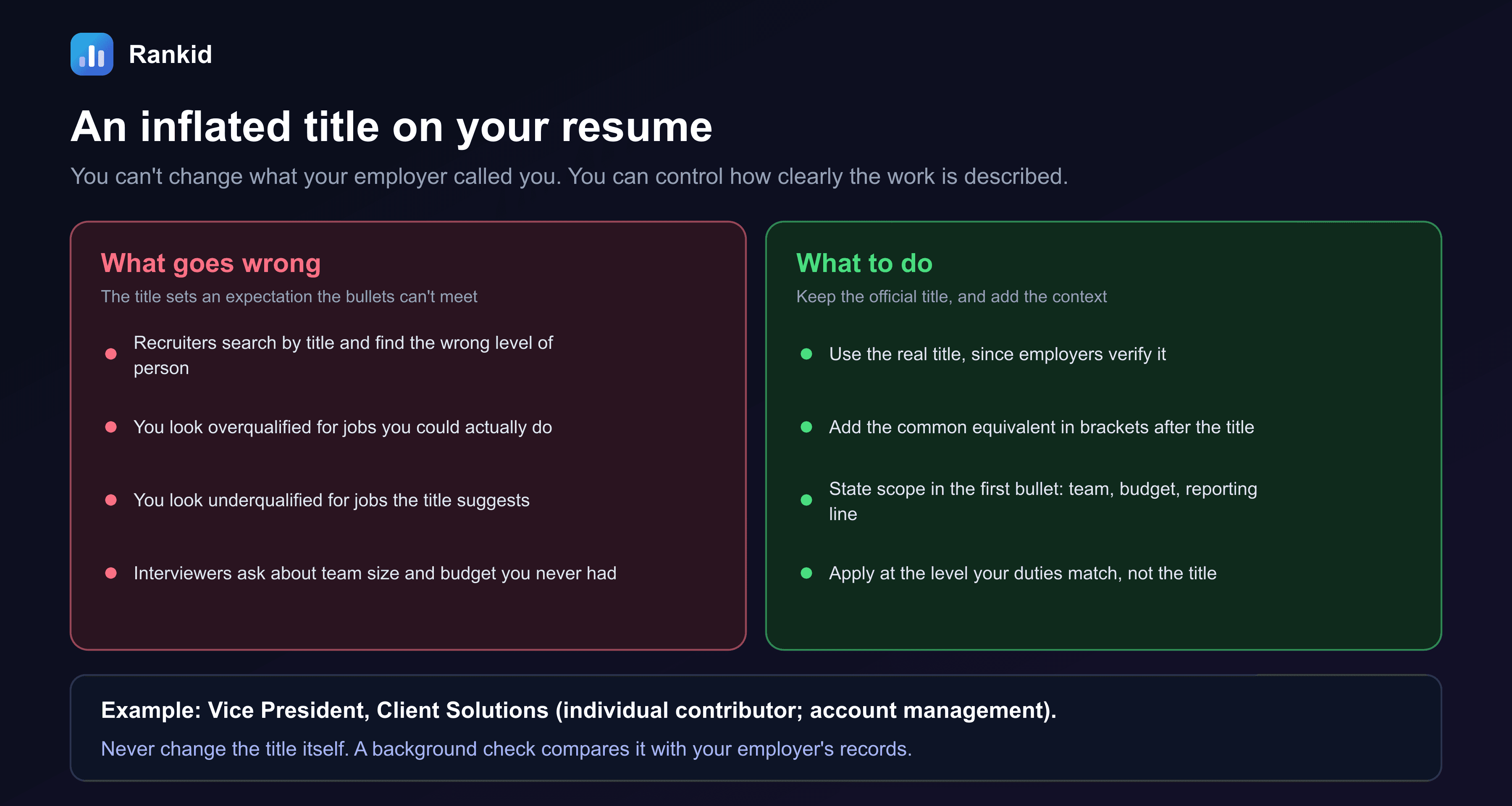
- Keep the official title.Employers confirm titles and dates with your previous employer. A title that doesn't match their records looks like a false claim, even if yours is the more honest description. See background checks.
- Add the equivalent in brackets. For example: Vice President, Client Solutions (individual contributor; account management). This is clarification, not alteration.
- Put scope in the first bullet. Team size, budget, who you reported to, how many accounts or users. One line answers the question the title raises.
- Use the target job's terms in the bullets. Screening software and recruiters match on skills and duties as well as titles. See resume keywords.
- Apply at your real level. Aim for roles your duties match. Your summary can say so directly. See resume summaries.
Does your resume match the job, or just the title?
Paste your resume and a posting at the level you're aiming for. Rankid gives you a free 0-100 match score and shows the exact requirements you meet and miss, so you can see which level your experience supports. No signup required.
Check your match score freeIf you're offered a title instead of a raise
You don't have to refuse it. Ask what comes with it.
- "What changes in my responsibilities and decision-making?" If nothing, you know what kind of title it is.
- "What is the pay range for this title here?"If you're below it, ask what the plan is to bring you into it.
- "When will my pay be reviewed against the new title?" Get a date, in writing.
- "Does this change my overtime status?"Ask this if you're moving from hourly to salaried.
The same applies to a job offer. A larger title is worth something for your next move only if the scope is real, and it never makes up for a salary below the market rate. See how to negotiate salary.
For employers: what inflated titles cost you
Free titles have a bill attached. It arrives as mismatched hires, pay disputes and legal exposure.
- Define levels before titles. Write down what each level requires in scope, decisions and experience. Then attach titles to levels, not to individuals.
- Tie every title to a pay range. If a title has no range, it will be used in place of one. See salary bands and compa-ratio.
- Write postings for the real job. An inflated title brings applicants who expect a bigger role, and they leave when they find out. See how to write a job description.
- Classify by duties.A manager title doesn't make a role exempt from overtime. Misclassification claims carry back pay and penalties.
- Screen past the title.Other employers' titles are inflated too. Assess what a candidate did, not what they were called. See skills-based hiring.
Screen on what candidates did, not what they were called
Rankid scores every applicant against your job description on a consistent 0-100 scale and shows the exact requirements each one matched and missed, so an inflated title doesn't carry a resume further than the experience behind it. First 5 resumes free, no signup.
Try bulk screening freeFrequently asked questions
What is job title inflation?
Job title inflation is giving a job a more senior or impressive title than its pay, responsibilities and authority justify. Examples are a Vice President who manages nobody, a Head of Marketing who is the only marketer, or a Senior title added at review time with no change in pay or duties.
Why do companies inflate job titles?
Because a title costs nothing. Employers use titles in place of raises, to make a posting more attractive to applicants, to keep people from leaving, and to impress clients. Research has also found some employers use manager titles on low-paid salaried jobs to treat them as exempt from overtime pay.
How do I know if my job title is inflated?
Compare the title with the job. Check whether you have direct reports, a budget or decision-making authority; whether your pay falls in the market range for the title; whether you meet most of the requirements in postings for the same title elsewhere; and whether anything changed besides the title when you received it. Two or more misses suggest inflation.
Is an inflated job title bad for your career?
It can be. In one survey, 41% of workers said a title had made them look overqualified or underqualified to recruiters. An inflated title can price you out of roles you could do, and set you up to fail interviews for roles at the level the title suggests. It helps only if you can also show the scope behind it.
Can I change my job title on my resume?
You shouldn't replace it. Employers verify titles in background checks, and a mismatch can look like dishonesty. Keep the official title and add the common equivalent in brackets, for example 'Vice President, Client Solutions (individual contributor; account management)', then state your real scope in the first bullet.
Should I accept a better title without a raise?
Treat it as the start of a negotiation, not the result. Ask what changes in responsibilities, authority and pay, and when pay will be reviewed. If the answer is that nothing changes, the title is a label. You can accept it, but get a date for a pay review in writing.
Can a job title make me exempt from overtime?
No. In the US, whether you are exempt from overtime depends on how you are paid, how much you earn and what duties you actually perform. A manager title on a job with no real management duties does not make the role exempt. If you think you are misclassified, you can contact the Department of Labor or your state labor agency.
What is the difference between title inflation and a dry promotion?
A dry promotion gives you a higher title and more responsibility without more pay. Title inflation is broader: the title rises but the job may not change at all. It also covers titles inflated at the hiring stage and titles used to avoid overtime.
Key takeaways
- Job title inflation is giving a job a bigger title than its pay, duties and authority justify.
- The average job title grew 69% longer between 2013 and 2025, from 2.4 words to 4, according to BambooHR.
- In a MyPerfectResume survey, 92% of workers said companies use titles to create the appearance of career growth, and 15% had taken lower pay for a better title.
- There are three kinds: the consolation title in place of a raise, the bait title in a job posting, and the overtime title used to treat a job as exempt.
- A title does not make a job exempt from overtime. Duties do. One study estimated $4 billion in overtime was avoided in 2019 through manager titles.
- Check your own title against scope, pay, other employers' postings, and what changed when you received it.
- On a resume, keep the official title, add the common equivalent in brackets, and state your real scope in the first bullet.
Frequently asked questions
What is job title inflation?
Job title inflation is giving a job a more senior or impressive title than its pay, responsibilities and authority justify. Examples are a Vice President who manages nobody, a Head of Marketing who is the only marketer, or a Senior title added at review time with no change in pay or duties.
Why do companies inflate job titles?
Because a title costs nothing. Employers use titles in place of raises, to make a posting more attractive to applicants, to keep people from leaving, and to impress clients. Research has also found some employers use manager titles on low-paid salaried jobs to treat them as exempt from overtime pay.
How do I know if my job title is inflated?
Compare the title with the job. Check whether you have direct reports, a budget or decision-making authority; whether your pay falls in the market range for the title; whether you meet most of the requirements in postings for the same title elsewhere; and whether anything changed besides the title when you received it. Two or more misses suggest inflation.
Is an inflated job title bad for your career?
It can be. In one survey, 41% of workers said a title had made them look overqualified or underqualified to recruiters. An inflated title can price you out of roles you could do, and set you up to fail interviews for roles at the level the title suggests. It helps only if you can also show the scope behind it.
Can I change my job title on my resume?
You shouldn't replace it. Employers verify titles in background checks, and a mismatch can look like dishonesty. Keep the official title and add the common equivalent in brackets, for example 'Vice President, Client Solutions (individual contributor; account management)', then state your real scope in the first bullet.
Should I accept a better title without a raise?
Treat it as the start of a negotiation, not the result. Ask what changes in responsibilities, authority and pay, and when pay will be reviewed. If the answer is that nothing changes, the title is a label. You can accept it, but get a date for a pay review in writing.
Can a job title make me exempt from overtime?
No. In the US, whether you are exempt from overtime depends on how you are paid, how much you earn and what duties you actually perform. A manager title on a job with no real management duties does not make the role exempt. If you think you are misclassified, you can contact the Department of Labor or your state labor agency.
What is the difference between title inflation and a dry promotion?
A dry promotion gives you a higher title and more responsibility without more pay. Title inflation is broader: the title rises but the job may not change at all. It also covers titles inflated at the hiring stage and titles used to avoid overtime.