Overemployment: Is Working Two Remote Jobs Legal, and How Do Employers Find Out? (2026)
In July 2025, a startup founder posted a warning about an engineer he had just hired: the man was, he said, working at three or four startups at the same time. Within days, more than ten other founders replied that they had hired the same person too. It went viral as a story about one man, but it was really a story about a quiet trend. Remote work made it possible to hold two full-time jobs from one laptop, and by December 2025 more Americans were doing exactly that than at any point on record. Most of what the internet says about overemployment is wrong, though, including how common it is, what makes it illegal, and what actually gets people caught.
Quick answer
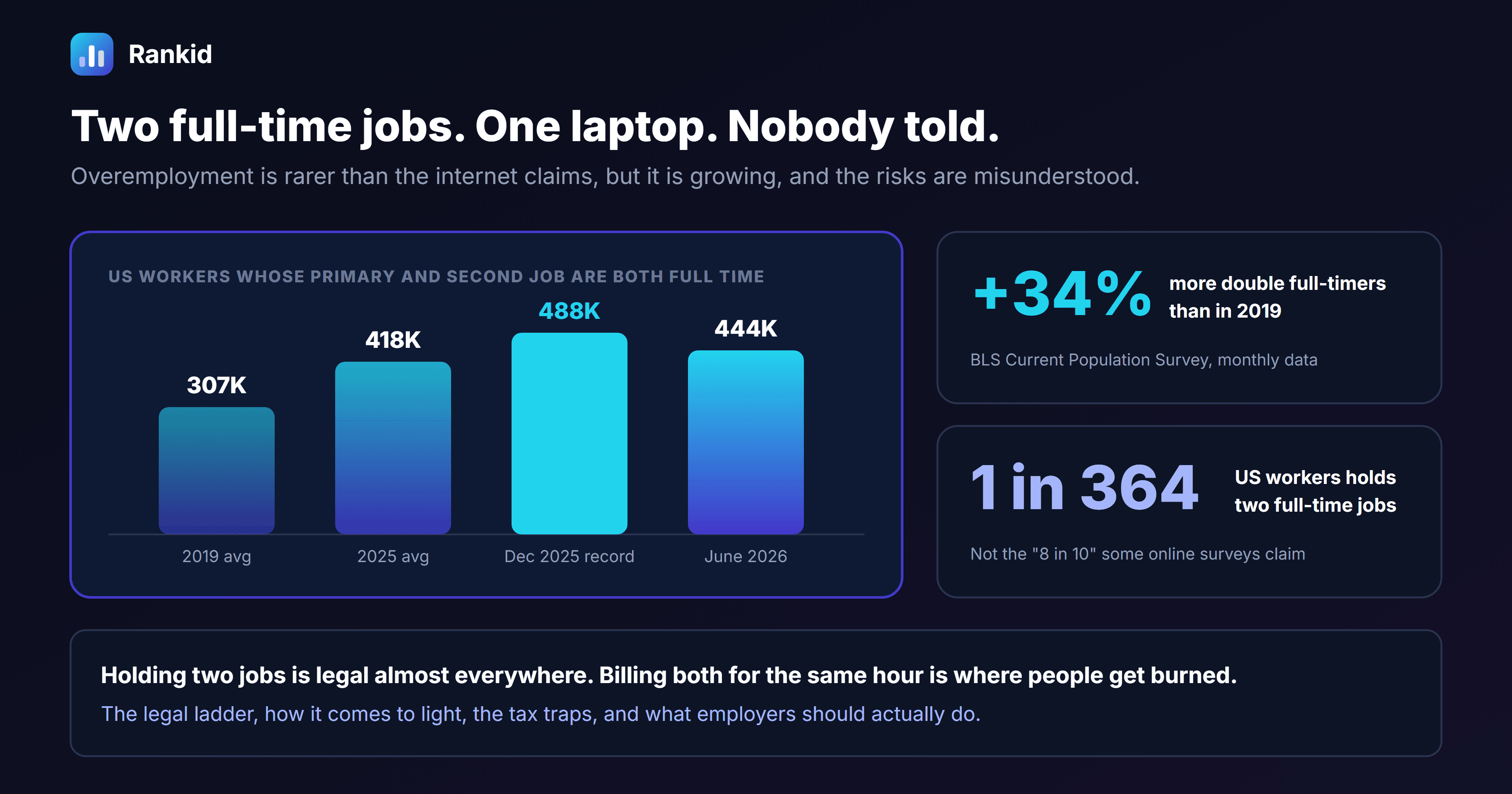
Quick answer: overemployment means holding two full-time jobs at once, usually remote and usually undisclosed. About 444,000 Americans (roughly 1 in 364 workers) held two full-time jobs in June 2026, up 34% since 2019. In the US it is generally not illegal, but it can breach an outside-employment policy (fireable), a contract clause (firing for cause, lost equity, lawsuits), or, if you bill two employers for the same hours, become fraud. It usually comes to light through declining output, calendar collisions or a background check. If you do it, disclose where required, never overlap paid hours, and fix your W-4 and 401(k) contributions.
What overemployment is (and isn't)
Overemploymentis holding two or more full-time jobs at the same time, typically remote knowledge-work roles, and typically without telling either employer. Online communities that popularised the idea in 2021 call the jobs "J1" and "J2." The pitch was simple: if a remote job only needs 25 focused hours a week, why not fill the rest with a second salary?
It's worth separating it from its neighbours. A side hustle is small and self-directed, like weekend freelancing. Moonlighting usually means a full-time job plus a part-time one. Fractional workis openly splitting your week between several clients, common for senior finance, marketing and engineering leaders. Overemployment is specifically two full-time roles, each expecting a full week, and that is exactly why it creates problems the others don't.
How common is it really? Survey hype vs payroll reality
You may have seen headlines claiming that most remote workers hold two jobs. A 2023 online survey made that claim about nearly eight in ten of its respondents. It's a self-selected sample, and the real number is far smaller.
The US Bureau of Labor Statistics tracks this directly in its Current Population Survey. The group to watch is people whose primary and second jobs are both full time. That figure averaged about 307,000 in 2019, rose to about 418,000 in 2025, hit a record of roughly 488,000 in December 2025, and stood at about 444,000 in June 2026. That's roughly 1 in 364 workers, and about 34% higher than before the pandemic. Monthly figures bounce around, so focus on the trend rather than any single month.
Broader multiple jobholding, meaning anyone with any second job, is much larger at about 8.5 million people, or around 5.3% of the employed, but that's still below its mid-1990s peak. So the accurate story is this: moonlighting isn't new, but the two-full-time-jobs version is growing fast, and it is concentrated in remote-friendly fields like software, data, design, marketing, finance and program management.
Why it's growing now
Is it legal? The four-rung risk ladder
"Is it illegal to work two jobs?" is the most searched question on this topic, and the honest answer is that the second job itself is almost never the problem. What matters is what you signed and how you spend and bill your time.
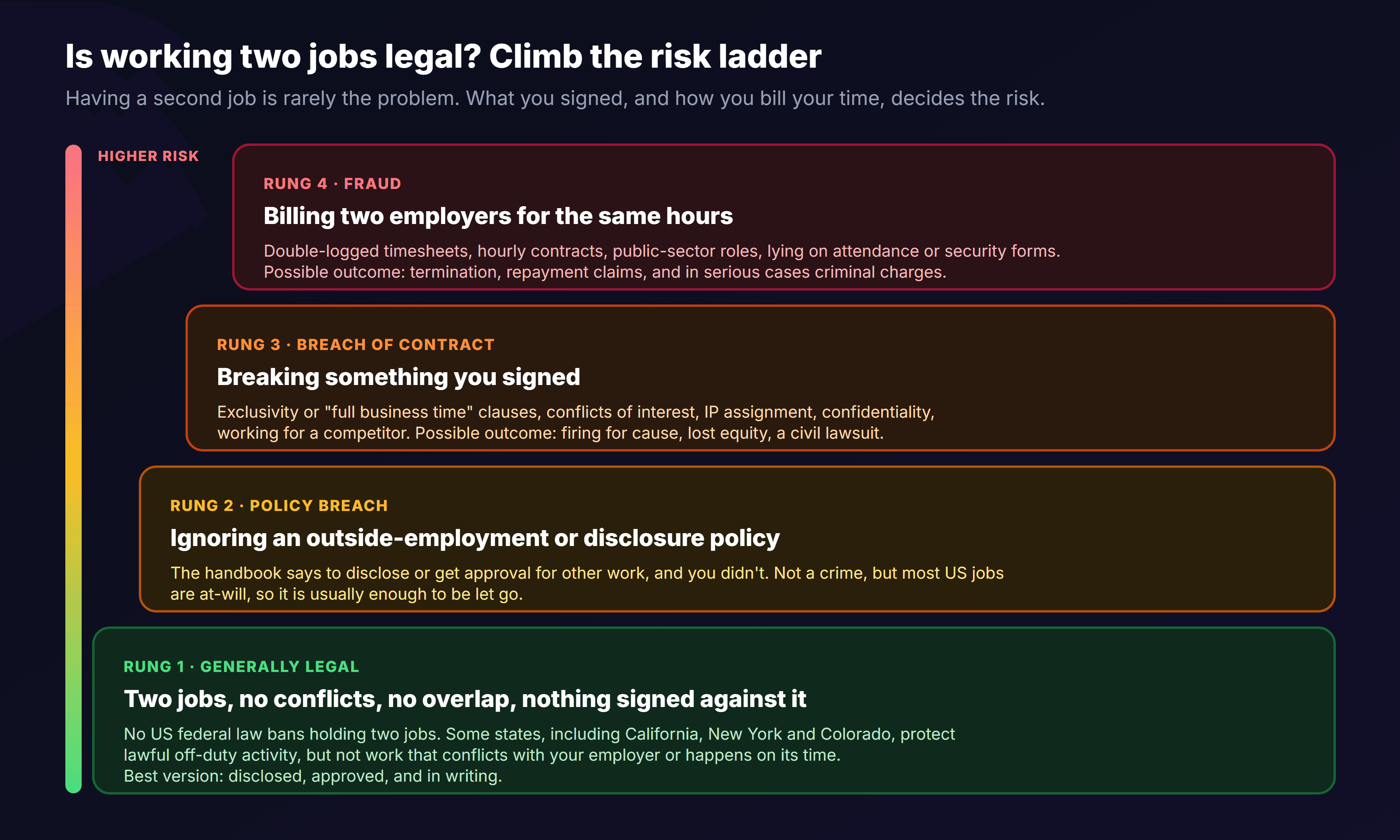
- Rung 1: generally legal.No US federal law bans holding two jobs. A few states, including California, New York and Colorado, protect lawful off-duty activities, though those protections generally don't cover work that conflicts with your employer's business or happens on its time. Outside the US, check local rules: some countries cap total weekly working hours across all employers.
- Rung 2: policy breach.Many employee handbooks require you to disclose, or get approval for, outside employment. Ignoring that isn't a crime, but most US employment is at-will, so it is usually enough to justify letting you go.
- Rung 3: breach of contract.Offer letters and employment agreements often include exclusivity or "full business time" language, conflict-of-interest rules, confidentiality terms and IP assignment clauses that may claim anything you build. Our guides to the offer letter and non-compete agreements explain what to look for. Breaking these can mean termination for cause, lost severance and unvested equity, and a civil claim.
- Rung 4: fraud.Billing two employers for the same hours, especially on hourly contracts or timesheets, misusing one employer's resources for another, or lying on official or security forms moves the risk from civil to potentially criminal. Public-sector roles are especially risky because the money is taxpayers'.
One more wrinkle: if you're a non-exempt, hourly employee, every hour is on the record, which makes overlap easy to prove. Our guide to exempt vs non-exempt status explains the difference.
How a second job usually comes to light
People imagine detection as a dramatic discovery. In practice it's usually a pattern a manager notices, followed by someone checking.
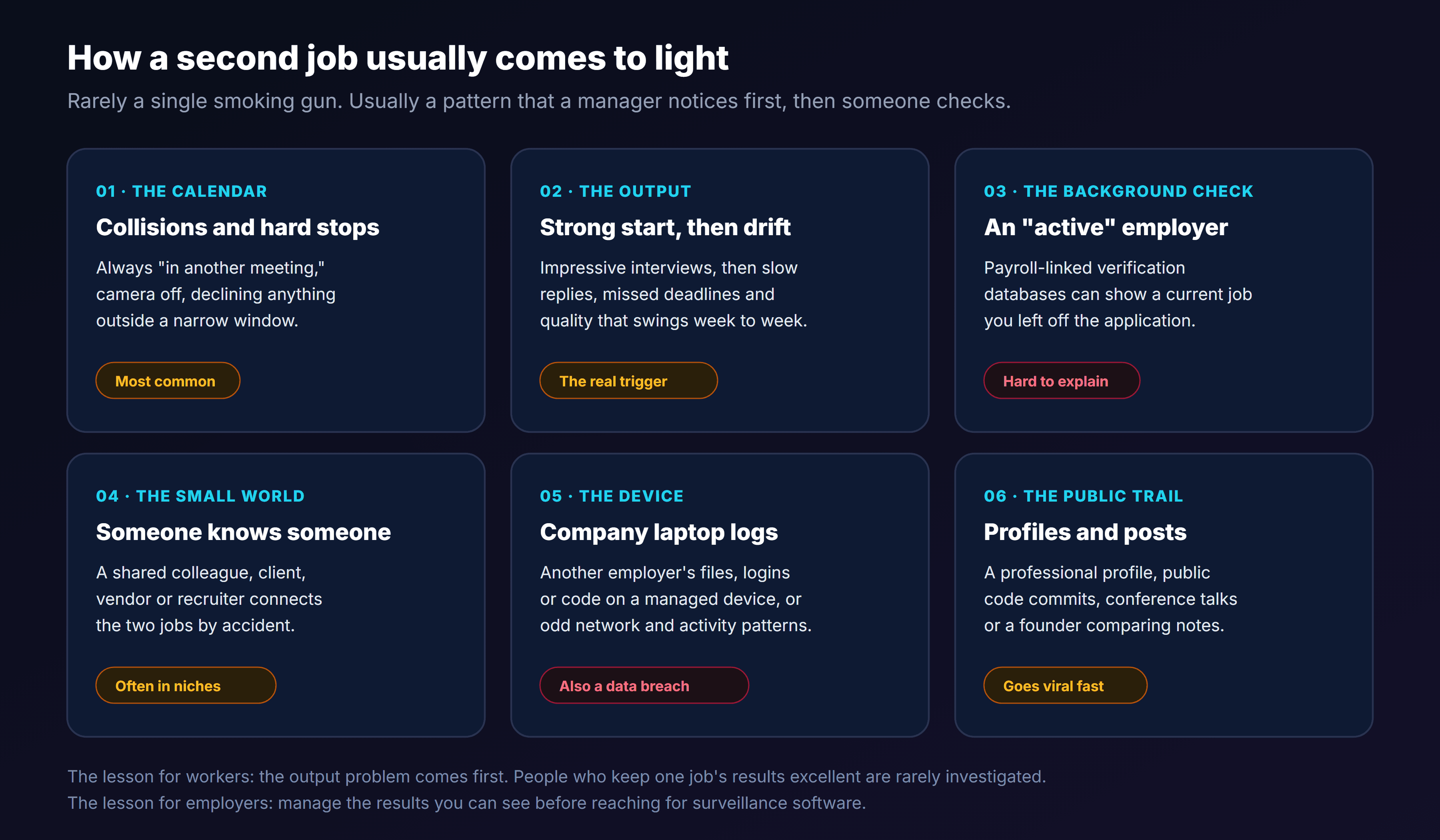
- The calendar.Constant "other meetings," cameras off, and rigid hard stops are the most common early signal.
- The output. The pattern in the viral 2025 case was typical: impressive interviews, then slow replies and uneven delivery. Declining performance is almost always what prompts anyone to look.
- The background check.Some employment verification services draw on payroll data from a large share of US employers, so a new employer's check may show a current job you didn't list. Our guide to background checks covers what shows up, and leaving a current job off an application that asks for it is its own misrepresentation.
- The small world. In niche industries, a shared colleague, client or recruiter connects the dots by accident.
- The device.Logging into another employer's systems on a company-managed laptop shows up in security logs, and it can be a data breach for both companies.
- The public trail. Professional profiles, public code, talks and, increasingly, founders comparing notes online.
The money traps nobody warns you about
Even people who manage two jobs well often trip over the paperwork. Each payroll system assumes it is your only job, and nobody adds the two together until you file your taxes.
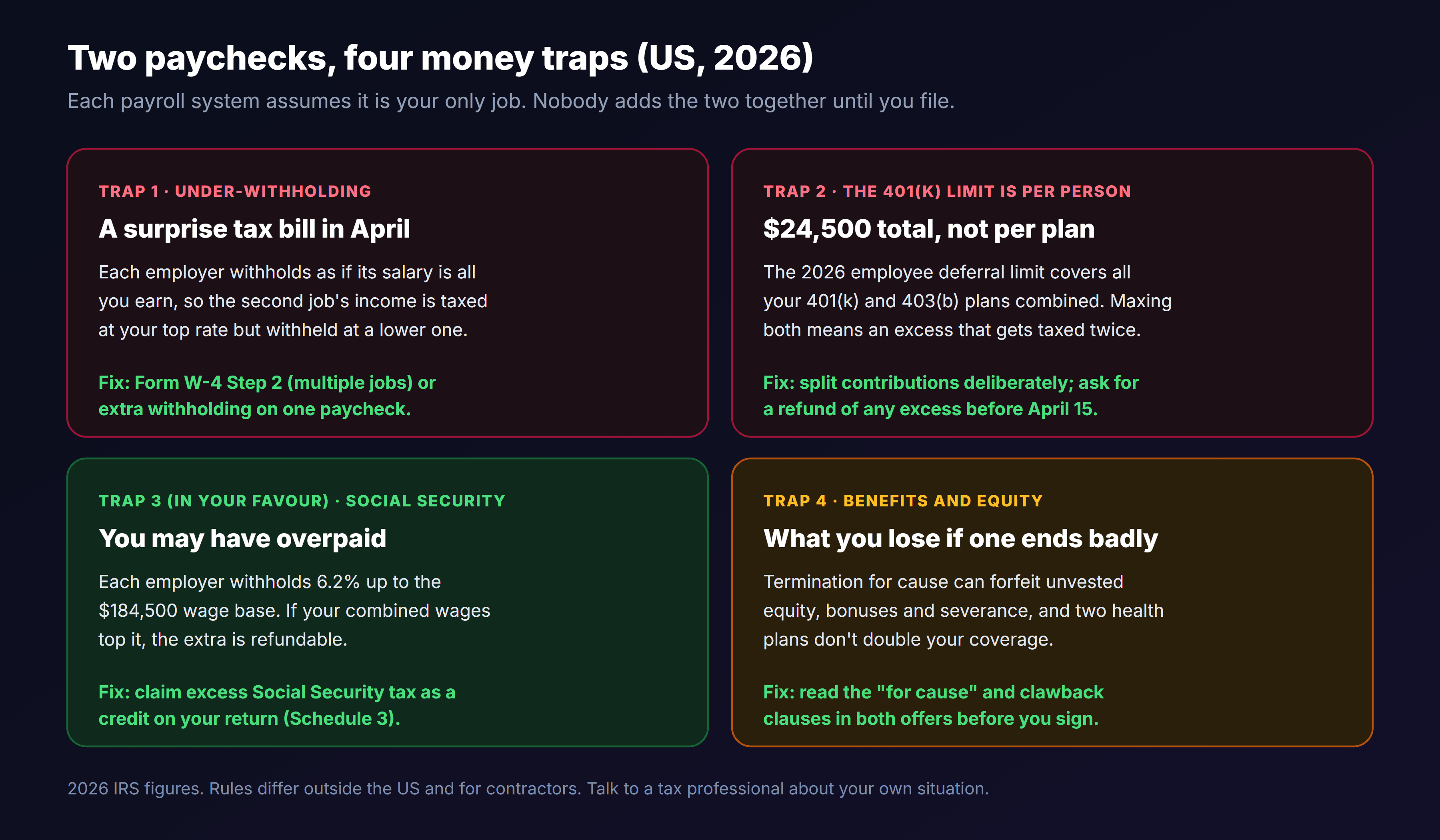
- Under-withholding. Each employer withholds income tax as if its salary were all you earn, so the combined income is often under-withheld. Use Step 2 of Form W-4 (multiple jobs) or request extra withholding from one paycheck.
- The 401(k) limit is per person. The 2026 employee deferral limit of $24,500 applies across all your 401(k) and 403(b) plans combined. Maxing out both creates an excess deferral that needs to be refunded, generally by April 15 of the following year, or it can be taxed twice.
- Social Security, in your favour. Each employer withholds 6.2% up to the 2026 wage base of $184,500. If your combined wages exceed that, you can claim the excess as a credit on your return.
- Benefits and equity.Termination for cause can forfeit unvested equity, bonuses and severance, and holding two health plans doesn't double your coverage.
If you're considering it: a pre-flight checklist
This isn't a guide to hiding a second job. It's the list of things that separate a sustainable arrangement from one that ends in a termination letter.
Read everything you signed
Rule out conflicts
Never overlap paid hours
Keep the systems separate
Answer application questions truthfully
Fix the paperwork on day one
Consider asking instead of hiding
The two-manager test
Weighing a second role? Check the fit before you apply
Paste your resume and the job posting into Rankid for a free 0-100 match score and the exact requirements you meet and miss. Whether you're considering a fractional role, a disclosed second job, or a clean move to one better job, know where you stand first. No signup required.
Check your match score freeFor employers: a fair playbook when you suspect it
The instinct is to reach for monitoring software. It's usually the wrong first move, because it erodes trust among the honest majority while the real problem, underperformance, is already visible without it.
- Write a clear policy. Say whether outside work needs disclosure or approval, what counts as a conflict, and what core availability you expect. Put it in the job description and offer letter, not only the handbook.
- Manage outcomes, not activity. Clear goals, regular one-on-ones and a 30-60-90 day plan surface problems early, whatever their cause.
- Address the work directly. If deadlines slip and availability vanishes, handle it through normal performance management, and use a performance improvement plan honestly rather than as a pretext.
- Ask, then investigate with facts. A direct, non-accusatory conversation often resolves it. If you investigate, rely on evidence, apply policy consistently, and involve HR and legal counsel before any termination.
- Tighten hiring without treating everyone as a suspect. Live interviews, structured reference checks and consistent verification catch most problems. Our guide to fake job candidates covers fair verification, and our guide to hiring remote employees covers expectations to set up front.
- Offer a legitimate path. Part-time, fractional and approved outside work bring some of this activity into the open, where it can be managed.
Hire on evidence from the first screen
Rankid scores every resume against your job description on a consistent 0-100 scale and shows the exact requirements each candidate matched and missed, so your interviews focus on verifying real skills and the right candidates reach them faster. First 5 resumes free, no signup.
Try bulk screening freeFrequently asked questions
What is overemployment?
Overemployment is holding two or more full-time jobs at the same time, usually remote knowledge-work jobs, typically without telling either employer. The term was popularised by online communities in 2021, when remote work made it possible to do two jobs from one desk. People in those communities often call the jobs J1 and J2. It is different from ordinary moonlighting, where someone holds one full-time job and a small part-time or side job.
How many people are overemployed?
Fewer than viral surveys suggest. US Bureau of Labor Statistics Current Population Survey data showed about 444,000 people whose primary and second jobs were both full time in June 2026, roughly 1 in 364 workers, after a record of about 488,000 in December 2025. That is around 34% more than in 2019. Broader multiple jobholding, which includes any second job, covers about 8.5 million people, or roughly 5.3% of the employed. Online surveys claiming most remote workers hold two jobs use self-selected samples and should be read with caution.
Is it illegal to work two full-time jobs at the same time?
In the US it is generally not illegal. No federal law bans holding two jobs, and some states, including California, New York and Colorado, protect certain lawful off-duty activity. The legal risk comes from what surrounds the second job: breaking an exclusivity, conflict-of-interest, confidentiality or IP clause you signed, violating a disclosure policy, or, most seriously, billing two employers for the same hours or lying on official forms, which can amount to fraud. Rules differ in other countries, some of which cap total working hours across all jobs.
Can I be fired for having a second job?
Yes, in most US jobs. Most employment is at-will, so an employer can usually let you go for breaking a policy on outside employment, for a conflict of interest, or for performance problems caused by the second job, even though holding it isn't a crime. If you signed an agreement requiring exclusive or full-time devotion to the role, you could be terminated for cause, which can cost you severance, bonuses or unvested equity.
How do employers find out about a second job?
Usually through a pattern rather than a single discovery: calendar collisions and constant unavailability, output that starts strong and then drifts, a pre-employment background check or payroll-linked verification database that shows a current employer you didn't list, a shared colleague or client in a small industry, activity on a company-managed device, or public profiles and posts. In most cases, declining performance is what prompts anyone to look.
Does a background check show my current job?
It can. Standard employment verification confirms the jobs you list. But some verification services draw on payroll data from very large numbers of employers, so a check may show an active employer you didn't mention. Leaving a current job off an application when the form asks for all current employment is also a misrepresentation that can justify withdrawing an offer, even if the job itself would have been fine.
What taxes do I need to think about with two W-2 jobs?
Three things. First, each employer withholds income tax as if its salary is your only income, so you are often under-withheld; use Step 2 of Form W-4 or add extra withholding. Second, the 401(k) employee deferral limit, $24,500 in 2026, applies to you as a person across all plans, so contributing the maximum at both jobs creates an excess that must be corrected. Third, each employer withholds Social Security tax up to the $184,500 wage base, so if your combined wages exceed it you can claim the excess back as a credit on your tax return.
Should I tell my employer about a second job?
If your contract or handbook requires disclosure or approval, yes, and disclosing turns a firing risk into a documented arrangement. Many employers approve outside work that doesn't compete, doesn't overlap working hours and doesn't use company resources. Put the approval in writing. If the second role would compete with your employer, create a conflict of interest, or require overlapping hours, it is safer not to take it.
Is overemployment ethical?
It depends on how it is done. Doing two jobs well, without overlapping paid hours, conflicts, or breaking agreements, is closer to having a demanding side business. Collecting two salaries while doing each job badly, double-billing hours, or hiding the arrangement in violation of what you signed shifts real costs onto colleagues and employers. A useful test: would both managers be satisfied with your results if they could see everything?
What should an employer do if they suspect an employee has a second job?
Start with the work, not the suspicion. Address missed deadlines, availability and quality directly through normal performance management, check whether your outside-employment policy is clear and communicated, and ask the person straightforwardly. Investigate only with facts, apply policy consistently, and involve HR or legal counsel before any termination. Heavy surveillance tends to damage trust among the honest majority and can raise privacy concerns.
How can employers reduce the risk of hiring someone who is overemployed?
Be explicit about expectations in the job description and offer letter, including core hours and whether outside work needs approval. Run live, interactive interviews and structured reference checks, set clear 30-60-90 day goals so performance problems surface early, and manage by visible outcomes rather than activity. Consider offering legitimate part-time or fractional arrangements, which draws some people into the open rather than underground.
Is overemployment the same as having a side hustle?
No. A side hustle is usually small, part-time and self-directed, such as freelancing on weekends or running a small business, and it rarely conflicts with a full-time job. Overemployment means two full-time roles, each expecting roughly a full working week, and that is where overlapping hours, conflicting obligations and contractual problems arise.
Key takeaways
- Overemployment means holding two full-time jobs at once, usually remote and usually undisclosed. It differs from side hustles, moonlighting and openly fractional work.
- About 444,000 Americans (roughly 1 in 364 workers) held two full-time jobs in June 2026, after a record of about 488,000 in December 2025, and up about 34% since 2019 (BLS Current Population Survey).
- Viral claims that most remote workers are overemployed come from self-selected online surveys and overstate it dramatically.
- In the US, holding two jobs is generally legal. The risk climbs from policy breach (fireable) to breach of contract (for-cause firing, lost equity, lawsuits) to fraud (billing the same hours twice).
- It usually comes to light through declining output, calendar collisions, background checks showing an unlisted employer, small-world connections, company devices, or public profiles.
- Two W-2s bring tax traps: under-withholding, a per-person $24,500 401(k) limit in 2026, and possible excess Social Security tax you can reclaim above the $184,500 wage base.
- If you're considering it, read what you signed, avoid conflicts, never overlap paid hours, keep systems separate, answer applications truthfully, and consider disclosure.
- Employers should write a clear policy, manage outcomes rather than activity, address performance directly, investigate with facts, and offer legitimate part-time or fractional paths.
Frequently asked questions
What is overemployment?
Overemployment is holding two or more full-time jobs at the same time, usually remote knowledge-work jobs, typically without telling either employer. The term was popularised by online communities in 2021, when remote work made it possible to do two jobs from one desk. People in those communities often call the jobs J1 and J2. It is different from ordinary moonlighting, where someone holds one full-time job and a small part-time or side job.
How many people are overemployed?
Fewer than viral surveys suggest. US Bureau of Labor Statistics Current Population Survey data showed about 444,000 people whose primary and second jobs were both full time in June 2026, roughly 1 in 364 workers, after a record of about 488,000 in December 2025. That is around 34% more than in 2019. Broader multiple jobholding, which includes any second job, covers about 8.5 million people, or roughly 5.3% of the employed. Online surveys claiming most remote workers hold two jobs use self-selected samples and should be read with caution.
Is it illegal to work two full-time jobs at the same time?
In the US it is generally not illegal. No federal law bans holding two jobs, and some states, including California, New York and Colorado, protect certain lawful off-duty activity. The legal risk comes from what surrounds the second job: breaking an exclusivity, conflict-of-interest, confidentiality or IP clause you signed, violating a disclosure policy, or, most seriously, billing two employers for the same hours or lying on official forms, which can amount to fraud. Rules differ in other countries, some of which cap total working hours across all jobs.
Can I be fired for having a second job?
Yes, in most US jobs. Most employment is at-will, so an employer can usually let you go for breaking a policy on outside employment, for a conflict of interest, or for performance problems caused by the second job, even though holding it isn't a crime. If you signed an agreement requiring exclusive or full-time devotion to the role, you could be terminated for cause, which can cost you severance, bonuses or unvested equity.
How do employers find out about a second job?
Usually through a pattern rather than a single discovery: calendar collisions and constant unavailability, output that starts strong and then drifts, a pre-employment background check or payroll-linked verification database that shows a current employer you didn't list, a shared colleague or client in a small industry, activity on a company-managed device, or public profiles and posts. In most cases, declining performance is what prompts anyone to look.
Does a background check show my current job?
It can. Standard employment verification confirms the jobs you list. But some verification services draw on payroll data from very large numbers of employers, so a check may show an active employer you didn't mention. Leaving a current job off an application when the form asks for all current employment is also a misrepresentation that can justify withdrawing an offer, even if the job itself would have been fine.
What taxes do I need to think about with two W-2 jobs?
Three things. First, each employer withholds income tax as if its salary is your only income, so you are often under-withheld; use Step 2 of Form W-4 or add extra withholding. Second, the 401(k) employee deferral limit, $24,500 in 2026, applies to you as a person across all plans, so contributing the maximum at both jobs creates an excess that must be corrected. Third, each employer withholds Social Security tax up to the $184,500 wage base, so if your combined wages exceed it you can claim the excess back as a credit on your tax return.
Should I tell my employer about a second job?
If your contract or handbook requires disclosure or approval, yes, and disclosing turns a firing risk into a documented arrangement. Many employers approve outside work that doesn't compete, doesn't overlap working hours and doesn't use company resources. Put the approval in writing. If the second role would compete with your employer, create a conflict of interest, or require overlapping hours, it is safer not to take it.
Is overemployment ethical?
It depends on how it is done. Doing two jobs well, without overlapping paid hours, conflicts, or breaking agreements, is closer to having a demanding side business. Collecting two salaries while doing each job badly, double-billing hours, or hiding the arrangement in violation of what you signed shifts real costs onto colleagues and employers. A useful test: would both managers be satisfied with your results if they could see everything?
What should an employer do if they suspect an employee has a second job?
Start with the work, not the suspicion. Address missed deadlines, availability and quality directly through normal performance management, check whether your outside-employment policy is clear and communicated, and ask the person straightforwardly. Investigate only with facts, apply policy consistently, and involve HR or legal counsel before any termination. Heavy surveillance tends to damage trust among the honest majority and can raise privacy concerns.
How can employers reduce the risk of hiring someone who is overemployed?
Be explicit about expectations in the job description and offer letter, including core hours and whether outside work needs approval. Run live, interactive interviews and structured reference checks, set clear 30-60-90 day goals so performance problems surface early, and manage by visible outcomes rather than activity. Consider offering legitimate part-time or fractional arrangements, which draws some people into the open rather than underground.
Is overemployment the same as having a side hustle?
No. A side hustle is usually small, part-time and self-directed, such as freelancing on weekends or running a small business, and it rarely conflicts with a full-time job. Overemployment means two full-time roles, each expecting roughly a full working week, and that is where overlapping hours, conflicting obligations and contractual problems arise.