Panel Interview: What It Is, How to Prepare, and How to Run One (2026)
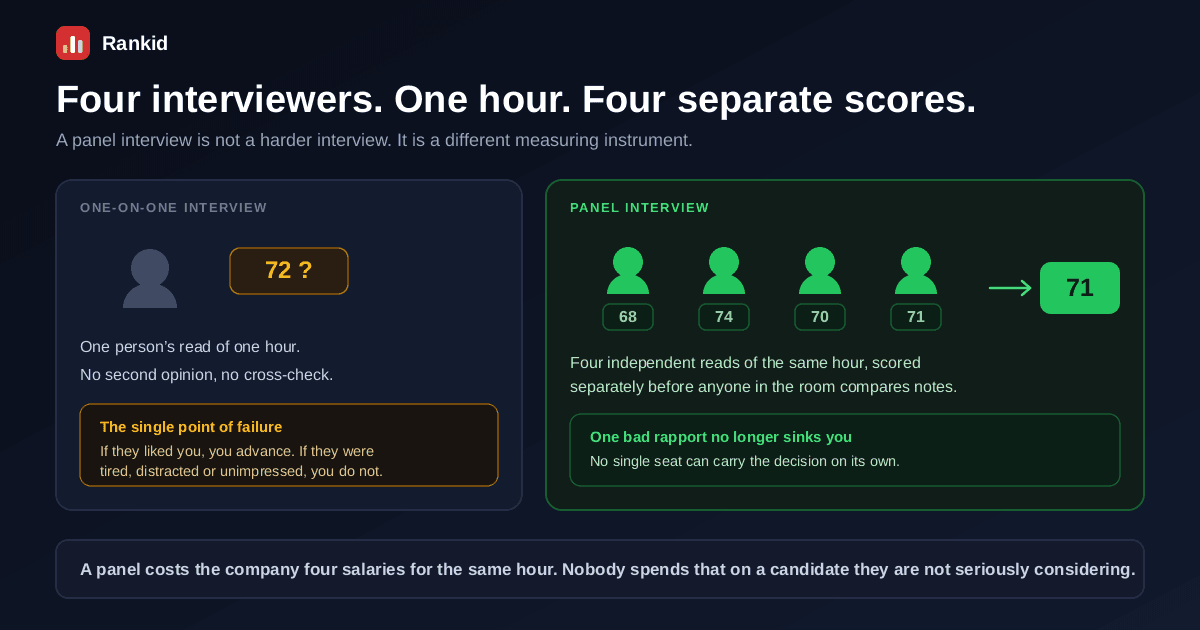
The invitation says one hour, and then lists four names. You read them twice, look up each one on LinkedIn, and arrive at the conclusion most people arrive at: this is the hard version. Four people instead of one, four chances to say the wrong thing, four sets of notes being taken while you talk. That reading is wrong, and believing it is what makes people underperform in the room. A panel interview is not a harder interview. It is a different measuring instrument, built to do something a one-on-one structurally cannot.
Quick answer
Quick answer: a panel interview is one session in which several interviewers, usually three to five, question a single candidate at the same time and score them independentlyafterwards. It exists to remove the single point of failure in a one-on-one, where one person's impression decides everything. It is different from a group interview (one interviewer, many candidates) and from a sequential loop (one interviewer at a time). Being invited to one is usually a good sign, because it costs the company several salaries for the same hour.
What is a panel interview?
A panel interview is a single interview session in which several interviewers question one candidate at the same time. Three to five people is the normal range, the session usually runs 45 to 90 minutes, and each interviewer records their own score afterwards.
The defining feature is not the headcount. It is that everybody hears the same answers. In a conventional hiring loop, each interviewer forms an impression from a different conversation, and then the team compares notes on what are effectively four different data sets. A panel removes that. The input is identical for everyone in the room, so the differences between their scores tell you something about the candidate rather than something about who happened to ask the better question.
You will see the same thing called a panel-style interview, a panel-based interview, or simply an interview panel. They all mean this. The format is standard in the public sector, healthcare, education, government, academia and unionised environments, where a consistent and documented process is a requirement rather than a preference, and it is increasingly common in private companies for senior roles and for any role that sits between two teams.
Panel interview vs group interview vs sequential loop
These three get used interchangeably in conversation and they describe almost opposite experiences. Turning up prepared for the wrong one is a genuinely bad way to start an hour.
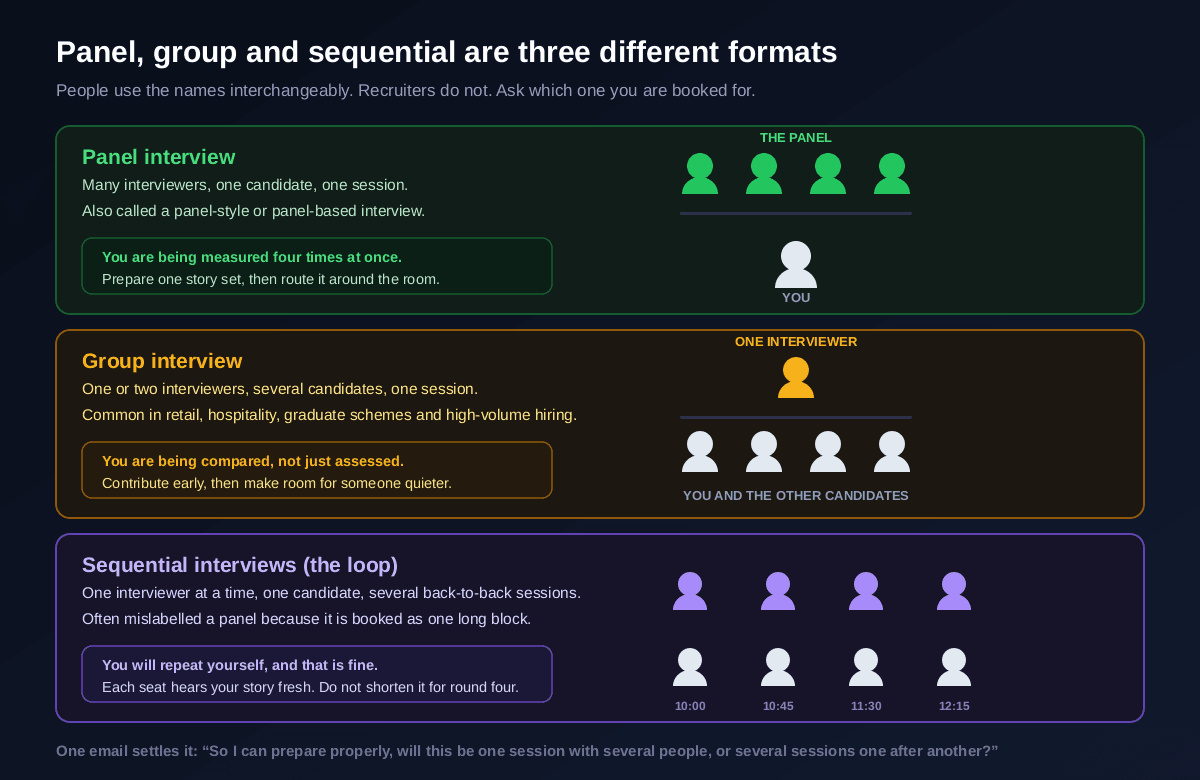
The group interview is the one people confuse with a panel most often, and it is close to its mirror image: one interviewer, several candidates, and a format built for volume. It shows up in retail, hospitality, call centres and graduate schemes because it lets a company assess twenty people in an afternoon. The skill being measured there is how you behave among peers, not what you know.
The sequential loop gets mislabelled for a different reason: it is booked as one long block, so it looks like a panel on your calendar. It is not. You meet each person alone, which means you will repeat yourself, and the thing to resist is shortening your story by round four because you are bored of telling it. The fourth interviewer is hearing it for the first time.
The one email that removes all doubt
Who is in the room, and what each seat is testing
This is the part almost nobody prepares for, and it is where a panel is genuinely different from a one-on-one. The people in the room are not four interchangeable interviewers asking four versions of the same question. Each one is there for a specific reason, is testing something different, and holds a different amount of power to say no.
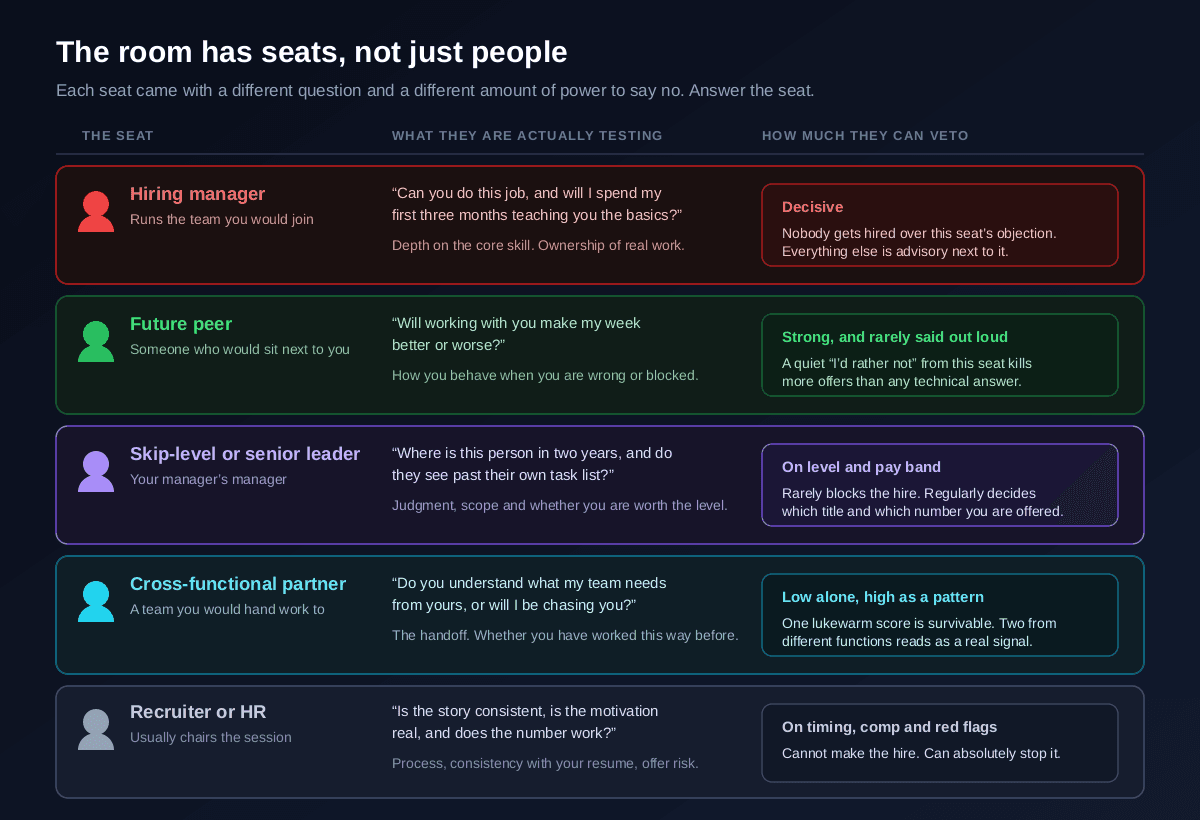
Two rows on that map are worth reading twice. The hiring manager is decisive: nobody gets hired over that seat's objection, and every other opinion in the room is advisory next to it. And the future peer holds far more power than their job title suggests. A quiet "I'd rather not work with them" from someone who would sit next to you kills more offers than any technical answer ever does, and it almost never gets recorded in those words.
Which produces the most useful single instruction in this article: answer the seat, not just the question. When the cross-functional partner asks how you handled a project, they are not testing your project management vocabulary. They are asking whether they will spend next year chasing you for things. Answer that.
Is a panel interview a good sign?
Usually yes, and for a reason that has nothing to do with how it feels while you are sitting in it.
A panel costs the company four or five salaries for the same hour, plus the scheduling effort of finding a slot that four busy calendars share. Ask any recruiter what the hardest logistical task in hiring is and this is the answer. Nobody spends that on a candidate they are not seriously considering. Panels also sit late in most processes, usually after a screening interview and a first round, so the invitation itself means you have cleared the earlier filters.
Two honest caveats:
- Some organisations panel everybody at a given stage as a matter of policy, especially in government, education and healthcare. There the panel is a process feature, not a signal about you.
- Do not try to read the room. Four people taking notes look identical whether they are impressed or unconvinced. The panel format gives you almost no live feedback, which is exactly why so many candidates walk out convinced it went badly and then get the offer.
Panel interview pros and cons
The format trades comfort for fairness. That trade lands very differently depending on which side of the table you are sitting on.
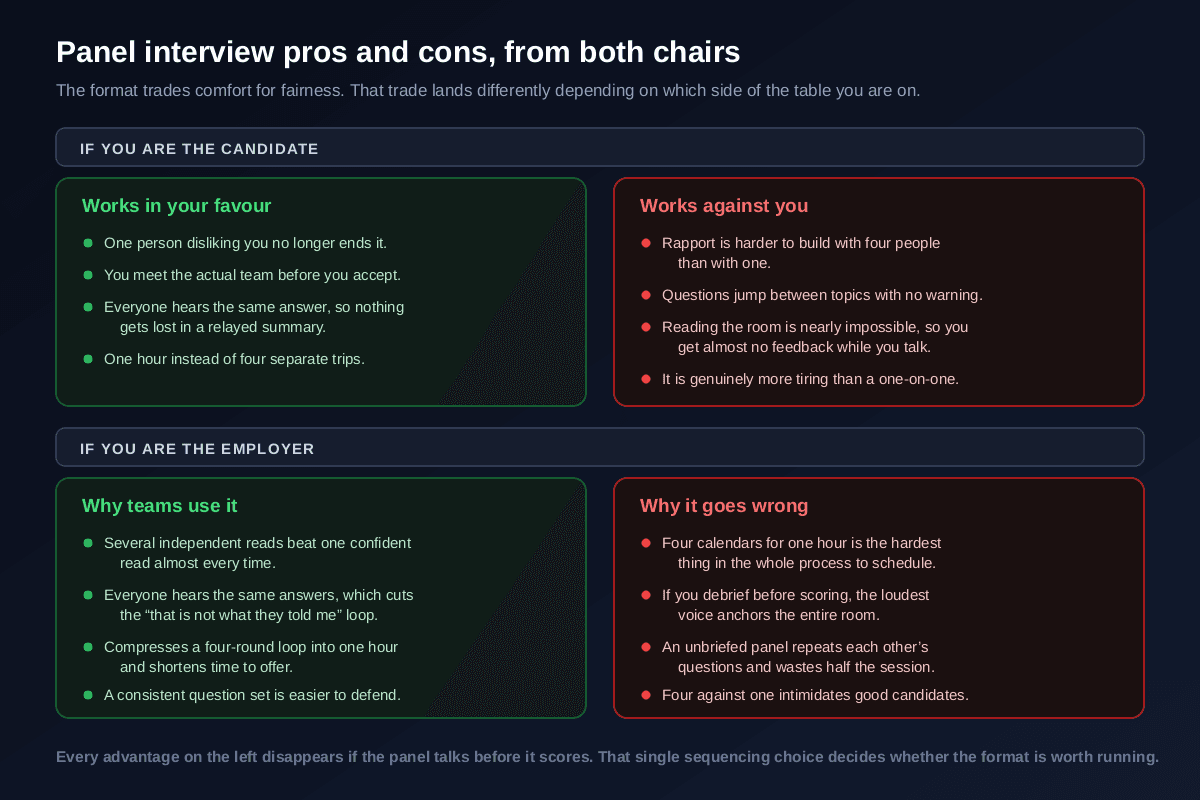
The line at the bottom of that chart is the one that matters most: every advantage on the left disappears if the panel talks before it scores. More on that in the employer section, because it is the single decision that determines whether the format was worth running at all.
How to prepare for a panel interview
Prepare a story set, not a script. Panel questions are broader than one-on-one questions, because each panellist only gets three or four and has to make them count. A script for specific questions will not survive that. A set of stories will.
Build six to eight stories, one per theme
Get the names and job titles, then look each person up
Map every story to a line in the job description
Write two questions per panellist
Rehearse out loud, to more than one person
The general groundwork still applies on top of this: our guide to preparing for a job interview covers company research, logistics and nerves, and what to wear to an interview matters slightly more here than usual, because four people form a first impression instead of one.
Where to look when four people are watching
Eye contact is the mechanical problem candidates ask about most, and it has a mechanical answer. Three moves, used on every question, and the format stops feeling like a firing squad.
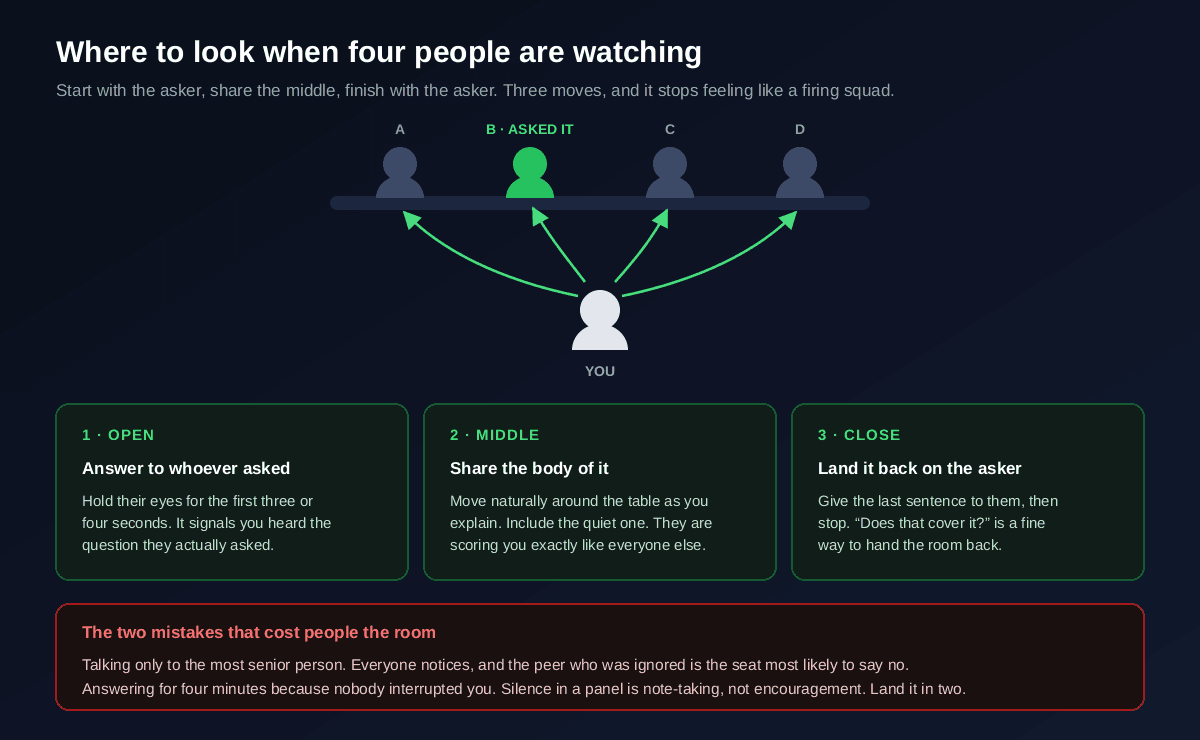
The second mistake on that chart is the expensive one. Silence in a panel is note-taking, not encouragement. In a one-on-one, an interviewer signals that you have said enough. In a panel, four people who are all writing will let you talk for five minutes, and every extra minute is a question somebody else now will not get to ask. Land it in two and stop.
Common panel interview questions, and who is really asking
The questions themselves are rarely exotic. What changes is that the same words mean different things depending on the chair they come from, and matching your answer to the reason rather than the wording is most of the skill.
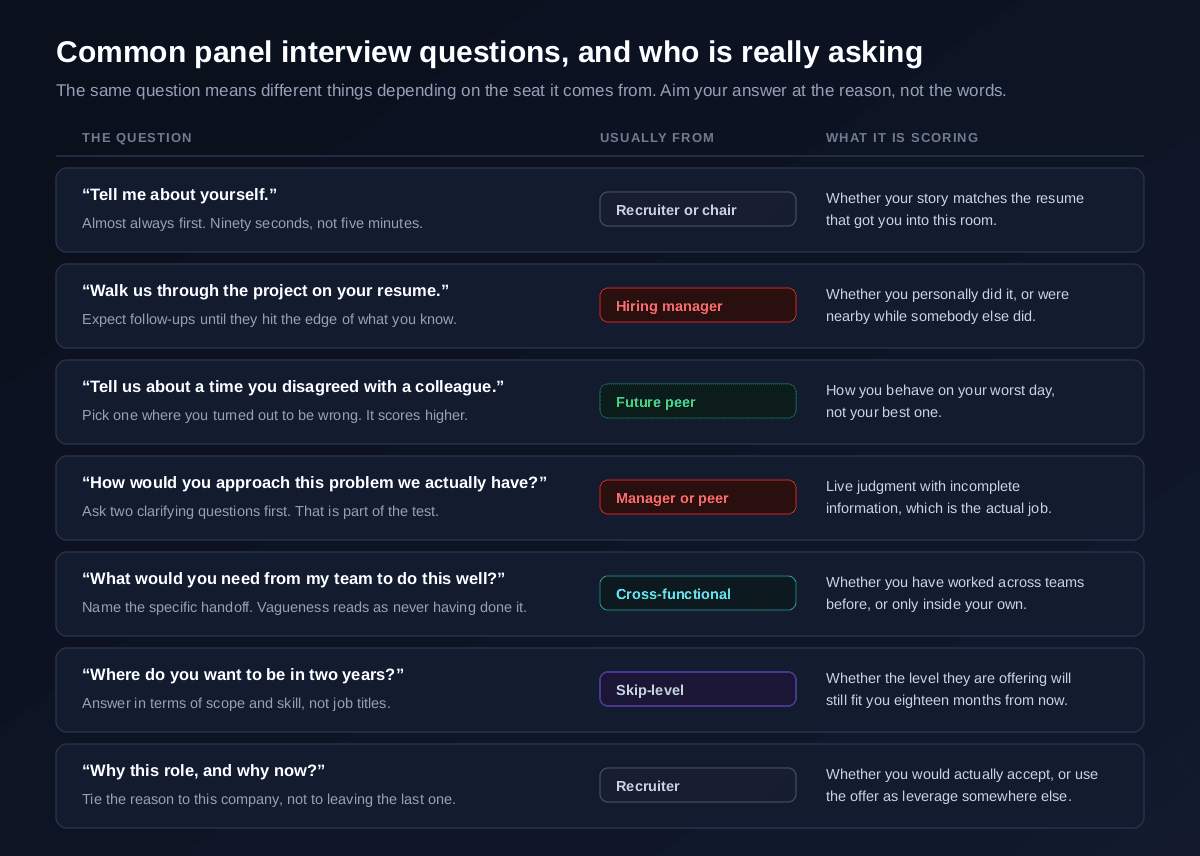
Two of those deserve expanding. On "tell us about a time you disagreed with a colleague", candidates almost always pick an example where they turned out to be right. Pick one where you were wrong. The peer asking is trying to find out how you behave on your worst day, and a story that ends with you being vindicated answers a question nobody asked.
On the live problem question, asking two clarifying questions before you start answering is not stalling, it is part of what is being scored. Nobody in that room has ever solved a real problem without first establishing what the problem was. For the broader set of wordings, see how to answer common interview questions.
Questions to ask in a panel interview
Prepare one per person, aimed at what that role would genuinely know. You will get through two or three, so prioritise.
- To the hiring manager:"What would make the first six months a success in this role?" This is the seat that decides, and this question gets you the criteria you would actually be judged on.
- To the future peer:"What is the team like in a bad week?" Everyone can describe a good week. The answer to this one tells you what you are signing up for.
- To the cross-functional partner:"Where do handoffs between our two teams currently break down?" It signals you already think in terms of the seam between teams, which is why that person was invited.
- To the skip-level:"How does this role connect to what the wider team is trying to do next year?" Scope questions land well with the seat that thinks about scope.
Two rules. Never ask something the job description already answers, which is the most common own goal in this part of an interview. And keep compensation, notice periods and remote-work policy for a separate conversation with the recruiter rather than raising them in front of the full panel, where they eat time you would rather spend on the role. Our list of questions to ask in an interview has more, sorted by what each one actually reveals.
Virtual panel interviews
A virtual panel removes exactly the things that made the in-person version manageable: the turn-taking cues, the eye contact, the shared room. Four things break, and each has a specific fix.
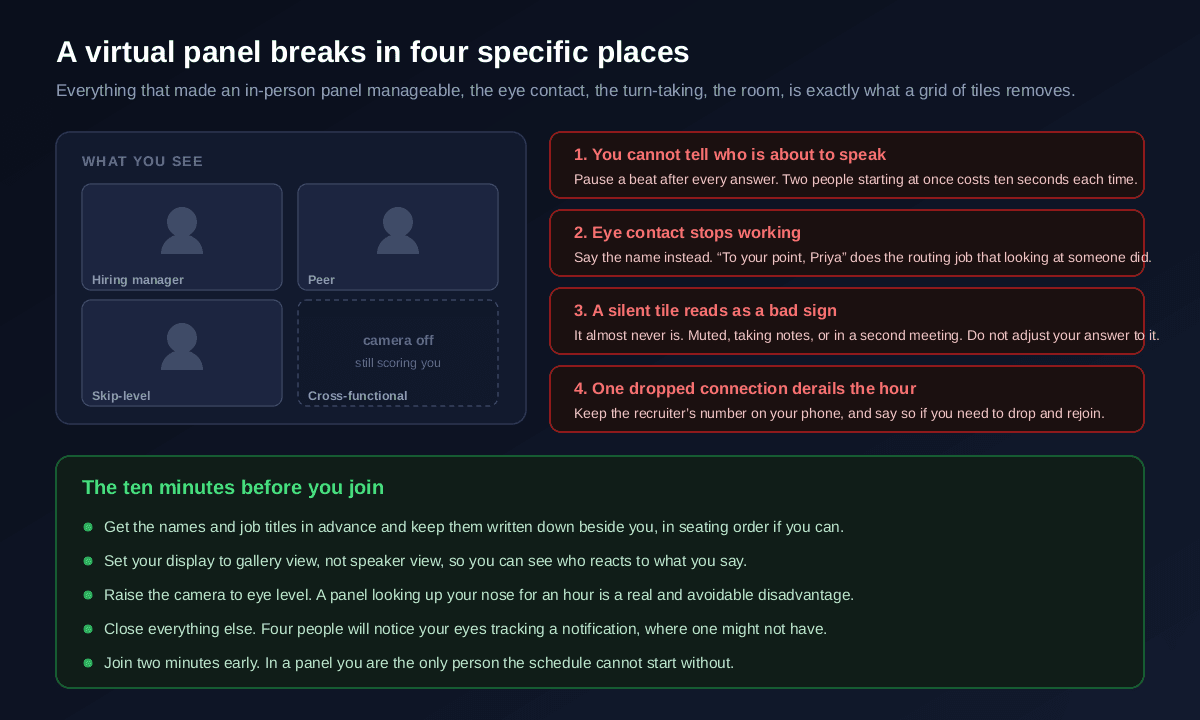
The name trick is the one that does the most work. "To your point, Priya, that is exactly where we hit the problem" performs the routing job that looking at someone did in a physical room. It is also why writing the names down before you join matters more on video than it does in person: on a grid of tiles you cannot lean over and read a badge.
Before the panel, check your resume against the job description
A panel scores you against the requirements in the job description, usually line by line. Paste your resume and the posting into Rankid to see your match score, which requirements you already evidence, and the exact keywords you are missing, so you know which gaps the room is going to probe. Free, no signup.
Check your match score freeThe thank you email after a panel interview
Send individual emails, not one group message. Within 24 hours, four or five sentences each, and each one referencing something that specific person actually said or asked.
The specificity is the entire point. A panel of four who each open an identical paragraph will notice immediately, and a copy-pasted round of thanks reads worse than sending nothing at all. If you did not collect addresses in the room, write to the recruiter or the chair and ask them to pass your thanks on by name. That is a routine request and gets handled without comment.
Use the note to do one piece of real work as well: complete an answer you were not happy with. "I gave you a partial answer on the migration timeline and wanted to add the part I left out" is a legitimate second attempt, and panels tend to respect it, because it shows you were still thinking about the problem after you left. Our guide to the thank you email after an interview has the full templates, including the version for multiple interviewers.
For employers: how to conduct a panel interview
There is one decision here that matters more than every other decision combined, and most panels get it backwards.
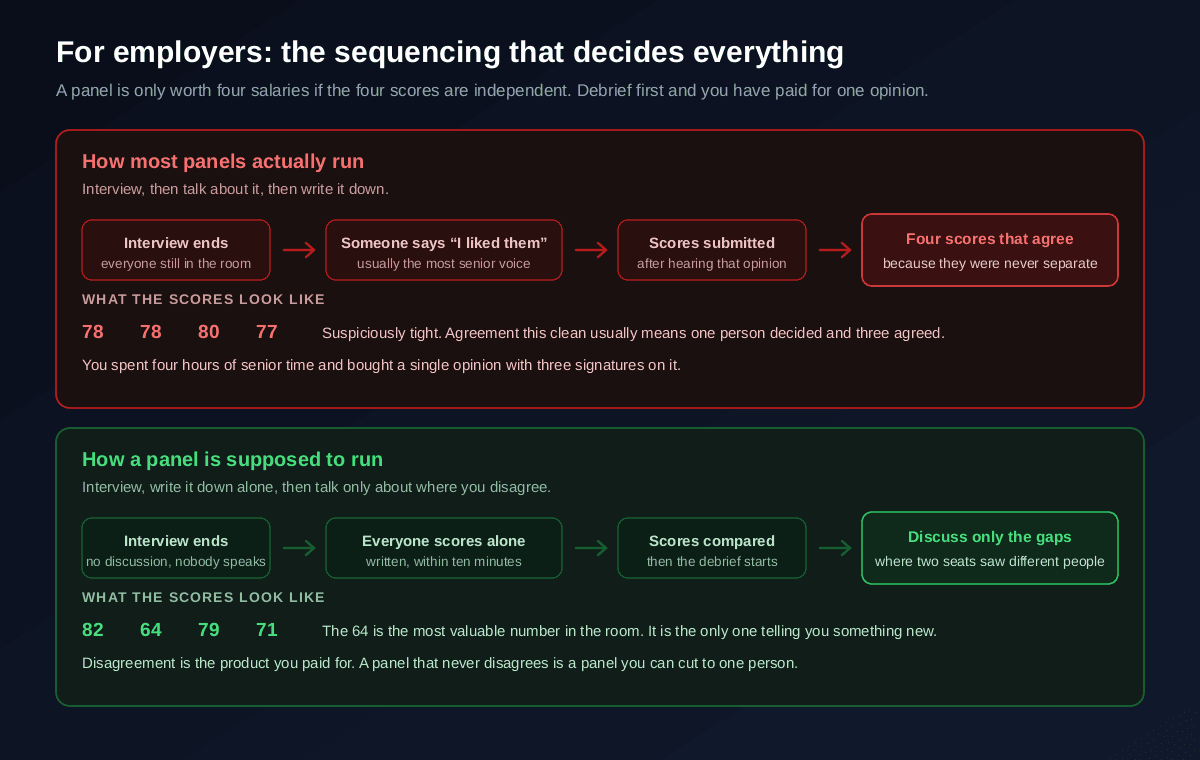
Every panellist submits a written score before anybody says a word about the candidate. If you debrief first, the most senior or most confident voice in the room anchors everyone else, and you have just spent four salaries to buy a single opinion with three signatures on it. The tell is in the numbers: a panel whose scores cluster suspiciously tightly is usually a panel that talked before it scored.
Disagreement is the product you paid for. A panel that never disagrees is a panel you can cut to one person. The rest of the operating rules:
- Assign each panellist a distinct area in advance. An unbriefed panel repeats each other and wastes half the session covering the same ground three times.
- Name a chair. Someone has to open, run time, cut off an over-running answer politely, and close. Without one, the session over-runs and the last panellist gets four minutes.
- Ask every candidate the same core questions. That is what makes scores comparable across candidates and what makes the process defensible if it is ever challenged. The interview scorecard is the instrument for this, and structured interview questions covers how to build the set.
- Cap it at four or five people. Above that, panellists disengage because they get one question each, and candidates find the format intimidating in a way that suppresses the very performance you are trying to measure.
- Debrief the same day, focused only on the gaps. Where two seats saw different people is where the information is. The rest is confirmation.
One fairness note worth taking seriously. A panel is a stronger instrument than a one-on-one precisely because it averages away individual bias, but only if the panel itself is not uniformly composed and only if the criteria were written before the candidates were seen. Check the outcomes for adverse impact like you would any other selection step, and see skills-based hiring for keeping the criteria tied to the work rather than to background.
Panels are also expensive enough that they should only ever see a shortlist you are confident in. If you are putting four people in a room to assess candidates you have not screened properly, the format cannot save you: shortlisting candidates from resumes covers the step that comes before this one, and the hiring process covers where the panel fits in the whole sequence.
Only panel the shortlist that deserves four calendars
Upload your applicants and the job description. Rankid scores every candidate against the real requirements and shows the evidence behind each score, so the people who reach your panel are the ones worth an hour of four salaries. First 5 resumes free, no signup.
Try bulk screening freeFrequently asked questions
What is a panel interview?
A panel interview is a single interview session in which several interviewers question one candidate at the same time. It typically involves three to five people, runs 45 to 90 minutes, and each interviewer scores the candidate separately afterwards. The defining feature is not the number of people, it is the fact that everyone hears the same answers at the same moment. In a normal hiring loop, each interviewer forms an impression from a different conversation, then compares notes on what are effectively different data sets. In a panel, the input is identical for everybody, so the differences between their scores tell you something real about the candidate rather than something about who happened to ask the better question. You will also see it called a panel-style interview, a panel-based interview, or simply an interview panel, and all three mean the same thing. It is standard practice in the public sector, healthcare, education, government, academia and unionised environments, where a documented and consistent process is required, and increasingly common in the private sector for senior or cross-functional roles.
What is the difference between a panel interview and a group interview?
A panel interview has many interviewers and one candidate. A group interview has one or two interviewers and many candidates. People use the terms interchangeably and they describe almost opposite experiences, so it is worth confirming which one you are booked for before you prepare. In a panel, the whole hour is about you, and your task is to give complete answers and route them around a room of people with different priorities. In a group interview you are being compared against other candidates in real time, often through a group exercise or a discussion task, and the skill being measured is how you behave among peers: whether you contribute early, whether you make space for quieter people, whether you dominate. Group interviews are most common in retail, hospitality, call centres, graduate schemes and other high-volume hiring, because they let a company assess twenty people in an afternoon. There is also a third format that gets mislabelled constantly: sequential interviews, sometimes called the loop or the onsite, where you meet one interviewer at a time in back-to-back sessions. That is booked as one long block, which is why people call it a panel, but you are meeting each person alone. One email settles it: ask whether it will be one session with several people, or several sessions one after another.
Is a panel interview a good sign?
Generally yes, for a reason that has nothing to do with how the interview feels while you are in it. A panel costs the company several salaries for the same hour, plus the scheduling effort of finding a slot that four or five busy calendars share, which in most organisations is the single hardest thing in the whole hiring process to arrange. Nobody spends that on a candidate they are not seriously considering. Panels also sit late in the process at most companies, usually after a screening call and a first-round interview, so being invited to one means you have already cleared earlier filters. Two caveats keep this honest. First, some organisations run panels for every candidate at a given stage as standard policy, particularly in government, education and healthcare, so there the panel is a process feature rather than a signal about you specifically. Second, the panel format itself gives you very little live feedback, since four people taking notes look identical whether they are impressed or unconvinced, so do not try to read the room. The invitation is the signal. What happens inside the room is not.
How many people are usually on an interview panel?
Three to five is the normal range, and four is the most common single answer. Below three it is not really functioning as a panel, because two interviewers tend to converge into one shared view very quickly. Above five it stops working for a different reason: the session becomes unwieldy, individual panellists disengage because they only get one or two questions each, and candidates find the format genuinely intimidating in a way that suppresses the performance you are trying to measure. If you are told to expect more than six people, it is usually a formal public-sector or academic board where several of the attendees are observers or note-takers rather than active questioners, and it is entirely reasonable to ask the recruiter who will actually be asking you questions. As a candidate, always ask for the names and job titles in advance. Recruiters expect this request and it is not presumptuous. It lets you research each person, understand what each of them is likely to care about, and address people by name during the session, which is the single easiest way to make a panel feel like a conversation rather than an interrogation.
How do you prepare for a panel interview?
Prepare a story set, not a script. Build six to eight concrete stories from your actual work, each covering a different theme: a hard technical problem, a conflict with a colleague, a failure you owned, a project you led, a time you changed your mind, a time you worked across teams. Each one should be tellable in about two minutes using a clear structure of situation, action and result. That set will cover most of what a panel asks, because panel questions are broad by design. Then do four specific things. Get the names and titles in advance and look each person up, so you know which seat is the hiring manager and which is the future peer. Re-read the job description and map each of your stories to a requirement in it, since a panel is usually scoring against a written set of criteria drawn directly from that description. Prepare two questions for each panellist, aimed at what their role would actually know. And rehearse out loud, ideally to two or three people rather than to a mirror, because the specific difficulty of a panel is delivering to several faces at once and that is the part you cannot practise alone.
Where should you look during a panel interview?
Use a simple three-part rule and it stops being a problem. Start with whoever asked the question and hold their eyes for the first three or four seconds, which signals that you heard the question they actually asked rather than a general version of it. Through the middle of your answer, move your attention naturally around the table so that everybody is included, and deliberately make sure the quiet one gets some of it, because a silent panellist is scoring you exactly like everyone else. Then land the final sentence back on the person who asked, which closes the loop and makes it obvious you have finished. A short 'does that cover what you were asking?' is a clean way to hand the room back. Two mistakes cost people badly here. The first is talking only to the most senior person present, which everyone notices, and which alienates the future peer, the seat most likely to quietly sink an offer. The second is answering for four minutes because nobody interrupted you. Silence in a panel is note-taking, not encouragement. Land your answers in about two minutes and stop.
What are the most common panel interview questions?
Panel questions are broader than one-on-one questions, because each panellist gets only a few and has to make them count. Expect: tell me about yourself, which usually opens and should be about ninety seconds rather than five minutes; walk us through a project on your resume, where the follow-ups will continue until they find the edge of what you actually know; tell us about a time you disagreed with a colleague, where choosing an example in which you turned out to be wrong scores higher than one where you were vindicated; how would you approach a specific problem the team currently has, where asking two clarifying questions before answering is part of what is being measured; what would you need from my team to do this well, which usually comes from a cross-functional partner testing whether you have genuinely worked across team boundaries; where do you want to be in two years, which is a level and retention question best answered in terms of scope and skill rather than job titles; and why this role and why now, which is the offer-risk question and needs a reason tied to this company rather than to leaving your last one. The useful move is to notice which seat asked, because the same words mean different things from different chairs.
What questions should I ask in a panel interview?
Prepare one question per panellist, aimed at what that person's role would actually know, and expect to use two or three of them rather than all of them. Asking the hiring manager what would make the first six months a success, asking the future peer what the team is like in a bad week rather than a good one, asking the cross-functional partner where handoffs between your two teams currently break down, and asking the skip-level how this role connects to what the wider team is trying to achieve next year, all get you real information and all demonstrate that you understand who is in the room. Two practical rules. Do not ask a question the job description already answers, which is the single most common own goal in this part of the interview. And if you get only one question, prioritise the hiring manager, because that is the seat whose opinion decides the outcome. Save compensation, notice periods, holiday and remote-work policy for the recruiter separately rather than raising them in front of the whole panel, where they consume time you would rather spend on the role itself.
How do I handle a virtual panel interview?
A virtual panel removes exactly the things that made an in-person panel manageable. Four adjustments cover most of it. First, you cannot see who is about to speak, so pause a full beat after each answer instead of running straight on, since two people starting at once costs everybody ten seconds each time it happens. Second, eye contact stops doing its routing job, so use names instead: 'to your point, Priya' does the work that looking at someone did in a physical room, which is why having the names written down beside you matters more on video than in person. Third, a silent or camera-off tile reads as disapproval and almost never is, since panellists mute themselves, take notes, or occasionally sit in a second meeting, so do not adjust your answers in response to a face you cannot read. Fourth, have the recruiter's phone number to hand before you join, because a dropped connection in a panel derails four calendars rather than one and you want to be able to say what happened. Beyond that, use gallery view rather than speaker view so you can see reactions, raise the camera to eye level, close everything that can produce a notification, and join two minutes early, since in a panel you are the only person the meeting cannot start without.
Should I send a thank you email after a panel interview?
Yes, and send individual emails rather than one group message. Write to each panellist separately within 24 hours, reference something specific that person actually said or asked, and keep each message to four or five sentences. The specificity is the whole point: a panel of four who each receive an identical paragraph will notice immediately, and it reads worse than sending nothing. If you did not collect email addresses during the session, send one message to the recruiter or the chair and ask them to pass on your thanks to the others by name, which is a normal request and gets handled routinely. Use the note to do one piece of real work as well as being polite, which is to correct or complete an answer you were not happy with. A sentence like 'I gave you a partial answer on the migration timeline and wanted to add the part I left out' is a legitimate second attempt, and panels tend to respect it because it shows you were still thinking after you left the room.
How do you conduct a panel interview as an employer?
The sequencing decides everything, and most panels get it backwards. The rule is that every panellist writes and submits their own score before anyone in the room says a word about the candidate. If you debrief first, the most senior or most confident voice anchors the room and you have spent four salaries to buy one opinion with three signatures on it. You can see it in the numbers: a panel whose scores cluster tightly is usually a panel that talked before it scored. Divergence is the product you paid for. Beyond that, do five things. Assign each panellist a distinct area in advance so nobody repeats a question and the whole competency set actually gets covered. Name a chair who runs time, opens, closes and stops the session from over-running. Ask every candidate the same core questions, which is what makes the scores comparable and what makes the process defensible if it is ever challenged. Cap the panel at four or five, because larger boards disengage panellists and intimidate candidates. And debrief within the same day, focused specifically on the questions where two seats saw different people, since that is where the useful information is.
How long does a panel interview last?
Most run 45 to 60 minutes, and formal public-sector or academic boards often run 60 to 90. The structure inside that hour is fairly predictable: a few minutes of introductions where each panellist says who they are, roughly two thirds of the session on questions cycling between panellists, then 10 to 15 minutes at the end for your questions and next steps. Two practical implications follow from the arithmetic. First, in a 60-minute session with four interviewers, you have roughly ten minutes of speaking time per panellist, which is why two-minute answers work and five-minute answers actively harm you, since every extra minute you spend is a question somebody else no longer gets to ask. Second, the introductions at the start are the only chance you get to fix the names to the faces, so write them down as they are said rather than trusting yourself to remember four new people while also being interviewed. If nobody introduces themselves, it is completely acceptable to ask at the top: a simple request for everyone to say their name and role takes 40 seconds and makes the entire rest of the hour easier to navigate.
Key takeaways
- A panel interview is one session with several interviewers and one candidate, scored independently afterwards. Everyone hears the same answers, which is the whole point of the format.
- It is not the same as a group interview (one interviewer, many candidates) or a sequential loop (one interviewer at a time). Ask the recruiter which one you are booked for.
- Being invited to a panel is usually a good sign. Four calendars for one hour is the most expensive thing in hiring to arrange, and nobody arranges it casually.
- The room has seats, not just people. The hiring manager is decisive, the future peer holds a quiet veto that sinks more offers than any technical answer, and the skip-level usually decides your level and pay band.
- Answer the seat, not just the question. The same words mean different things from different chairs.
- Where to look: start with whoever asked, share the middle of the answer around the table including the quiet one, land the last sentence back on the asker.
- Silence in a panel is note-taking, not encouragement. Two-minute answers. Every extra minute is a question somebody else no longer gets to ask.
- Prepare six to eight stories mapped to lines in the job description, not a script. Panels score against written criteria taken straight from the posting.
- On video, use names instead of eye contact, use gallery view, and never adjust your answer to a silent tile. It almost never means what you think.
- Send individual thank you emails within 24 hours, each referencing something that person said. An identical paragraph to four people reads worse than nothing.
- Employers: every panellist scores in writing before anyone speaks. Debrief first and you paid four salaries for one opinion with three signatures on it.
- Employers: tight agreement is a warning sign, not a success. Disagreement between seats is the information you ran the panel to get.
Frequently asked questions
What is a panel interview?
A panel interview is a single interview session in which several interviewers question one candidate at the same time. It typically involves three to five people, runs 45 to 90 minutes, and each interviewer scores the candidate separately afterwards. The defining feature is not the number of people, it is the fact that everyone hears the same answers at the same moment. In a normal hiring loop, each interviewer forms an impression from a different conversation, then compares notes on what are effectively different data sets. In a panel, the input is identical for everybody, so the differences between their scores tell you something real about the candidate rather than something about who happened to ask the better question. You will also see it called a panel-style interview, a panel-based interview, or simply an interview panel, and all three mean the same thing. It is standard practice in the public sector, healthcare, education, government, academia and unionised environments, where a documented and consistent process is required, and increasingly common in the private sector for senior or cross-functional roles.
What is the difference between a panel interview and a group interview?
A panel interview has many interviewers and one candidate. A group interview has one or two interviewers and many candidates. People use the terms interchangeably and they describe almost opposite experiences, so it is worth confirming which one you are booked for before you prepare. In a panel, the whole hour is about you, and your task is to give complete answers and route them around a room of people with different priorities. In a group interview you are being compared against other candidates in real time, often through a group exercise or a discussion task, and the skill being measured is how you behave among peers: whether you contribute early, whether you make space for quieter people, whether you dominate. Group interviews are most common in retail, hospitality, call centres, graduate schemes and other high-volume hiring, because they let a company assess twenty people in an afternoon. There is also a third format that gets mislabelled constantly: sequential interviews, sometimes called the loop or the onsite, where you meet one interviewer at a time in back-to-back sessions. That is booked as one long block, which is why people call it a panel, but you are meeting each person alone. One email settles it: ask whether it will be one session with several people, or several sessions one after another.
Is a panel interview a good sign?
Generally yes, for a reason that has nothing to do with how the interview feels while you are in it. A panel costs the company several salaries for the same hour, plus the scheduling effort of finding a slot that four or five busy calendars share, which in most organisations is the single hardest thing in the whole hiring process to arrange. Nobody spends that on a candidate they are not seriously considering. Panels also sit late in the process at most companies, usually after a screening call and a first-round interview, so being invited to one means you have already cleared earlier filters. Two caveats keep this honest. First, some organisations run panels for every candidate at a given stage as standard policy, particularly in government, education and healthcare, so there the panel is a process feature rather than a signal about you specifically. Second, the panel format itself gives you very little live feedback, since four people taking notes look identical whether they are impressed or unconvinced, so do not try to read the room. The invitation is the signal. What happens inside the room is not.
How many people are usually on an interview panel?
Three to five is the normal range, and four is the most common single answer. Below three it is not really functioning as a panel, because two interviewers tend to converge into one shared view very quickly. Above five it stops working for a different reason: the session becomes unwieldy, individual panellists disengage because they only get one or two questions each, and candidates find the format genuinely intimidating in a way that suppresses the performance you are trying to measure. If you are told to expect more than six people, it is usually a formal public-sector or academic board where several of the attendees are observers or note-takers rather than active questioners, and it is entirely reasonable to ask the recruiter who will actually be asking you questions. As a candidate, always ask for the names and job titles in advance. Recruiters expect this request and it is not presumptuous. It lets you research each person, understand what each of them is likely to care about, and address people by name during the session, which is the single easiest way to make a panel feel like a conversation rather than an interrogation.
How do you prepare for a panel interview?
Prepare a story set, not a script. Build six to eight concrete stories from your actual work, each covering a different theme: a hard technical problem, a conflict with a colleague, a failure you owned, a project you led, a time you changed your mind, a time you worked across teams. Each one should be tellable in about two minutes using a clear structure of situation, action and result. That set will cover most of what a panel asks, because panel questions are broad by design. Then do four specific things. Get the names and titles in advance and look each person up, so you know which seat is the hiring manager and which is the future peer. Re-read the job description and map each of your stories to a requirement in it, since a panel is usually scoring against a written set of criteria drawn directly from that description. Prepare two questions for each panellist, aimed at what their role would actually know. And rehearse out loud, ideally to two or three people rather than to a mirror, because the specific difficulty of a panel is delivering to several faces at once and that is the part you cannot practise alone.
Where should you look during a panel interview?
Use a simple three-part rule and it stops being a problem. Start with whoever asked the question and hold their eyes for the first three or four seconds, which signals that you heard the question they actually asked rather than a general version of it. Through the middle of your answer, move your attention naturally around the table so that everybody is included, and deliberately make sure the quiet one gets some of it, because a silent panellist is scoring you exactly like everyone else. Then land the final sentence back on the person who asked, which closes the loop and makes it obvious you have finished. A short 'does that cover what you were asking?' is a clean way to hand the room back. Two mistakes cost people badly here. The first is talking only to the most senior person present, which everyone notices, and which alienates the future peer, the seat most likely to quietly sink an offer. The second is answering for four minutes because nobody interrupted you. Silence in a panel is note-taking, not encouragement. Land your answers in about two minutes and stop.
What are the most common panel interview questions?
Panel questions are broader than one-on-one questions, because each panellist gets only a few and has to make them count. Expect: tell me about yourself, which usually opens and should be about ninety seconds rather than five minutes; walk us through a project on your resume, where the follow-ups will continue until they find the edge of what you actually know; tell us about a time you disagreed with a colleague, where choosing an example in which you turned out to be wrong scores higher than one where you were vindicated; how would you approach a specific problem the team currently has, where asking two clarifying questions before answering is part of what is being measured; what would you need from my team to do this well, which usually comes from a cross-functional partner testing whether you have genuinely worked across team boundaries; where do you want to be in two years, which is a level and retention question best answered in terms of scope and skill rather than job titles; and why this role and why now, which is the offer-risk question and needs a reason tied to this company rather than to leaving your last one. The useful move is to notice which seat asked, because the same words mean different things from different chairs.
What questions should I ask in a panel interview?
Prepare one question per panellist, aimed at what that person's role would actually know, and expect to use two or three of them rather than all of them. Asking the hiring manager what would make the first six months a success, asking the future peer what the team is like in a bad week rather than a good one, asking the cross-functional partner where handoffs between your two teams currently break down, and asking the skip-level how this role connects to what the wider team is trying to achieve next year, all get you real information and all demonstrate that you understand who is in the room. Two practical rules. Do not ask a question the job description already answers, which is the single most common own goal in this part of the interview. And if you get only one question, prioritise the hiring manager, because that is the seat whose opinion decides the outcome. Save compensation, notice periods, holiday and remote-work policy for the recruiter separately rather than raising them in front of the whole panel, where they consume time you would rather spend on the role itself.
How do I handle a virtual panel interview?
A virtual panel removes exactly the things that made an in-person panel manageable. Four adjustments cover most of it. First, you cannot see who is about to speak, so pause a full beat after each answer instead of running straight on, since two people starting at once costs everybody ten seconds each time it happens. Second, eye contact stops doing its routing job, so use names instead: 'to your point, Priya' does the work that looking at someone did in a physical room, which is why having the names written down beside you matters more on video than in person. Third, a silent or camera-off tile reads as disapproval and almost never is, since panellists mute themselves, take notes, or occasionally sit in a second meeting, so do not adjust your answers in response to a face you cannot read. Fourth, have the recruiter's phone number to hand before you join, because a dropped connection in a panel derails four calendars rather than one and you want to be able to say what happened. Beyond that, use gallery view rather than speaker view so you can see reactions, raise the camera to eye level, close everything that can produce a notification, and join two minutes early, since in a panel you are the only person the meeting cannot start without.
Should I send a thank you email after a panel interview?
Yes, and send individual emails rather than one group message. Write to each panellist separately within 24 hours, reference something specific that person actually said or asked, and keep each message to four or five sentences. The specificity is the whole point: a panel of four who each receive an identical paragraph will notice immediately, and it reads worse than sending nothing. If you did not collect email addresses during the session, send one message to the recruiter or the chair and ask them to pass on your thanks to the others by name, which is a normal request and gets handled routinely. Use the note to do one piece of real work as well as being polite, which is to correct or complete an answer you were not happy with. A sentence like 'I gave you a partial answer on the migration timeline and wanted to add the part I left out' is a legitimate second attempt, and panels tend to respect it because it shows you were still thinking after you left the room.
How do you conduct a panel interview as an employer?
The sequencing decides everything, and most panels get it backwards. The rule is that every panellist writes and submits their own score before anyone in the room says a word about the candidate. If you debrief first, the most senior or most confident voice anchors the room and you have spent four salaries to buy one opinion with three signatures on it. You can see it in the numbers: a panel whose scores cluster tightly is usually a panel that talked before it scored. Divergence is the product you paid for. Beyond that, do five things. Assign each panellist a distinct area in advance so nobody repeats a question and the whole competency set actually gets covered. Name a chair who runs time, opens, closes and stops the session from over-running. Ask every candidate the same core questions, which is what makes the scores comparable and what makes the process defensible if it is ever challenged. Cap the panel at four or five, because larger boards disengage panellists and intimidate candidates. And debrief within the same day, focused specifically on the questions where two seats saw different people, since that is where the useful information is.
How long does a panel interview last?
Most run 45 to 60 minutes, and formal public-sector or academic boards often run 60 to 90. The structure inside that hour is fairly predictable: a few minutes of introductions where each panellist says who they are, roughly two thirds of the session on questions cycling between panellists, then 10 to 15 minutes at the end for your questions and next steps. Two practical implications follow from the arithmetic. First, in a 60-minute session with four interviewers, you have roughly ten minutes of speaking time per panellist, which is why two-minute answers work and five-minute answers actively harm you, since every extra minute you spend is a question somebody else no longer gets to ask. Second, the introductions at the start are the only chance you get to fix the names to the faces, so write them down as they are said rather than trusting yourself to remember four new people while also being interviewed. If nobody introduces themselves, it is completely acceptable to ask at the top: a simple request for everyone to say their name and role takes 40 seconds and makes the entire rest of the hour easier to navigate.