Reverse Recruiting: What a Reverse Recruiter Does, What It Costs, and Whether It's Worth It in 2026
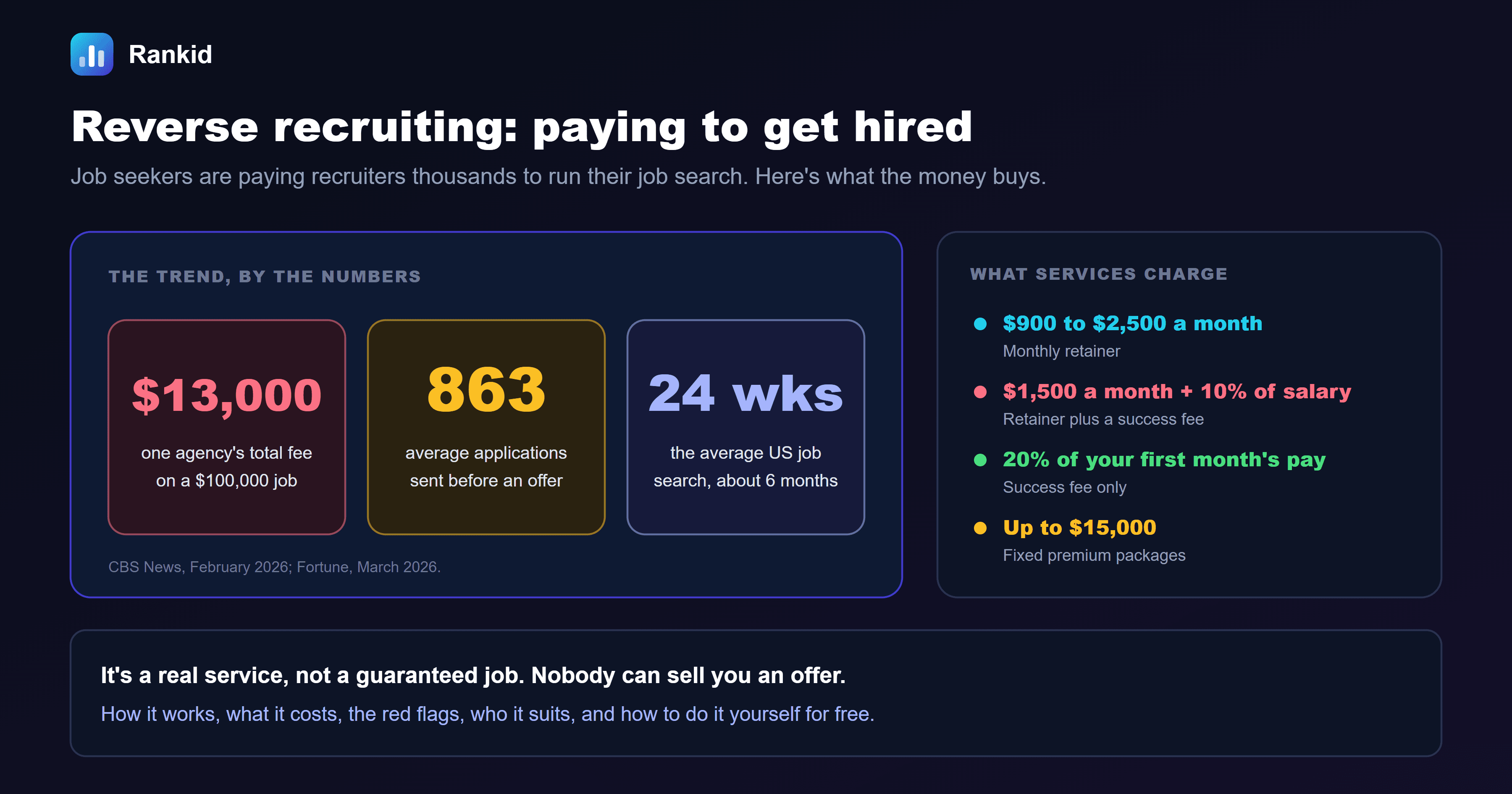
For as long as recruiters have existed, the deal has been simple: the company pays, the candidate doesn't. In 2026, a growing number of job seekers are flipping it. They're paying recruiters, sometimes more than $10,000, to find roles, write applications and chase hiring managers for them. It's called reverse recruiting, and whether it's a smart shortcut or an expensive way to do something you could do yourself depends on what you think you're buying.
Quick answer
Quick answer: a reverse recruiter works for you, not the employer, and runs your job search for a fee. Expect $900 to $2,500 a month, or around $1,500 a month plus 10% of first-year salary, which CBS News put at $13,000on a $100,000 job. You're buying time and labor, not access: most have no inside track to jobs, and nobody can guarantee an offer. It suits busy senior candidates best. Never share passwords, and walk away from job guarantees. You can copy the method yourself in about five hours a week.
What is reverse recruiting?
Reverse recruiting is a service where you hire someone to act as your agent in the job market. A traditional recruiter is paid by a company to fill a specific opening. A reverse recruiter is paid by you to get you hired, wherever that turns out to be.
You'll also see it called a job search concierge, a job search agent or job search outsourcing. The pitch is the same: job hunting has become a second full-time job, so pay a professional to do it.
What does a reverse recruiter actually do?
- Sourcing roles. Building a list of openings that fit your background, pay target and location.
- Rewriting your resume and LinkedIn profile. Usually a one-time overhaul at the start.
- Applying for you. Filling in applications in your name. One agency told Fortune it submits 50 to 100 applications a week per client.
- Outreach. Messaging recruiters and hiring managers on your behalf, or drafting messages for you to send.
- Coaching. Interview preparation and, sometimes, help with negotiating the offer.
What they generally don't have is special access. A traditional recruiter knows about a role because the employer hired them to fill it. A reverse recruiter is, for the most part, applying through the same front door you would.
Reverse recruiter vs recruiter vs career coach
- Traditional recruiter or headhunter:paid by the employer, free to you, works to fill that employer's roles. Here's how to respond when one contacts you.
- Reverse recruiter: paid by you, does the search for you, across any employer.
- Career coach:paid by you, usually by the hour or package, teaches you to search better but doesn't apply for you.
- Resume writer: paid by you, a one-off fee for a document.
- AI auto-apply tool: a low-cost subscription that mass-submits applications with no human judgment. We covered the downsides in our guide to AI auto-apply.
Why reverse recruiting took off in 2026
Because the job search got long, and the people stuck in it have money.
- The average US job search now lasts about 24 weeks, roughly six months, according to reporting by CBS News and Fortune.
- About a quarter of unemployed Americans have been looking for 27 weeks or more, according to Bureau of Labor Statistics data cited by Fortune in March 2026.
- One figure cited in CBS News's reporting puts the odds of a cold online application leading to an interview at just 1% to 2%.
- The squeeze is sharpest in white-collar work, where experienced professionals with savings are competing for fewer openings.
Add ghost jobs, AI-generated application floods and automated screening, and you get candidates who feel the process is broken and are willing to pay someone to deal with it. As executive coach Liz Bentley told CBS News: "When companies pay recruiters, it's because talent is scarce. When candidates pay them, it's because jobs are scarce."
How much does a reverse recruiter cost?
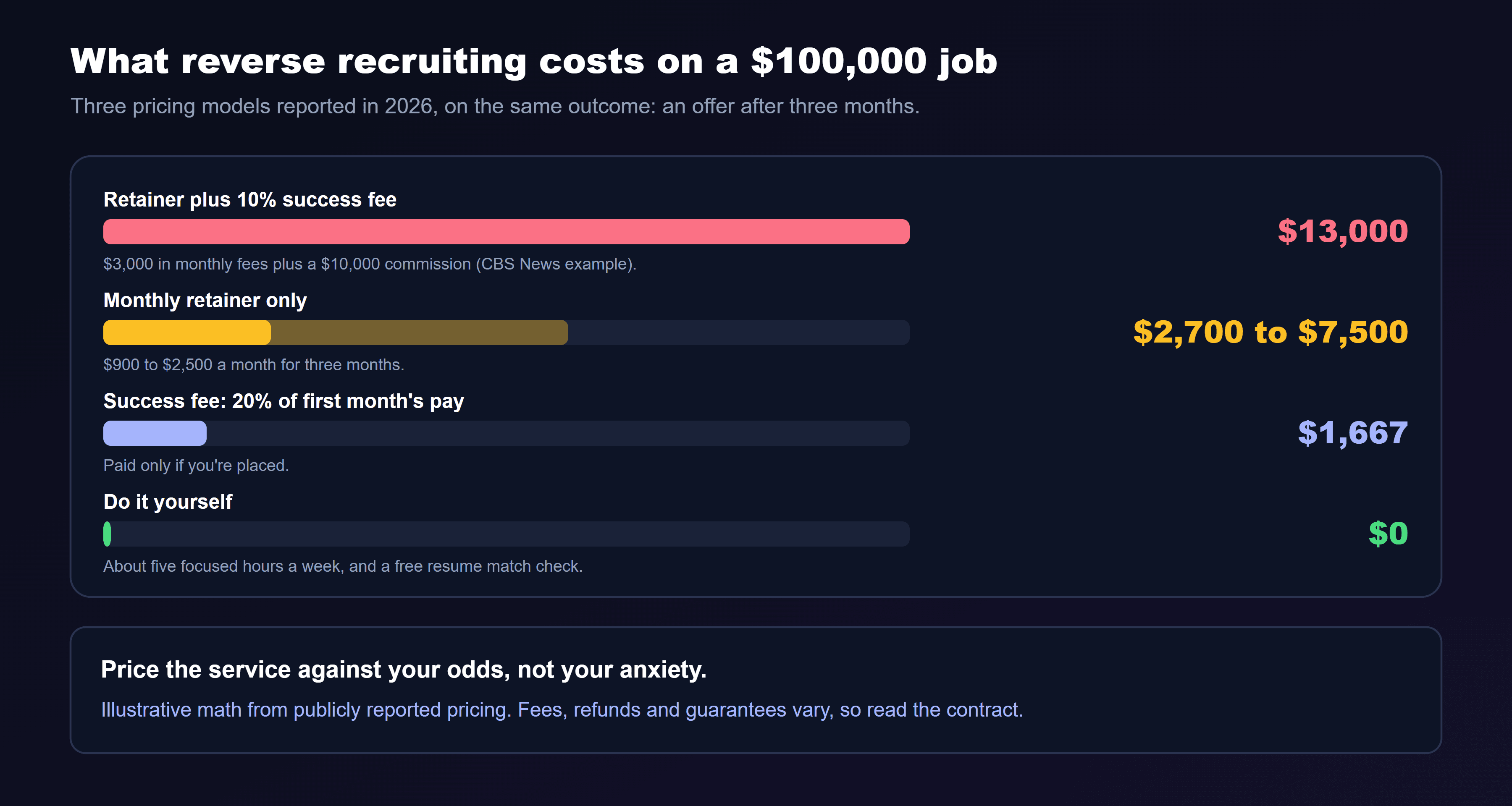
Prices reported in 2026 fall into a few models:
- Monthly retainer: one firm quoted by CBS News charges $900 to $2,500 a month.
- Retainer plus success fee: one agency charges $1,500 a month plus 10% of first-year salary when you accept an offer.
- Success fee only: one AI-powered platform charges 20% of your first month's paycheck, and only if you're placed.
- Fixed premium packages: reported at up to $15,000.
Here's what those models look like on the same result: a $100,000 job landed after three months.
Check the incentives
The number that should make you think: 863 applications
The founder of one reverse recruiting agency told Fortune that its clients average 863 applications before receiving an offer, rising to 924 for harder searches. The agency says its clients get an offer in about 12.7 weeks on average, roughly half the market average.
Those are the company's own figures, from a small client base, so treat them with care. But take them at face value and look at what they say: even with professionals running the search, the method is largely volume. An offer per 863 applications is about a tenth of a percent.
That's the honest trade-off. You're not paying for better odds per application. You're paying for someone else to send far more of them than you could face sending yourself. The alternative is to raise the odds on each one: apply to fewer roles that you match well, with a resume tailored to each, and a real person to contact. Lever's hiring data, covered in our guide to the hidden job market, shows referrals convert at roughly 1 in 16, compared with 1 in 152 for applicants.
Is reverse recruiting a scam? Red flags and green flags
The model is legitimate. The market around it is unregulated, the customers are stressed, and results are hard to check, which is exactly the setup job scamsthrive in. Consumer regulators have long warned people to be wary of paying upfront for the promise of a job. Recruiters interviewed about the trend have raised similar concerns; one said the firms are "really good at marketing" and that vulnerable job seekers can be easily swayed.
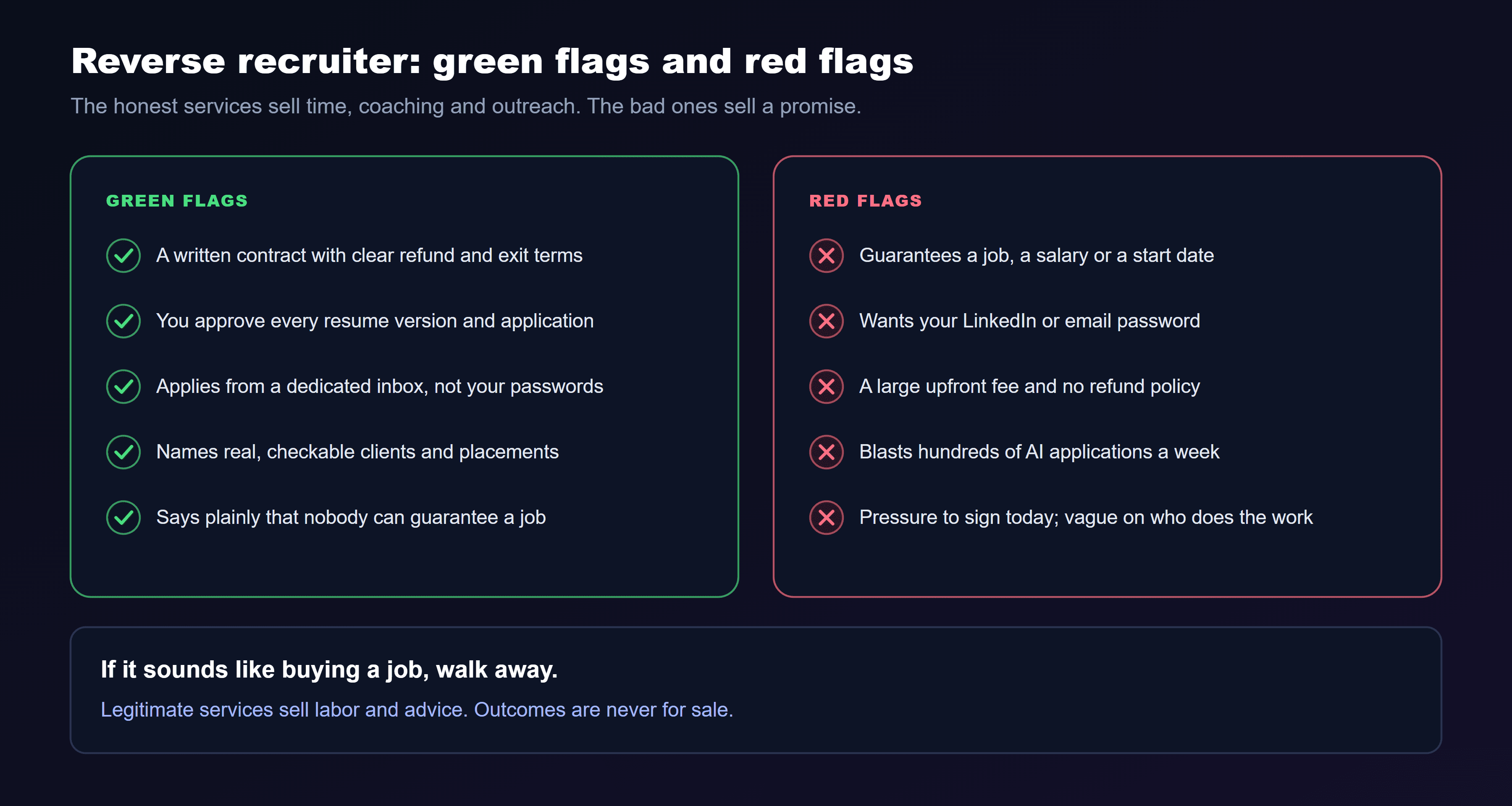
Red flags:
- A guaranteed job, salary or start date. Only an employer can make an offer. A guarantee of interviews is different, but read exactly what counts as one.
- They want your passwords.Handing over your LinkedIn or email login gives a stranger your professional identity and private messages, and breaks LinkedIn's user agreement.
- A big upfront fee with no refund terms.
- Pure volume.Hundreds of AI-generated applications a week can get you flagged as spam and put your name on resumes you've never read.
- Pressure and vagueness."Sign today," no named team, no clarity on who actually does the work.
Green flags:
- A written contract with clear scope, refund terms and a way out.
- You review and approve every resume version, and you can see every application sent.
- They work from a dedicated email alias, or draft messages for you to send.
- References and placements you can verify yourself.
- They tell you plainly that results aren't guaranteed.
Your name is on everything they send
Is reverse recruiting worth it? Who it suits
It may be worth it if:
- You're senior or specialized, with a salary that makes the fee a small share of the upside.
- You're employed and truly have no time to search.
- You know what you want, but dislike or avoid the outreach part.
- You can afford the fee without touching money you need to live on.
It's probably not worth it if:
- You're entry-level or early in your career, where volume applications convert worst.
- You're unemployed and the fee would shorten your financial runway.
- You're changing careers and haven't worked out your story yet. A coach, or our guide to a career change resume, will help more.
- Your real problem is the resume. If you're applying and hearing nothing, more applications of the same resume won't fix it. Start with why you're not getting interviews.
There's a fairness point too. Critics note that a paid fast lane widens the gap between job seekers who can afford help and those who can't. That's a good reason to know how to do it yourself.
How to be your own reverse recruiter in 5 hours a week
Strip away the branding and a reverse recruiter does four jobs. Here's how to do each one, without the invoice.
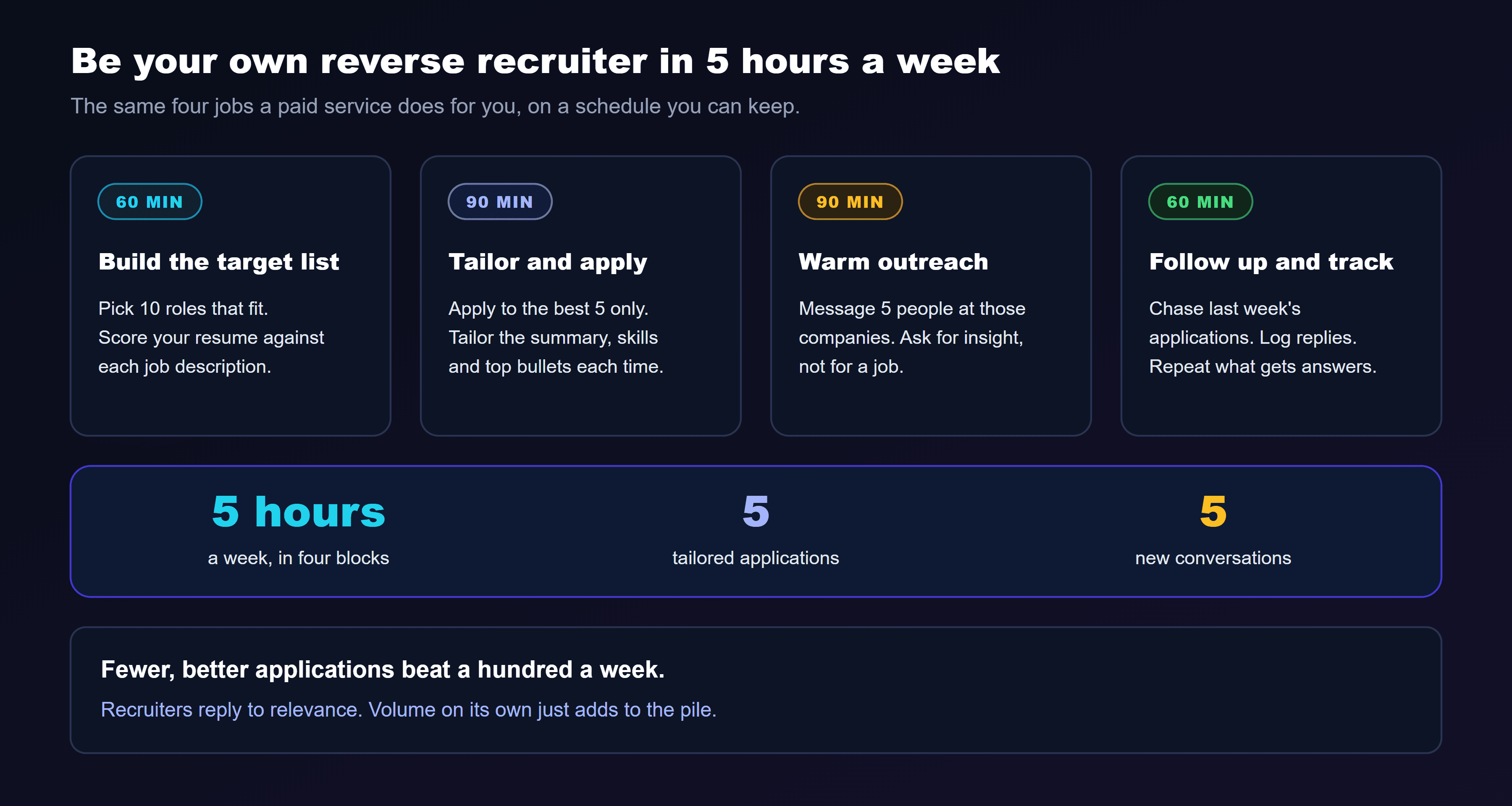
Build the target list (60 minutes)
Tailor and apply to the best five (90 minutes)
Warm outreach (90 minutes)
Follow up and track (60 minutes)
That's five tailored applications and five new conversations a week. Over three months it adds up to about 65 of each, which is a far better use of your name than 863 cold submissions.
Do the reverse recruiter's first job for free
Paste your resume and a job description into Rankid for a free 0-100 match score and the exact requirements you meet and miss, so you know which roles are worth your time before you apply. No signup required.
Check your match score freeFor recruiters and hiring teams: what this means for you
Reverse recruiting adds to a problem you already have: more applications per role, more of them written or submitted by someone other than the candidate.
- Expect more volume and more polish. A professionally tailored resume tells you less than it used to about the person behind it.
- Screen on evidence, not presentation. Compare every resume with the actual requirements of the role on the same scale. Our guide to resume screening criteria shows how.
- Verify in the conversation. A short screening interview with specific questions about listed projects quickly shows who knows their own resume.
- Don't penalize the candidate for getting help.Using an agent isn't dishonest. Misrepresenting experience is. Judge the substance.
- Fix what's driving it. People pay for this because applications vanish into silence. Timely replies and clear postings improve candidate experience and cut the noise you receive.
More applications than ever? Shortlist in minutes
Rankid scores every applicant against your job description on a consistent 0-100 scale and shows the exact requirements each matched and missed, so volume doesn't bury your best candidates. First 5 resumes free, no signup.
Try bulk screening freeFrequently asked questions
What is reverse recruiting?
Reverse recruiting is a paid service where a recruiter or agency works for the job seeker rather than the employer. A traditional recruiter is hired by a company to fill a role. A reverse recruiter is hired by you to run your job search: finding suitable roles, tailoring your resume, submitting applications, reaching out to hiring managers and preparing you for interviews.
How much does a reverse recruiter cost?
Reported 2026 pricing falls into three models. Monthly retainers run about $900 to $2,500 a month. Retainer-plus-success-fee services charge around $1,500 a month plus 10% of your first-year salary; CBS News calculated that at $13,000 on a $100,000 job. Success-fee-only platforms charge a share of early pay, such as 20% of your first month's paycheck. Premium fixed packages can reach $15,000.
Is reverse recruiting worth it?
It can be for senior or specialized candidates who are employed, short on time and able to treat the fee as a business expense. It's rarely worth it if you're early in your career, if the fee would strain your finances, or if the service's main offer is sending a high volume of applications. No service can guarantee an offer, so compare the price with what the same money would buy in coaching, a resume rewrite or more time to search.
Is reverse recruiting a scam?
Not in itself. There are legitimate agencies that provide real labor: research, tailored applications, outreach and coaching. But the model is easy to abuse, because customers are anxious and results are hard to verify. Treat it as a scam warning sign if a service guarantees a job, demands a large upfront fee with no refund terms, asks for your passwords, or pressures you to sign quickly.
What's the difference between a reverse recruiter and a traditional recruiter?
Who pays, and who they work for. A traditional recruiter or headhunter is paid by the employer and works to fill that employer's open roles; their service is free to candidates. A reverse recruiter is paid by the candidate and works to get that candidate hired anywhere suitable. A reverse recruiter usually has no special access to jobs; they are doing your search for you.
Should I give a reverse recruiter my LinkedIn password?
No. Sharing your login gives someone else control of your professional identity and your private messages, and LinkedIn's user agreement requires you to keep your password confidential and not share your account. A careful service will work from a dedicated email alias, send messages for you to approve, or draft outreach that you send yourself.
How long does it take to find a job in 2026?
About six months on average. Reporting in early 2026 put the average US job search at roughly 24 weeks, and Bureau of Labor Statistics data cited by Fortune showed about a quarter of unemployed people had been looking for 27 weeks or more. Searches tend to be longer for senior roles, career changers and people who rely only on online applications.
Can I do reverse recruiting myself?
Yes. A reverse recruiter does four things: builds a target list of roles, tailors and submits applications, does outreach to people at those companies, and follows up. You can do all four in about five focused hours a week: pick ten well-matched roles, send five tailored applications, start five conversations, and track what gets replies.
Key takeaways
- A reverse recruiter is paid by the job seeker, not the employer, to run the search: sourcing roles, applying, doing outreach and coaching.
- Reported 2026 prices range from $900 to $2,500 a month, to $1,500 a month plus 10% of salary ($13,000 on a $100,000 job), up to $15,000 for premium packages.
- You're buying time and labor, not access. Most reverse recruiters apply through the same channels you would.
- One agency reports its clients average 863 applications per offer, which shows the method leans on volume rather than better odds.
- The average US job search runs about 24 weeks, which is why demand has grown, especially among white-collar professionals.
- Red flags: job guarantees, requests for your passwords, large non-refundable upfront fees and mass AI applications.
- It suits busy, senior candidates who can afford it; it's a poor fit for early-career job seekers or anyone on a tight runway.
- You can copy the method in five hours a week: ten matched roles, five tailored applications, five conversations and consistent follow-up.
Frequently asked questions
What is reverse recruiting?
Reverse recruiting is a paid service where a recruiter or agency works for the job seeker rather than the employer. A traditional recruiter is hired by a company to fill a role. A reverse recruiter is hired by you to run your job search: finding suitable roles, tailoring your resume, submitting applications, reaching out to hiring managers and preparing you for interviews.
How much does a reverse recruiter cost?
Reported 2026 pricing falls into three models. Monthly retainers run about $900 to $2,500 a month. Retainer-plus-success-fee services charge around $1,500 a month plus 10% of your first-year salary; CBS News calculated that at $13,000 on a $100,000 job. Success-fee-only platforms charge a share of early pay, such as 20% of your first month's paycheck. Premium fixed packages can reach $15,000.
Is reverse recruiting worth it?
It can be for senior or specialized candidates who are employed, short on time and able to treat the fee as a business expense. It's rarely worth it if you're early in your career, if the fee would strain your finances, or if the service's main offer is sending a high volume of applications. No service can guarantee an offer, so compare the price with what the same money would buy in coaching, a resume rewrite or more time to search.
Is reverse recruiting a scam?
Not in itself. There are legitimate agencies that provide real labor: research, tailored applications, outreach and coaching. But the model is easy to abuse, because customers are anxious and results are hard to verify. Treat it as a scam warning sign if a service guarantees a job, demands a large upfront fee with no refund terms, asks for your passwords, or pressures you to sign quickly.
What's the difference between a reverse recruiter and a traditional recruiter?
Who pays, and who they work for. A traditional recruiter or headhunter is paid by the employer and works to fill that employer's open roles; their service is free to candidates. A reverse recruiter is paid by the candidate and works to get that candidate hired anywhere suitable. A reverse recruiter usually has no special access to jobs; they are doing your search for you.
Should I give a reverse recruiter my LinkedIn password?
No. Sharing your login gives someone else control of your professional identity and your private messages, and LinkedIn's user agreement requires you to keep your password confidential and not share your account. A careful service will work from a dedicated email alias, send messages for you to approve, or draft outreach that you send yourself.
How long does it take to find a job in 2026?
About six months on average. Reporting in early 2026 put the average US job search at roughly 24 weeks, and Bureau of Labor Statistics data cited by Fortune showed about a quarter of unemployed people had been looking for 27 weeks or more. Searches tend to be longer for senior roles, career changers and people who rely only on online applications.
Can I do reverse recruiting myself?
Yes. A reverse recruiter does four things: builds a target list of roles, tailors and submits applications, does outreach to people at those companies, and follows up. You can do all four in about five focused hours a week: pick ten well-matched roles, send five tailored applications, start five conversations, and track what gets replies.