Unlimited PTO: How It Really Works, the Payout Catch, and 7 Questions to Ask Before You Accept
"Unlimited PTO" might be the best-sounding two words in an offer letter. Take as much time off as you need. No counting days, no losing them in December. So why did Kickstarter scrap it, why has it nearly vanished from job postings, and why do some of the people who have it take fewerdays off than the people who don't? The answer is in a number that never appears in the offer: the balance you no longer have.
Quick answer
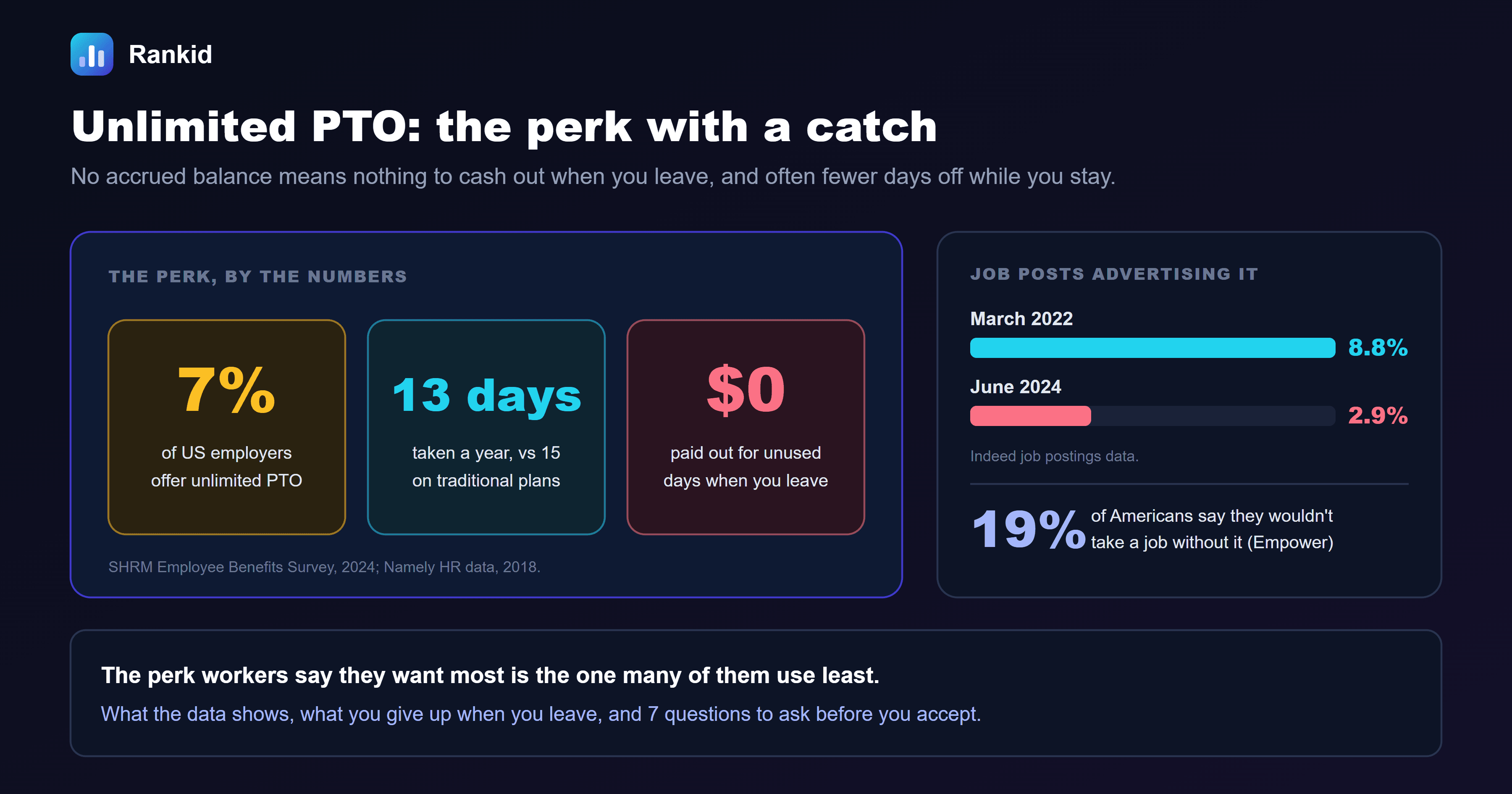
Quick answer: unlimited PTO means no fixed allowance and no accrued balance; time off is approved by your manager. Only about 7%of US employers offer it. Because nothing accrues, there's usually nothing to pay out when you quit or are laid off, which on a $100,000 salary with 15 unused days is about $5,769. Studies disagree on whether people take more or fewer days, so the policy is only as good as the culture. Before you accept, ask what the team actually took last yearand whether there's a minimum.
What is unlimited PTO?
Unlimited PTO is a paid time off policy with no set number of days. On a traditional plan you earn, or accrue, vacation as you work, for example 1.25 days a month, and that balance belongs to you. On an unlimited plan there is no balance at all. You request time off, and your manager says yes or no.
You'll see it under several names: flexible time off (FTO), open PTO, discretionary time off (DTO) or unlimited vacation. They all work the same way, and none of them is literally unlimited.
- It needs approval. Requests can be turned down for workload, deadlines or performance.
- It's usually for salaried staff. Hourly and non-exempt employees are often kept on accrued plans. See exempt vs non-exempt.
- It covers vacation, not everything. Sick leave, parental leave and medical leave are normally separate policies with their own rules.
- It doesn't roll over or cash out.There's nothing to carry into next year and, in most cases, nothing to pay you when you leave.
Unlimited PTO statistics: popular in surveys, rare in real life
Workers love the idea. Employers have been quietly backing away from it.
- Only about 7%of US employers offer unlimited or open leave, according to SHRM's 2024 Employee Benefits Survey.
- Job postings advertising it peaked at 8.8% in March 2022 and fell to 2.9% by June 2024, according to Indeed. In a cooler job market, companies feel less need to compete on perks.
- In an Empower survey, 19%of Americans said they wouldn't accept a job without unlimited PTO, and 26% would consider a lower-paying job that offered it.
- Big names have adopted it, including Netflix, which popularized the idea, and Microsoft, which moved US salaried staff to "Discretionary Time Off" in January 2023.
So there's a gap: a perk that a fifth of workers call a dealbreaker is offered by fewer than one in ten employers, and by fewer each year. To understand why, follow the money.
The payout catch: what happens when you quit or get laid off
On an accrued plan, the vacation you've earned and not used is a debt your employer owes you. It sits on the company's books as a liability. Wharton professor Peter Cappelli has estimated that US employers carry roughly $224 billion of it. In states such as California, Colorado, Illinois and Massachusetts, earned vacation has to be paid out when you leave, and many employers elsewhere pay it out by policy.
Switch to unlimited PTO and that debt disappears. Nothing accrues, so nothing is owed. Here's what that looks like for one person.
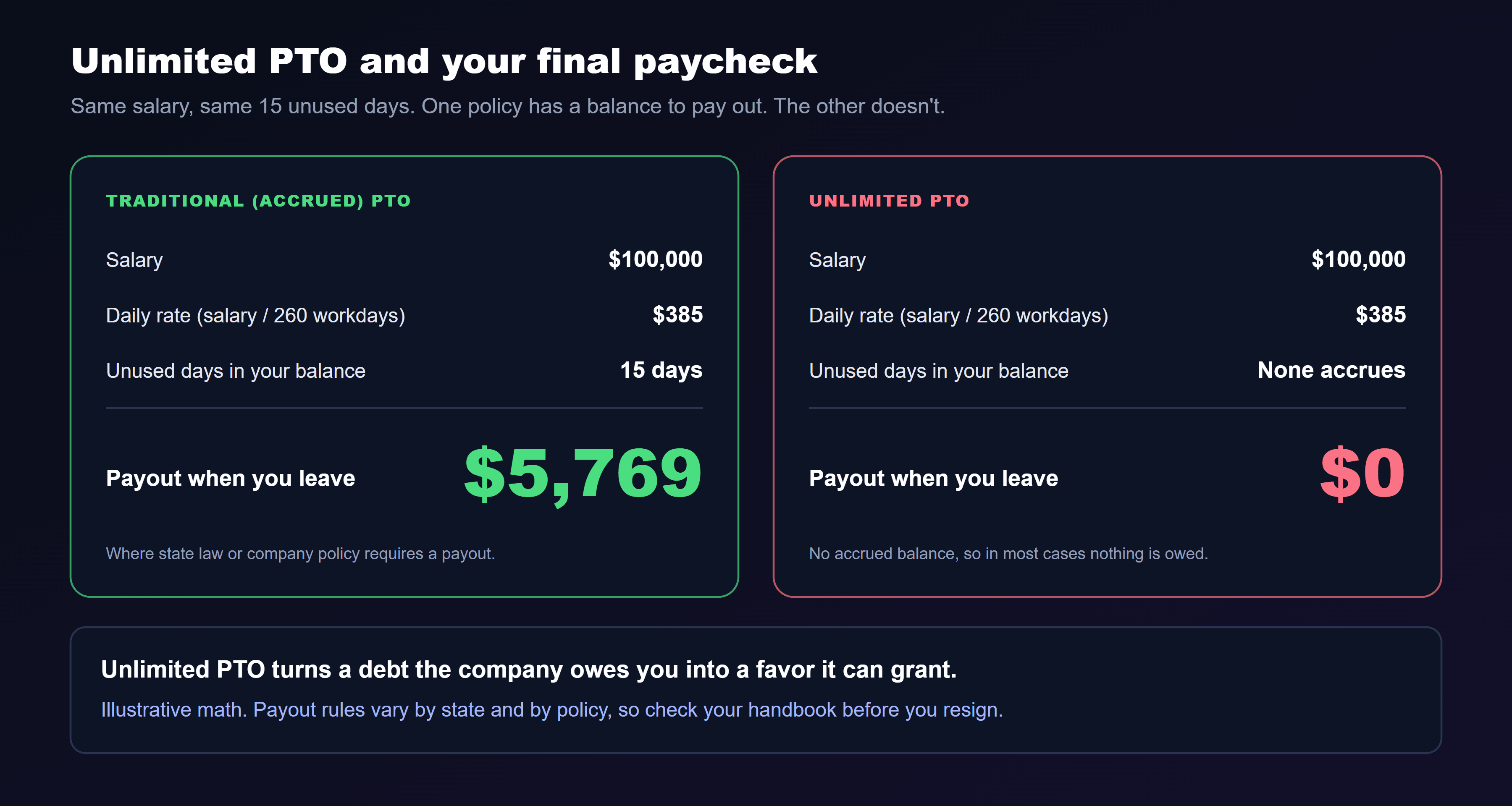
On a $100,000 salary, a working day is worth about $385. Leave with 15 unused days on an accrued plan in a payout state and your final paycheck includes roughly $5,769. Leave an unlimited plan having taken the same amount of time off and you get $0. The gap matters most in the situations you don't plan for, like a layoff, when that payout would have worked as extra severance.
Notice what Microsoft did
There is one important legal wrinkle. In McPherson v. EF Intercultural Foundation (2020), the first published California appeals decision on unlimited PTO, the court ordered an employer to pay out vacation because its "unlimited" policy wasn't in writing and, in practice, had an unspoken cap. The court said a genuine, clearly written unlimited policy may avoid payout, but one that is unlimited in name only does not. If your company's policy is informal and everyone "knows" the real limit, that case is worth mentioning to an employment lawyer.
Do people actually take less time off with unlimited PTO?
This is the most repeated claim about unlimited PTO, and the honest answer is: it depends who you ask.
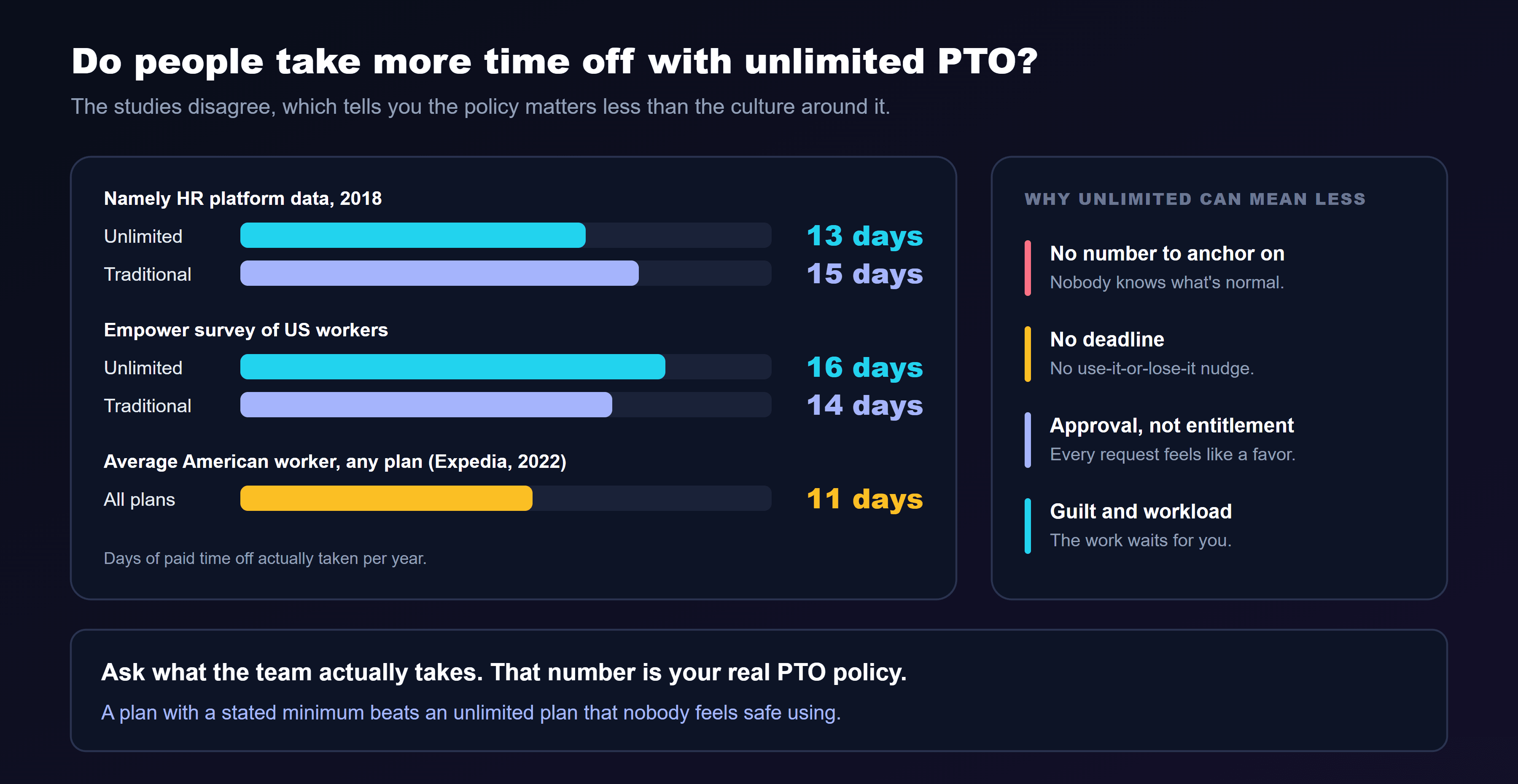
- Namely (2018): looking at real usage data across its client companies, the HR platform found people on unlimited plans took 13 days a year, versus 15 on traditional plans.
- Empower: a more recent survey found the reverse, 16 days with unlimited PTO versus 14 with a fixed allowance.
- Kickstarter: dropped its unlimited policy in 2015 after finding employees were taking less time off, and replaced it with a fixed allowance.
The studies don't really contradict each other. They show that "unlimited" is not a number, it's an absence of one, and people fill the gap with whatever their workplace signals. Four forces push usage down:
- No anchor."You have 20 days" tells you what's normal. "Take what you need" makes you guess, and most people guess low.
- No deadline. Use-it-or-lose-it rules are annoying, but they force a December break. Unlimited plans have no such nudge.
- Approval instead of entitlement.Spending days you've earned feels different from asking for a favor.
- Guilt and workload.If nobody covers your work, time off just means a worse week before and after. It's the same pressure behind quiet cracking and the push for a right to disconnect.
Unlimited PTO pros and cons
For employees, the upside is real when the culture supports it:
- No waiting months to accrue enough days for a trip, which helps most in your first year.
- Flexibility for the unplanned: a sick parent, a house move, a mental health day.
- No end-of-year scramble to use days, and no losing them.
- At companies that set a healthy norm, more total time off than a fixed plan would give.
And the downsides:
- No payout when you quit, are laid off or are fired.
- Uncertainty about how much is acceptable, which often leads to taking less.
- Uneven treatment: generous on one team, stingy on another, depending on the manager.
- Time off becomes tied to performance, so the people who most need a break may feel least able to ask.
For employers: less admin, no accrued liability and a strong recruiting line, against the risks of inconsistent approvals, burnout if people under-use it, and legal exposure where a policy is poorly written.
Is unlimited PTO a red flag?
Not automatically. Think of it as a yellow flag that the company's answers turn green or red.
- Green:they can tell you the average days taken, there's a stated minimum, time off is tracked, leaders take real vacations, and people are covered while they're out.
- Red:nobody knows the average, "we don't track it," the interviewer jokes about never using it, or the company switched from an accrued plan without paying out balances.
Pay extra attention if the company has recently made cuts. Moving to unlimited PTO shortly before layoffs reduces what departing employees are owed, so it's worth knowing the other signs that layoffs are coming.
7 questions to ask before you accept an unlimited PTO offer
Ask these once you have an offer, or at the final interview stage. They're normal questions, and a good employer will have ready answers.
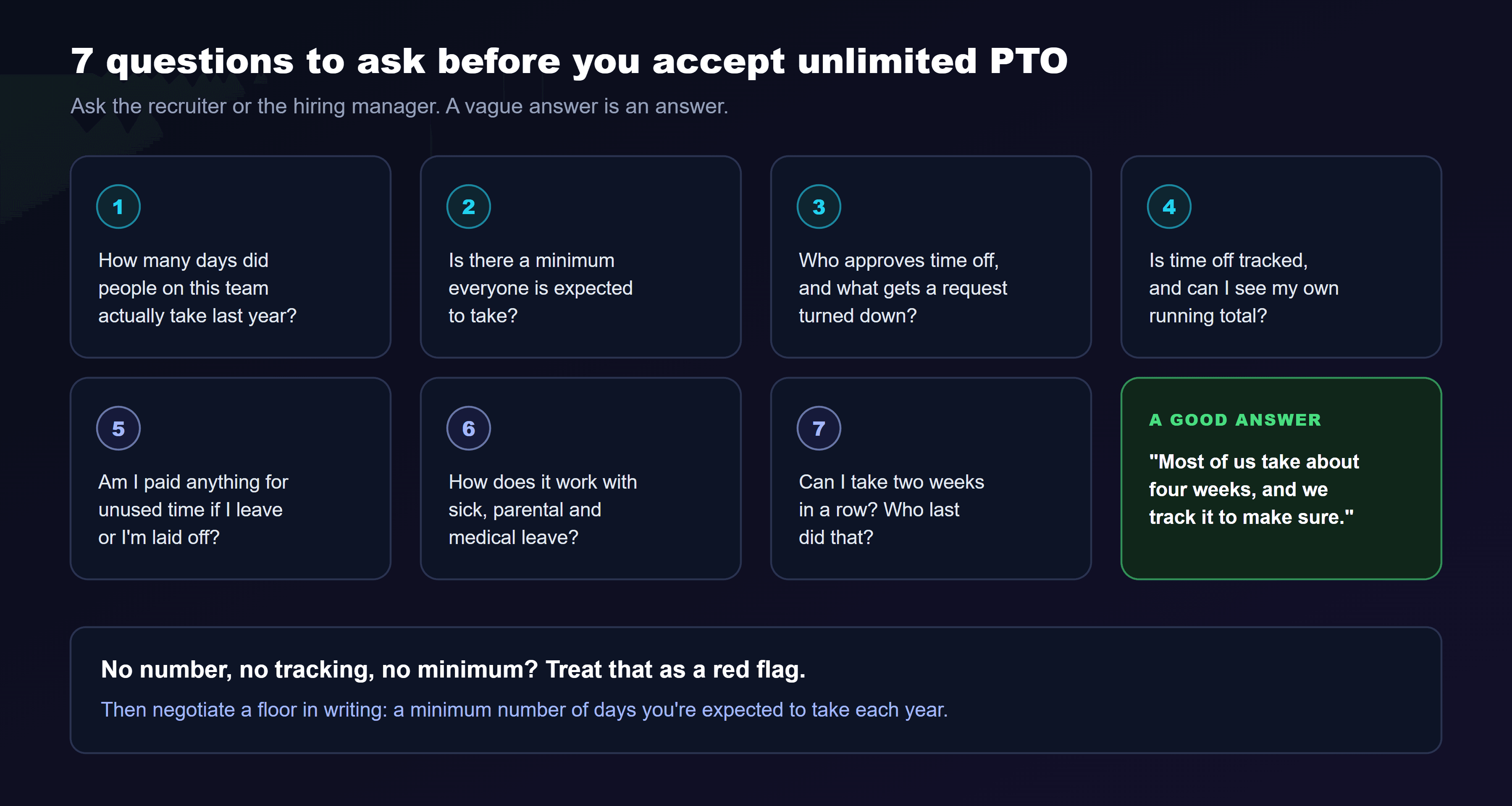
How many days did people on this team actually take last year?
Is there a minimum everyone is expected to take?
Who approves time off, and what gets a request turned down?
Is time off tracked, and can I see my own total?
Am I paid anything for unused time if I leave or I'm laid off?
How does it work with sick, parental and medical leave?
Can I take two weeks in a row? Who last did that?
More ideas in our list of questions to ask in an interview.
How to negotiate when PTO is "unlimited"
You can't ask for more than unlimited, but you can ask for certainty. Do it when you respond to the offer, alongside salary.
- Ask for a floor in writing:"I'd like the offer to note an expected minimum of 20 days a year."
- Pre-approve what's already booked:"I have a trip planned for the first two weeks of March. Can we confirm that in the offer?"
- Price the missing payout:if you're leaving a job with accrued PTO, the lost payout is a real number. Use it when you negotiate salary or a sign-on bonus.
- Comparing two offers?Treat unlimited PTO as worth the team's actual average, not infinity. Our guide to comparing multiple job offers shows how to line up the whole package.
How to actually use unlimited PTO once you have it
- Set your own number. Decide on a target, such as 20 to 25 days, in January, and track it yourself.
- Book early. Put your main breaks on the calendar at the start of the year. Time off requested months ahead is rarely refused.
- Take at least one full week.Long weekends don't give you the same recovery as a proper break.
- Hand over properly. A short handover note makes it easy for your manager to say yes next time.
- Use it before you resign.There's no payout, so unused time is simply lost. Take your break before you hand in your notice, not after.
Thinking bigger than a week off?
Weighing a new offer? Check the fit first
Paste your resume and a job description into Rankid for a free 0-100 match score and the exact requirements you meet and miss, so you know the role is right before you start comparing perks. No signup required.
Check your match score freeFor employers: how to design unlimited PTO that people actually use
If people don't take the time, you get the cost of burnout and turnover without the benefit of the perk. A policy that works usually has these parts:
- Set a minimum."Unlimited, with a minimum of 15 days" removes the guessing. Some companies that tried pure unlimited plans have moved to this model.
- Track it.You can't spot under-use or unfair approvals without data. Review usage by team and by manager.
- Make leaders go first. People copy what executives do, not what the handbook says.
- Write clear approval rules. Notice periods, coverage and blackout dates should be the same for everyone.
- Put it in writing, carefully. After McPherson, California employers in particular should have a written policy that makes clear time off is not a form of earned wages, and should apply it consistently. Get legal advice.
- Switch fairly. Pay out or preserve existing balances when you move from an accrued plan. Wiping them out damages trust on day one.
- Be honest in the job description."Unlimited PTO; the team averaged 22 days last year" is far more convincing than the perk alone. See how to write a job description.
Hiring? Spend your time on people, not piles
Rankid scores every applicant against your job description on a consistent 0-100 scale and shows the exact requirements each matched and missed, so you can shortlist in minutes. First 5 resumes free, no signup.
Try bulk screening freeFrequently asked questions
What is unlimited PTO?
Unlimited PTO (paid time off) is a policy with no fixed number of vacation days. You don't earn or accrue a balance; instead, you ask for time off as you need it and your manager approves it based on workload and performance. It's also called flexible time off, open PTO or discretionary time off. It isn't truly unlimited: requests can be denied, and you're still expected to get your work done.
Does unlimited PTO get paid out when you quit or are laid off?
Usually not. Payout laws in states such as California, Colorado, Illinois and Massachusetts apply to vacation you have earned or accrued. Under a genuine unlimited PTO policy nothing accrues, so there is generally no balance to pay out when you leave. The exception is a policy that is unlimited in name only: in McPherson v. EF Intercultural Foundation (2020), a California appeals court ordered payout because the employer's 'unlimited' policy wasn't in writing and had an implied cap in practice.
Is unlimited PTO a red flag?
Not on its own, but it's a yellow flag until you know how it works in practice. It's a good sign if the company can tell you the average number of days people take, sets a minimum, tracks usage and has leaders who visibly take time off. It's a red flag if nobody can give you a number, time off isn't tracked, or people describe feeling guilty for using it.
How many days should you take with unlimited PTO?
A reasonable benchmark is at least what a good traditional plan would give you: roughly 15 to 25 days a year, plus public holidays. Ask what your team actually takes and aim for the upper end of that range. If you take much less than you would have accrued on a traditional plan, the policy is costing you both rest and money.
Do people take less time off with unlimited PTO?
The evidence is mixed. HR platform Namely found in 2018 that employees on unlimited plans took an average of 13 days a year, compared with 15 on traditional plans. A later Empower survey found the opposite: 16 days with unlimited PTO versus 14 with a fixed allowance. The difference comes down to culture: where managers model time off and the company sets a minimum, people take more; where nobody knows what's normal, they take less.
Why do companies offer unlimited PTO?
Three reasons. It's an attractive perk that costs little to advertise. It's simpler to administer than tracking accruals and carry-over. And it removes accrued vacation from the balance sheet: with no balance owed to employees, there's no liability to carry and nothing to pay out when people leave. Wharton's Peter Cappelli has estimated US employers carry about $224 billion in unused vacation liability.
How common is unlimited PTO?
It's still rare. SHRM's 2024 Employee Benefits Survey found only about 7% of US employers offer unlimited or open leave. Indeed data shows the share of job postings advertising unlimited PTO peaked at 8.8% in March 2022 and had fallen to 2.9% by June 2024, as employers felt less pressure to compete on perks.
Can I negotiate PTO if a company has an unlimited policy?
Yes. You can't negotiate more days, but you can negotiate certainty. Ask for a written minimum number of days you're expected to take, pre-approval for a trip you've already planned, and clarity on how extended leave works. If the company is moving you from an accrued plan to unlimited, ask for your existing balance to be paid out or preserved.
Key takeaways
- Unlimited PTO means no fixed allowance and no accrued balance; time off depends on manager approval.
- Only about 7% of US employers offer it (SHRM, 2024), and job posts advertising it fell from 8.8% to 2.9% between 2022 and 2024 (Indeed).
- With no accrued balance, there's usually nothing to pay out when you leave: about $5,769 on a $100,000 salary with 15 unused days.
- Research is mixed on days taken: Namely found 13 vs 15 days on traditional plans, Empower found 16 vs 14. Culture decides.
- California's McPherson ruling shows an 'unlimited' policy that's unwritten or capped in practice can still trigger a payout.
- The key question is how many days the team actually took last year. That number is your real allowance.
- Negotiate certainty: a written minimum, pre-approved trips, and compensation for any payout you're giving up.
- Employers get the best results with a stated minimum, tracking, leaders who model time off and fair treatment of existing balances.
Frequently asked questions
What is unlimited PTO?
Unlimited PTO (paid time off) is a policy with no fixed number of vacation days. You don't earn or accrue a balance; instead, you ask for time off as you need it and your manager approves it based on workload and performance. It's also called flexible time off, open PTO or discretionary time off. It isn't truly unlimited: requests can be denied, and you're still expected to get your work done.
Does unlimited PTO get paid out when you quit or are laid off?
Usually not. Payout laws in states such as California, Colorado, Illinois and Massachusetts apply to vacation you have earned or accrued. Under a genuine unlimited PTO policy nothing accrues, so there is generally no balance to pay out when you leave. The exception is a policy that is unlimited in name only: in McPherson v. EF Intercultural Foundation (2020), a California appeals court ordered payout because the employer's 'unlimited' policy wasn't in writing and had an implied cap in practice.
Is unlimited PTO a red flag?
Not on its own, but it's a yellow flag until you know how it works in practice. It's a good sign if the company can tell you the average number of days people take, sets a minimum, tracks usage and has leaders who visibly take time off. It's a red flag if nobody can give you a number, time off isn't tracked, or people describe feeling guilty for using it.
How many days should you take with unlimited PTO?
A reasonable benchmark is at least what a good traditional plan would give you: roughly 15 to 25 days a year, plus public holidays. Ask what your team actually takes and aim for the upper end of that range. If you take much less than you would have accrued on a traditional plan, the policy is costing you both rest and money.
Do people take less time off with unlimited PTO?
The evidence is mixed. HR platform Namely found in 2018 that employees on unlimited plans took an average of 13 days a year, compared with 15 on traditional plans. A later Empower survey found the opposite: 16 days with unlimited PTO versus 14 with a fixed allowance. The difference comes down to culture: where managers model time off and the company sets a minimum, people take more; where nobody knows what's normal, they take less.
Why do companies offer unlimited PTO?
Three reasons. It's an attractive perk that costs little to advertise. It's simpler to administer than tracking accruals and carry-over. And it removes accrued vacation from the balance sheet: with no balance owed to employees, there's no liability to carry and nothing to pay out when people leave. Wharton's Peter Cappelli has estimated US employers carry about $224 billion in unused vacation liability.
How common is unlimited PTO?
It's still rare. SHRM's 2024 Employee Benefits Survey found only about 7% of US employers offer unlimited or open leave. Indeed data shows the share of job postings advertising unlimited PTO peaked at 8.8% in March 2022 and had fallen to 2.9% by June 2024, as employers felt less pressure to compete on perks.
Can I negotiate PTO if a company has an unlimited policy?
Yes. You can't negotiate more days, but you can negotiate certainty. Ask for a written minimum number of days you're expected to take, pre-approval for a trip you've already planned, and clarity on how extended leave works. If the company is moving you from an accrued plan to unlimited, ask for your existing balance to be paid out or preserved.