Revenge Quitting: Why Half of Workers Have Done It, What It Really Costs You, and How to Quit Smarter
Everyone has rehearsed it. The meeting where your manager takes credit for your work one more time, and instead of nodding, you stand up, say "I quit, effective now," and walk out. Nearly half of American workers say they've actually done some version of it. It has a name now: revenge quitting. And for about 24 hours, it feels incredible. This guide is about what happens on day two, and how to leave a bad job in a way that costs them more than it costs you.
Quick answer
Quick answer: revenge quitting is leaving abruptly, usually without notice, to protest bad treatment. A 2025 Monster survey found 47% of US workers have done it and 87% think it's justified. Only 4%do it over pay; the drivers are toxic culture and bad managers. It's usually legal in the US, but it can cost you PTO payouts, unemployment benefits, rehire eligibility and references. Never delete files or take data. Unless you're unsafe, use a 72-hour cool-down, line up your money and leave strategically.
What is revenge quitting?
Revenge quitting means resigning suddenly, often with no notice and sometimes timed for maximum impact, like the middle of a big project or the week before a launch, as a protest against how you've been treated. The point isn't just to leave. It's to make them feel it.
- Quiet quitting: you stay and do the bare minimum.
- Loud quitting: you stay but openly complain, or start a very public job search.
- Rage quitting: a spontaneous, emotional walkout, often on the spot.
- Revenge quitting: a deliberate, abrupt exit designed to hurt the employer, sometimes planned for weeks.
Revenge quitting statistics: how common it really is
In a March 2025 survey of more than 3,600 US workers, Monster found:
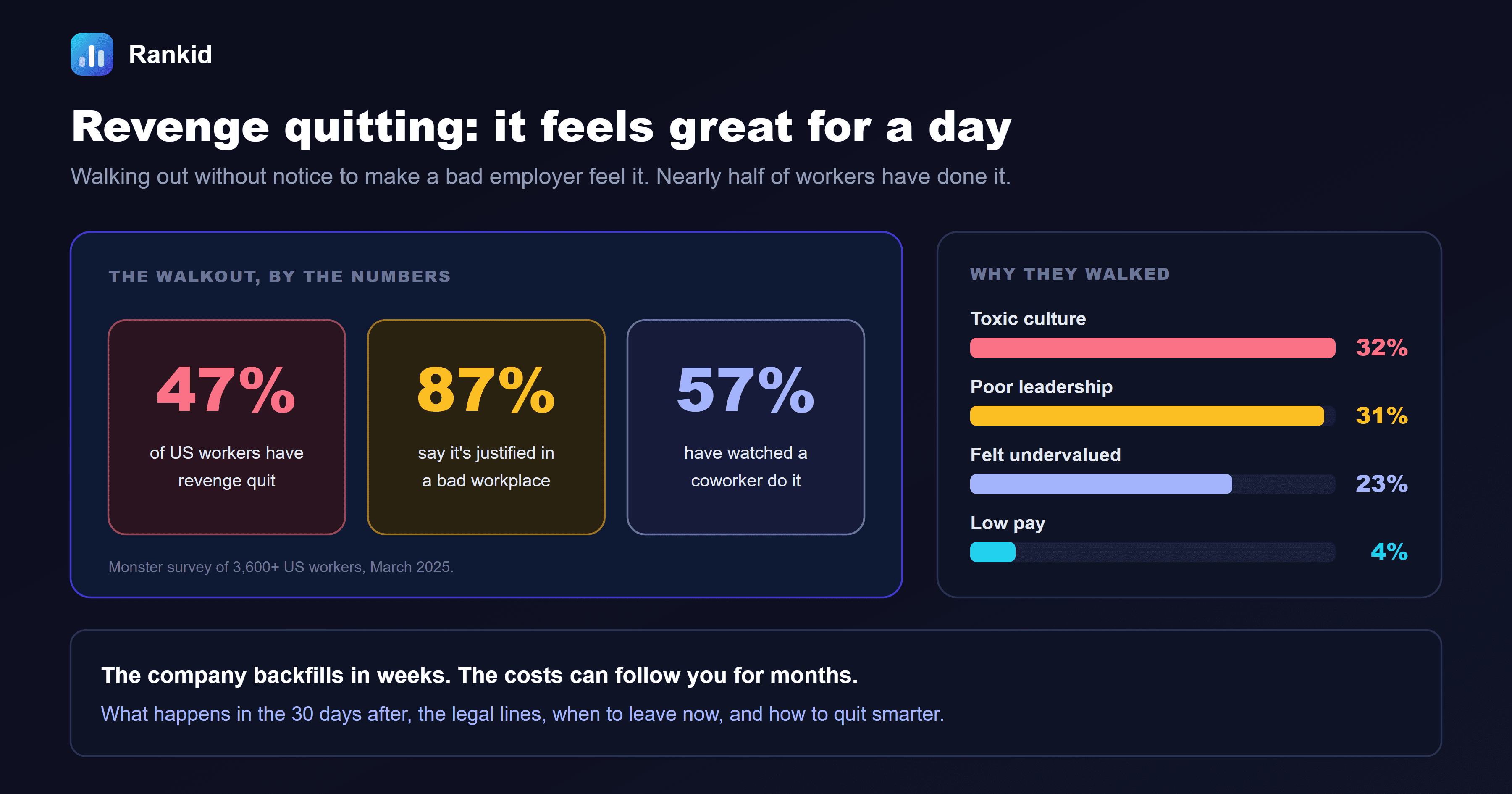
- 47% had abruptly quit a job without notice as a protest.
- 57% had watched at least one coworker do it.
- 87% believed revenge quitting is justified in a poor work environment.
- The top triggers were a toxic or disrespectful culture (32%), poor leadership or lack of trust (31%) and feeling undervalued (23%). Low pay was behind only about 4% of sudden exits.
It isn't just impatient new hires either. In the same survey, 17% of respondents had revenge quit within their first six months, but 18% had done it after more than two years in the job. Some of the most dramatic exits come from people who stayed loyal far longer than they should have.
Why revenge quitting exploded
Glassdoor predicted it. In its Worklife Trends 2025 report, 65%of professionals said they felt stuck in their jobs, rising to 73% in tech, at a time when quit rates had fallen to their lowest levels since 2020. When people feel trapped for years by a tough job market, resentment doesn't disappear. It builds, and the moment an exit appears, it comes out all at once.
Add the pressures of the last two years, including return-to-office mandates, dry promotions with no raise, and AI-driven workload creep, and you get a workforce that is exhausted, disrespected and waiting. Many first go through quiet cracking or job hugging. Revenge quitting is what happens when the hug ends.
What a revenge quit really costs you: the 30 days after
The fantasy ends at the door. Here's what tends to happen next, and which parts you can protect.
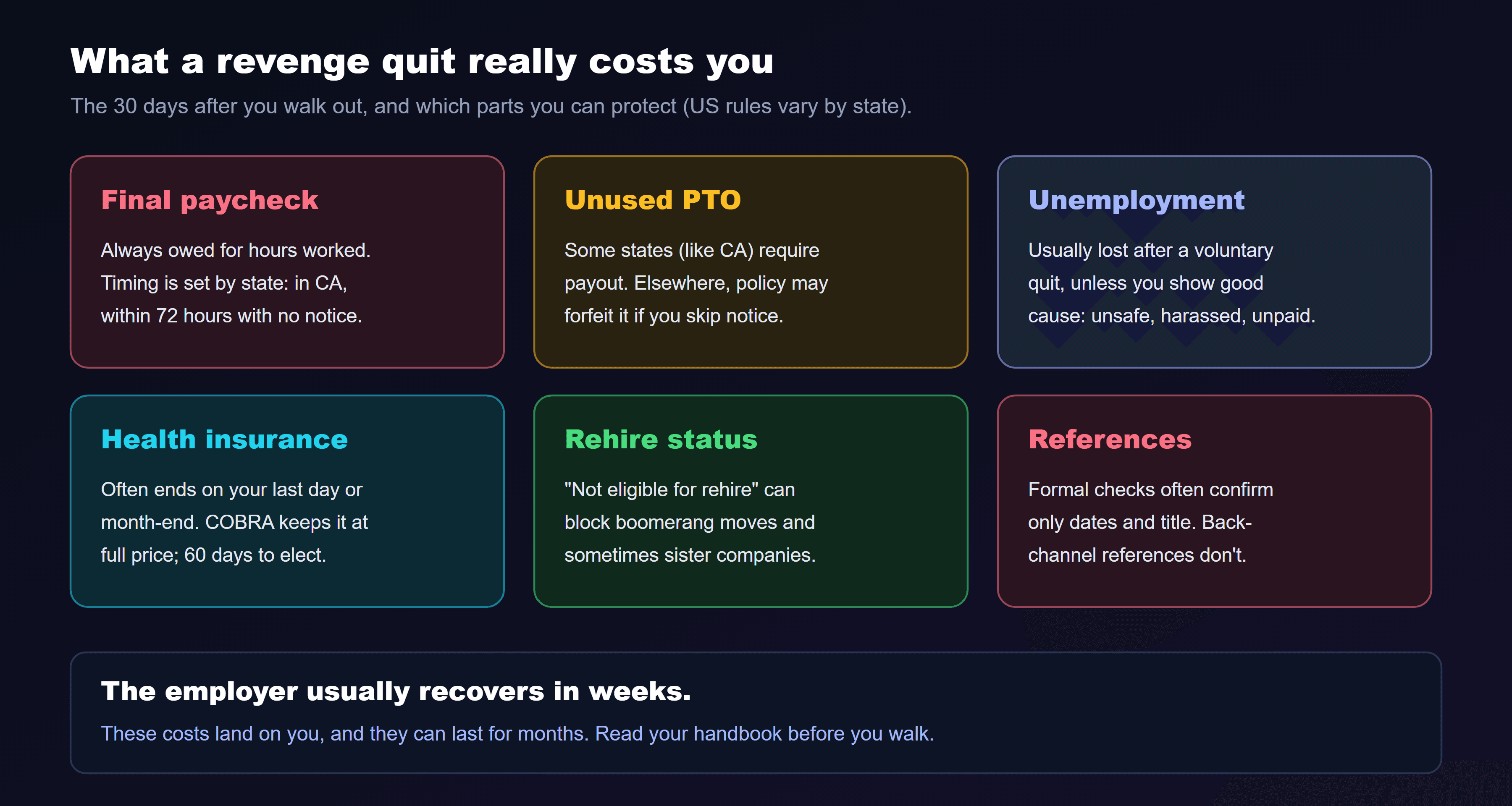
- Your final paycheck.You're always owed wages for time worked, but there's no federal rule on timing; states set it. In California, for example, final pay is due within 72 hours if you quit without notice.
- Unused PTO.Some states, like California, require employers to pay out earned vacation. Many others let company policy decide, and some policies forfeit the payout if you don't give notice. Read your handbook before you walk.
- Unemployment benefits. A voluntary quit usually disqualifies you, unless you can show good cause connected to the job.
- Health insurance. Coverage often ends on your last day or at the end of the month. COBRA can continue it, but at the full premium. Leaving job coverage also opens a 60-day special enrollment window on the ACA Marketplace.
- Rehire eligibility.A "not eligible for rehire" flag can close the door on a future return, and boomerang moves are increasingly common.
- References. Formal checks often confirm only dates and title, but managers talk, and backchannel references are common. See our guide to job references.
The uncomfortable truth
The legal lines: what you can and can't do on the way out
- Quitting with no notice:usually legal in the US, where most jobs are at-will, unless your contract requires notice. In the UK, employees must give at least one week's statutory notice after a month's service, and contracts often require more. Check your notice period.
- Deleting files, wiping laptops or sabotaging systems:don't. Work product belongs to the employer, and destroying it can bring breach-of-contract claims, lawsuits and, in serious cases, criminal charges under computer misuse laws.
- Taking client lists, code or confidential documents:also don't. Confidentiality agreements and trade secret laws apply after you leave, and non-compete and non-solicit clauses may too.
- What you can usually keep: your own pay stubs, tax forms, benefits paperwork, offer letter, and performance reviews or praise you received. Save personal copies before your access is cut.
- Public posts:truthful, factual reviews are generally protected. False statements of fact about named people can be defamation. Write it after you've left, calmly, and stick to what happened.
When walking out immediately is the right call
Not every abrupt exit is a mistake. Sometimes leaving today is the only sane option:
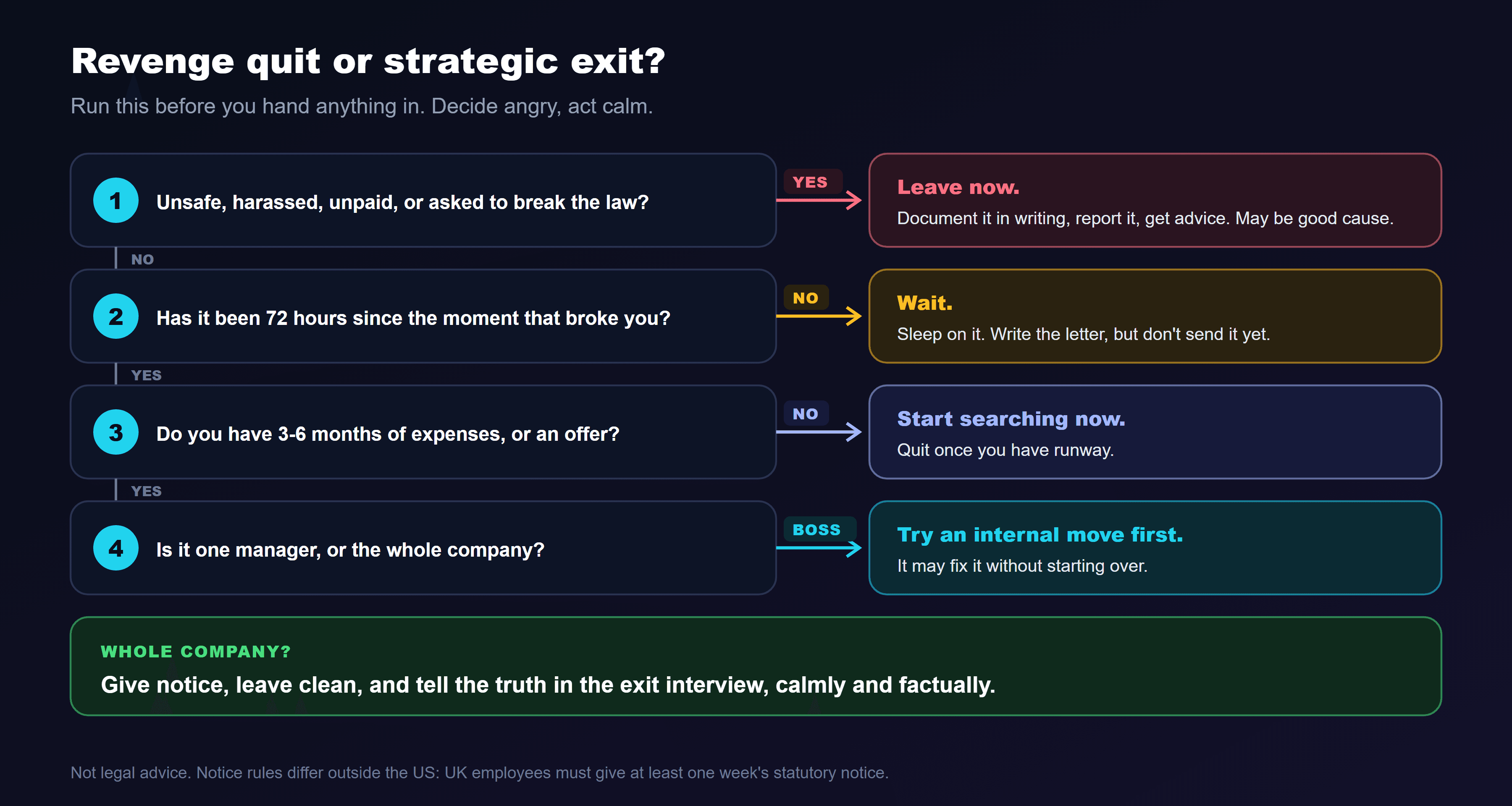
- Your physical safety is at risk, or you're being asked to work in unsafe conditions.
- You're being harassed or discriminated against and reporting hasn't stopped it.
- Your employer isn't paying you what you're owed.
- You're being asked to do something illegal.
- Staying is seriously damaging your health.
In these cases, document everything, report it in writing if you can, and get advice from an employment lawyer or your state labor department. A documented exit for good cause can protect your unemployment claim in the US, and in the UK it may support a constructive dismissal claim, where you resign because your employer seriously breached your contract.
The smarter alternative: a strategic exit
The best revenge is leaving well: on your timeline, with your money, references and reputation intact. Use this decision path before you hand anything in.
Take 72 hours
Line up your runway
Save what's yours
Check whether it's the job or the boss
Write a boring resignation letter
Tell the truth in the exit interview, carefully
Want them to feel it? Leave this way
How to explain an abrupt exit in a job interview
If you already revenge quit, don't panic. You need one calm, short, forward-looking answer to "why did you leave?"
- Keep it brief:"The culture had changed a lot after a leadership shift, and it stopped being a place where I could do my best work. I decided to leave and focus on finding the right next role."
- Own the short notice, if asked:"In hindsight, I'd have handled the timing differently. I've learned to address problems earlier."
- Pivot to what you want:"What I'm looking for now is a team with clear ownership and a manager who gives direct feedback, which is a big part of why this role appeals to me."
- Never trash the old employer.Interviewers hear it as a preview of how you'll talk about them. More examples in our guide to reasons for leaving a job.
Leaving? Make the next job a better fit
Paste your resume and a job description into Rankid for a free 0-100 match score and the exact requirements you meet and miss, so your next move is a step up, not just an escape. No signup required.
Check your match score freeFor employers: how to prevent revenge quitting
Revenge quits rarely come out of nowhere. They're the end of months of ignored signals. Monster asked workers what would have stopped them, and the answers are mostly free:
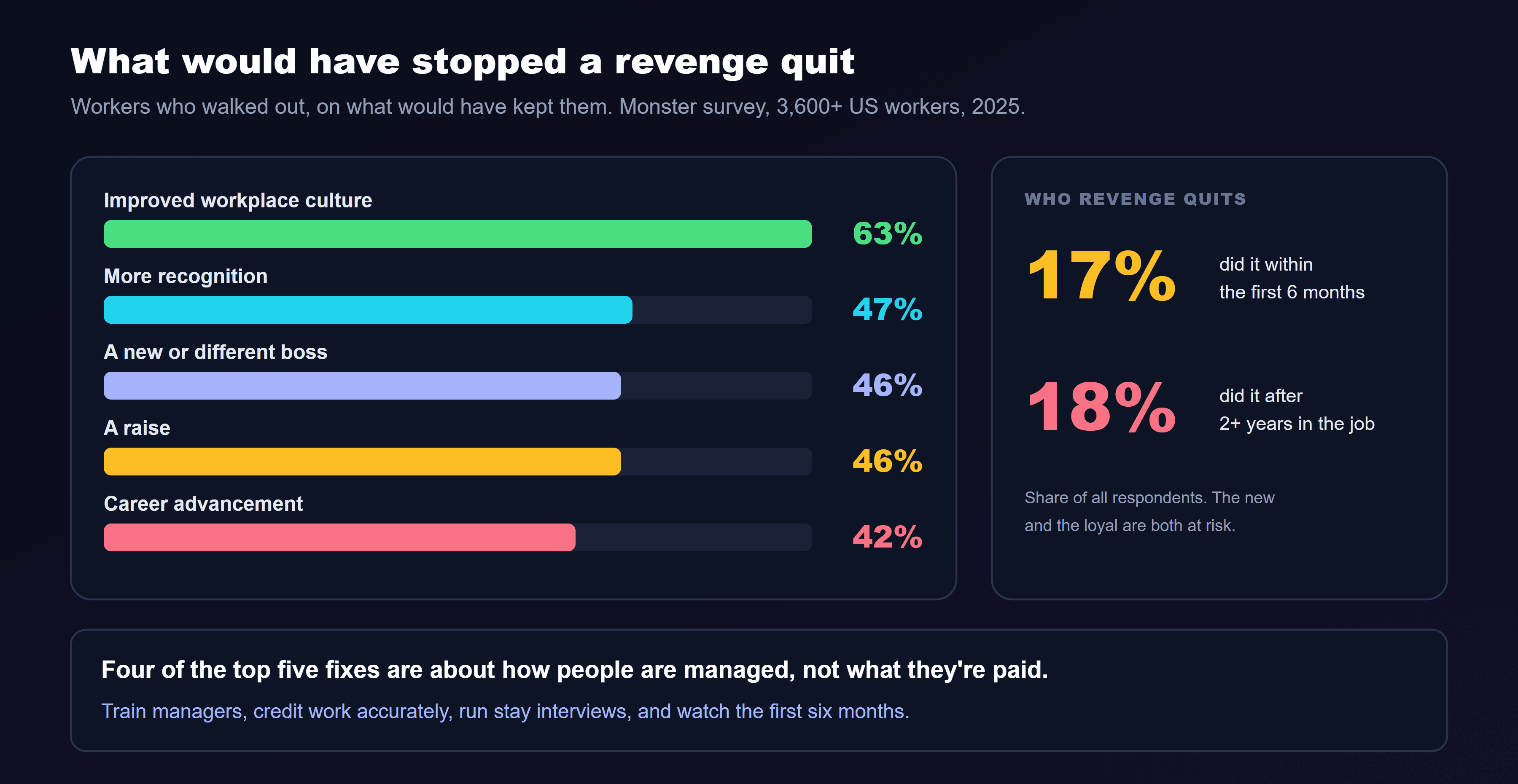
- Fix managers first. 46% said a different boss would have kept them. Train managers, measure them on retention, and act when the same team keeps losing people.
- Recognize work publicly and accurately. 47% wanted more recognition. Credit theft is one of the fastest routes to a revenge quit.
- Run real one-on-ones and stay interviews. Ask what would make someone leave before they do. Our guide to one-on-one meetings has questions that surface problems early.
- Watch the first six months.17% of respondents had revenge quit within six months, which usually means the job didn't match what was promised. Strong onboarding and honest job descriptions help.
- Don't take loyalty for granted. 18% had walked out after two-plus years. Long tenure without growth is a risk, not a guarantee.
- Have a coverage plan. Document critical work and cross-train, so no single exit can take a project down. See succession planning.
Backfill fast without lowering the bar
When someone leaves suddenly, Rankid scores every applicant against your job description on a consistent 0-100 scale and shows the exact requirements each matched and missed, so you can shortlist in minutes. First 5 resumes free, no signup.
Try bulk screening freeFrequently asked questions
What is revenge quitting?
Revenge quitting is resigning abruptly, usually without notice and sometimes at the most inconvenient moment for the employer, as a protest against poor treatment, a toxic culture or bad management. It's the opposite of quiet quitting: instead of silently doing the minimum, the employee makes a loud, sudden exit. Glassdoor named it a top workplace trend for 2025.
How common is revenge quitting?
Very. A March 2025 Monster survey of more than 3,600 US workers found 47% had abruptly quit a job without notice as a protest, 57% had seen a coworker do it, and 87% believed revenge quitting is justified in a poor work environment. The top reasons were a toxic culture (32%), poor leadership or lack of trust (31%) and feeling undervalued (23%). Low pay drove only about 4% of sudden exits.
Is it illegal to quit without notice?
In most of the US, no. Most employment is at-will, so you can leave at any time without notice unless you've signed a contract that requires it. Two weeks' notice is a courtesy, not a law. In the UK and many other countries, notice is a legal and contractual requirement: UK employees must give at least one week's statutory notice after a month's service, and contracts often require more.
What happens if you quit without notice?
You'll still be paid for the hours you worked, but you may lose things that depend on notice: some employers' policies forfeit unused PTO payouts if you don't give notice (where state law allows), your file may be marked 'not eligible for rehire,' your health coverage may end within days, and former managers may share their experience informally. You generally also can't collect unemployment after a voluntary quit unless you had good cause.
Can I get unemployment if I quit my job?
Usually not in the US, because unemployment insurance is for people who lose work through no fault of their own. Many states make exceptions for good cause connected to the job, such as unsafe conditions, harassment, unpaid wages or a major cut in pay or hours. Rules vary by state, so document the problems and apply anyway if you think you qualify.
Will revenge quitting hurt my future job search?
It can. Many employers only confirm dates and job titles in formal reference checks, but industries are small and backchannel references are common. The bigger risk is the interview question 'why did you leave?' Prepare a calm, brief, forward-looking answer, and avoid criticizing your former employer.
Is it okay to delete files or take data when I quit?
No. Work files, client lists and code generally belong to your employer. Deleting or taking them can breach your employment contract, confidentiality agreement and trade secret laws, and may expose you to lawsuits or even criminal charges under computer misuse laws. You can usually keep personal items such as your own pay stubs, benefits documents and performance reviews you were given.
When is it right to quit immediately?
When staying puts you at real risk: unsafe working conditions, harassment or discrimination that isn't being addressed, unpaid wages, being asked to do something illegal, or a serious threat to your health. In those cases, document what happened, report it in writing if you can, and get advice. A well-documented exit for good cause may also protect your unemployment eligibility, or support a constructive dismissal claim in the UK.
Key takeaways
- Revenge quitting is leaving abruptly, usually without notice, to protest poor treatment, a toxic culture or bad management.
- Monster found 47% of US workers have done it, 57% have seen a coworker do it, and 87% think it's justified in a bad workplace.
- Only about 4% of sudden exits are about pay; toxic culture (32%), poor leadership (31%) and feeling undervalued (23%) drive most.
- It's usually legal in the US, but it can cost you PTO payouts, unemployment eligibility, rehire status, references and health coverage.
- Never delete files, sabotage systems or take confidential data. Do save your own pay stubs, benefits documents and reviews.
- If you're unsafe, harassed, unpaid or asked to break the law, leave now, document everything and get advice.
- Otherwise, take 72 hours, line up runway, check if it's the boss or the company, and resign with a short, boring letter.
- Employers can prevent most revenge quits with better managers, recognition, stay interviews and honest onboarding.
Frequently asked questions
What is revenge quitting?
Revenge quitting is resigning abruptly, usually without notice and sometimes at the most inconvenient moment for the employer, as a protest against poor treatment, a toxic culture or bad management. It's the opposite of quiet quitting: instead of silently doing the minimum, the employee makes a loud, sudden exit. Glassdoor named it a top workplace trend for 2025.
How common is revenge quitting?
Very. A March 2025 Monster survey of more than 3,600 US workers found 47% had abruptly quit a job without notice as a protest, 57% had seen a coworker do it, and 87% believed revenge quitting is justified in a poor work environment. The top reasons were a toxic culture (32%), poor leadership or lack of trust (31%) and feeling undervalued (23%). Low pay drove only about 4% of sudden exits.
Is it illegal to quit without notice?
In most of the US, no. Most employment is at-will, so you can leave at any time without notice unless you've signed a contract that requires it. Two weeks' notice is a courtesy, not a law. In the UK and many other countries, notice is a legal and contractual requirement: UK employees must give at least one week's statutory notice after a month's service, and contracts often require more.
What happens if you quit without notice?
You'll still be paid for the hours you worked, but you may lose things that depend on notice: some employers' policies forfeit unused PTO payouts if you don't give notice (where state law allows), your file may be marked 'not eligible for rehire,' your health coverage may end within days, and former managers may share their experience informally. You generally also can't collect unemployment after a voluntary quit unless you had good cause.
Can I get unemployment if I quit my job?
Usually not in the US, because unemployment insurance is for people who lose work through no fault of their own. Many states make exceptions for good cause connected to the job, such as unsafe conditions, harassment, unpaid wages or a major cut in pay or hours. Rules vary by state, so document the problems and apply anyway if you think you qualify.
Will revenge quitting hurt my future job search?
It can. Many employers only confirm dates and job titles in formal reference checks, but industries are small and backchannel references are common. The bigger risk is the interview question 'why did you leave?' Prepare a calm, brief, forward-looking answer, and avoid criticizing your former employer.
Is it okay to delete files or take data when I quit?
No. Work files, client lists and code generally belong to your employer. Deleting or taking them can breach your employment contract, confidentiality agreement and trade secret laws, and may expose you to lawsuits or even criminal charges under computer misuse laws. You can usually keep personal items such as your own pay stubs, benefits documents and performance reviews you were given.
When is it right to quit immediately?
When staying puts you at real risk: unsafe working conditions, harassment or discrimination that isn't being addressed, unpaid wages, being asked to do something illegal, or a serious threat to your health. In those cases, document what happened, report it in writing if you can, and get advice. A well-documented exit for good cause may also protect your unemployment eligibility, or support a constructive dismissal claim in the UK.