Job Searching Over 50: How Age Bias Works and How to Get Past It (2026)
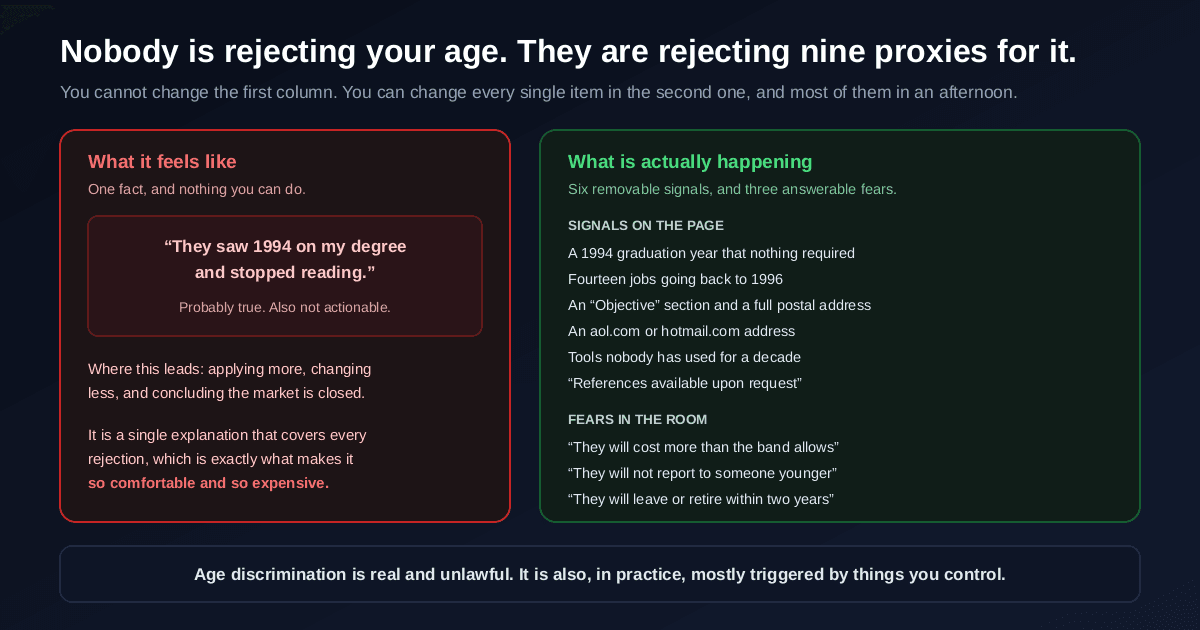
Twenty-two applications, no interviews, and one explanation that fits all of it: they saw the graduation year and stopped reading. It is a comfortable explanation because it is probably true at least some of the time, and it is an expensive one because it leads nowhere. There is a more useful version of the same observation. Almost nobody is looking at your resume and rejecting your age. They are reacting to a cluster of specific signals that stand in for it, and to three specific fears, and you can do something about every single one of them.
Quick answer
Quick answer: age bias in hiring is real and mostly happens at the six-second resume scan, triggered by removable signals rather than by your age itself. Fix the eight: graduation year, an aol or birth-year email, a full postal address, an "Objective" section, every job back to the 1990s, obsolete tools, "references available on request", and a four-page .doc. Answer "overqualified" as three fears: cost, boredom, and reporting to a younger manager. Never volunteer reassurance about your age. And use the twenty-eight-year-old test on everything you claim.
Where age bias actually enters the process
Before fixing anything, it is worth knowing where the losses occur, because the answer concentrates your effort enormously. Most of it happens before a human has spoken to you.
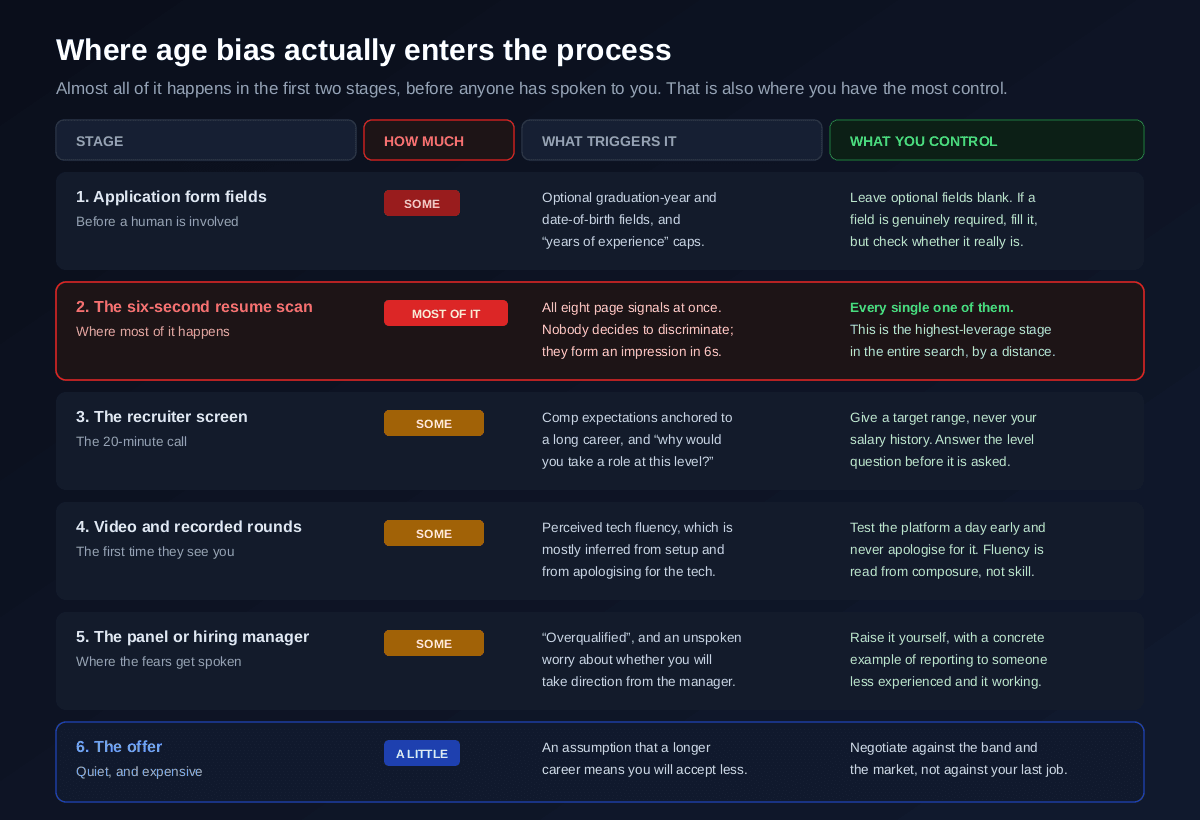
The important line on that table is the second row. In a six-second scan, nobody makes a decision to discriminate. They form an impression from a cluster of signals arriving simultaneously, and almost all of those signals are on the page by choice. That is not a comforting observation, it is a practical one: it means the highest-leverage work in your entire search is a single afternoon of editing.
The eight-signal audit
Here is a resume carrying all eight, which is more common than you would think, along with how long each fix actually takes.
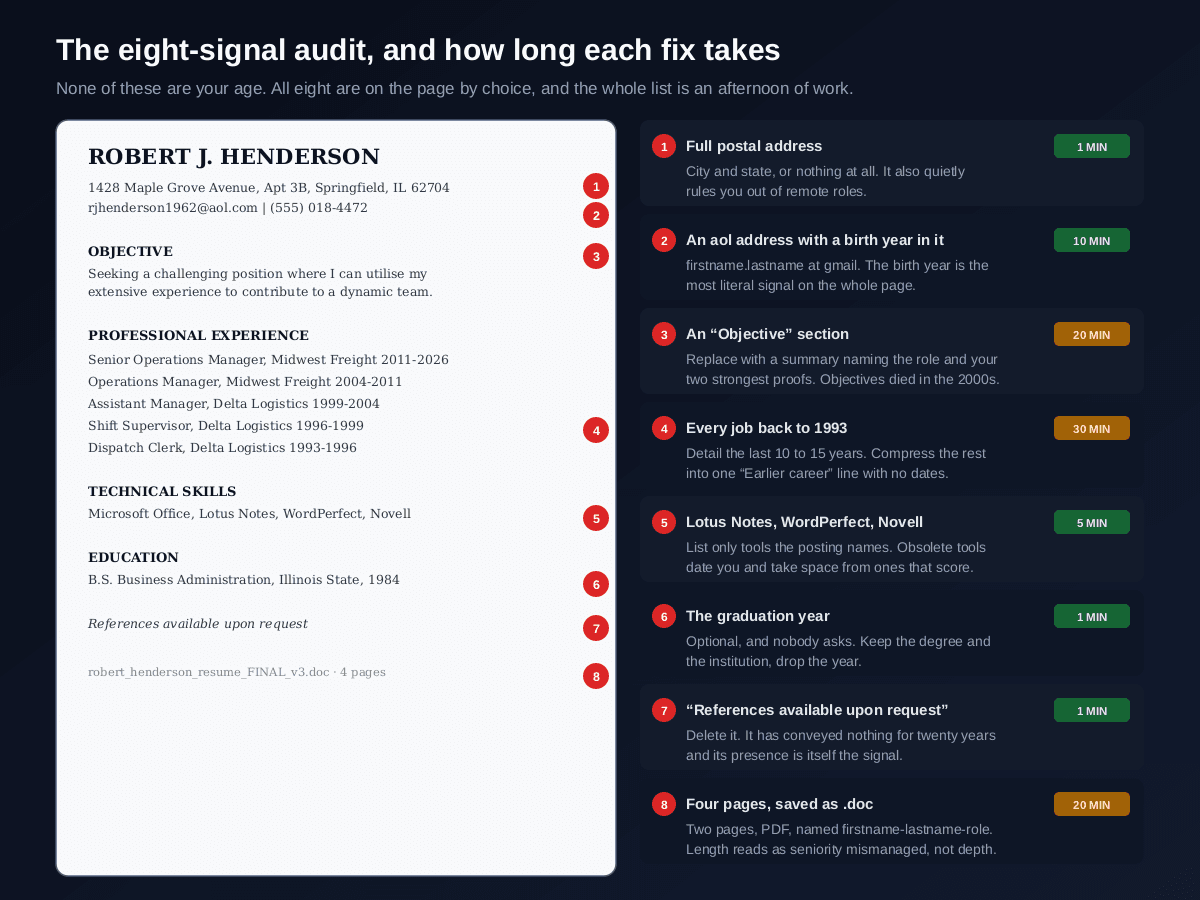
The whole list is under two hours, and four of the eight take under five minutes each. The two that need real thought are the work history and the summary.
On work history: detail the last 10 to 15 years, then compress everything earlier into one undated line such as "Earlier career: operations and logistics roles at Delta Logistics and Midwest Freight". That acknowledges the history without dating it, and it puts the page space where the reader is actually looking. How far back a resume should go covers the mechanics, and how long a resume should be covers the length question, which for experienced candidates is nearly always two pages rather than four.
On the summary: replace any "Objective" section with a summary that names the role you want and your two strongest proofs for it. Writing a professional resume summary covers the format, and it is also your highest-value keyword position, which matters because the page has to clear an ATS before any of this reaches a human.
Is this dishonest? No, and the line is clean
How to answer "you might be overqualified"
This is almost never a comment about your ability. It is three separate fears wearing one sentence, and each one needs a different answer.
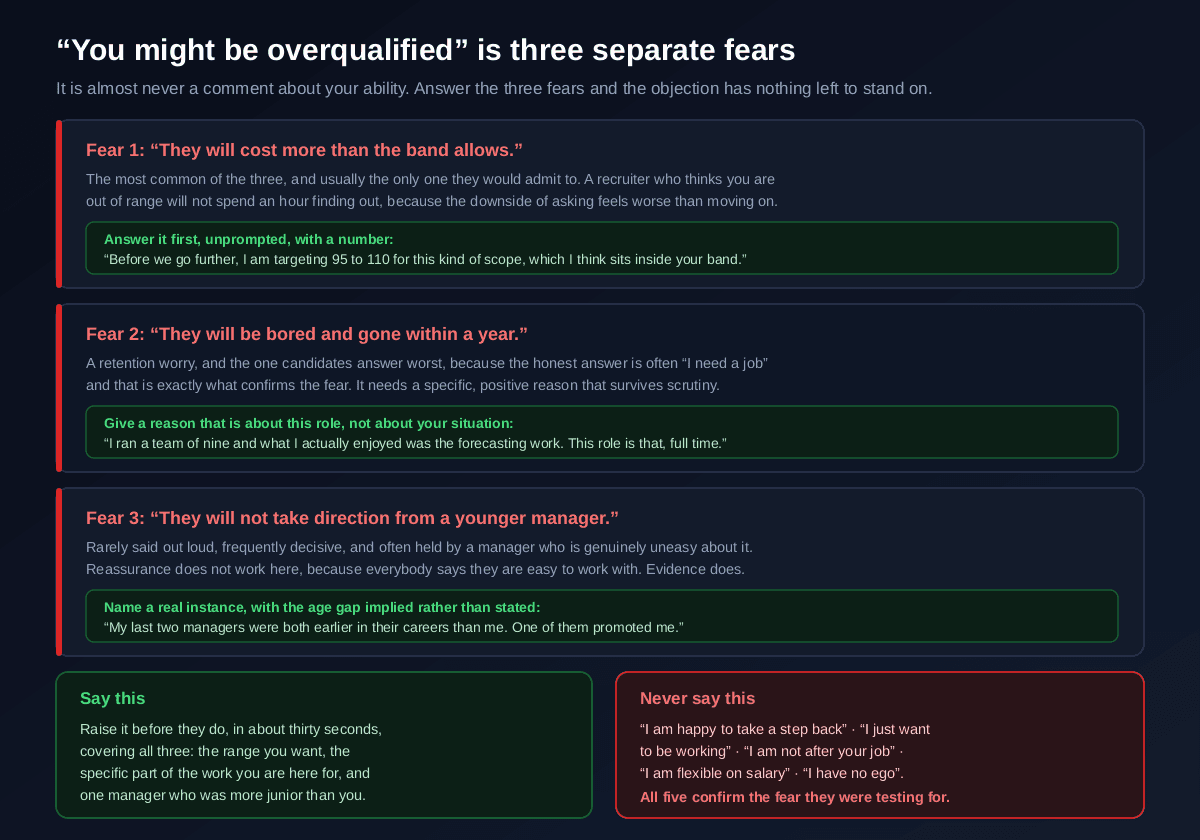
Raise it before they do.Thirty seconds covering all three, early in the first real conversation, is worth more than any answer you give once they have already formed the concern. And the five phrases in the red box all do the same damage: they confirm the fear that was being tested. "I am happy to take a step back" answers the cost fear by conceding it, and confirms the boredom fear at the same time.
On money specifically, give a target range and never your salary history, which anchors an offer to your last job rather than to this one and matters more the longer your career has been. How to negotiate salary covers the mechanics, and how to respond to a recruiter covers the exact wording for the first message, which is where this conversation usually starts.
Selling experience without saying "wealth of experience"
There is a test that sorts useful claims from useless ones instantly, and it eliminates most of what experienced candidates habitually say about themselves.
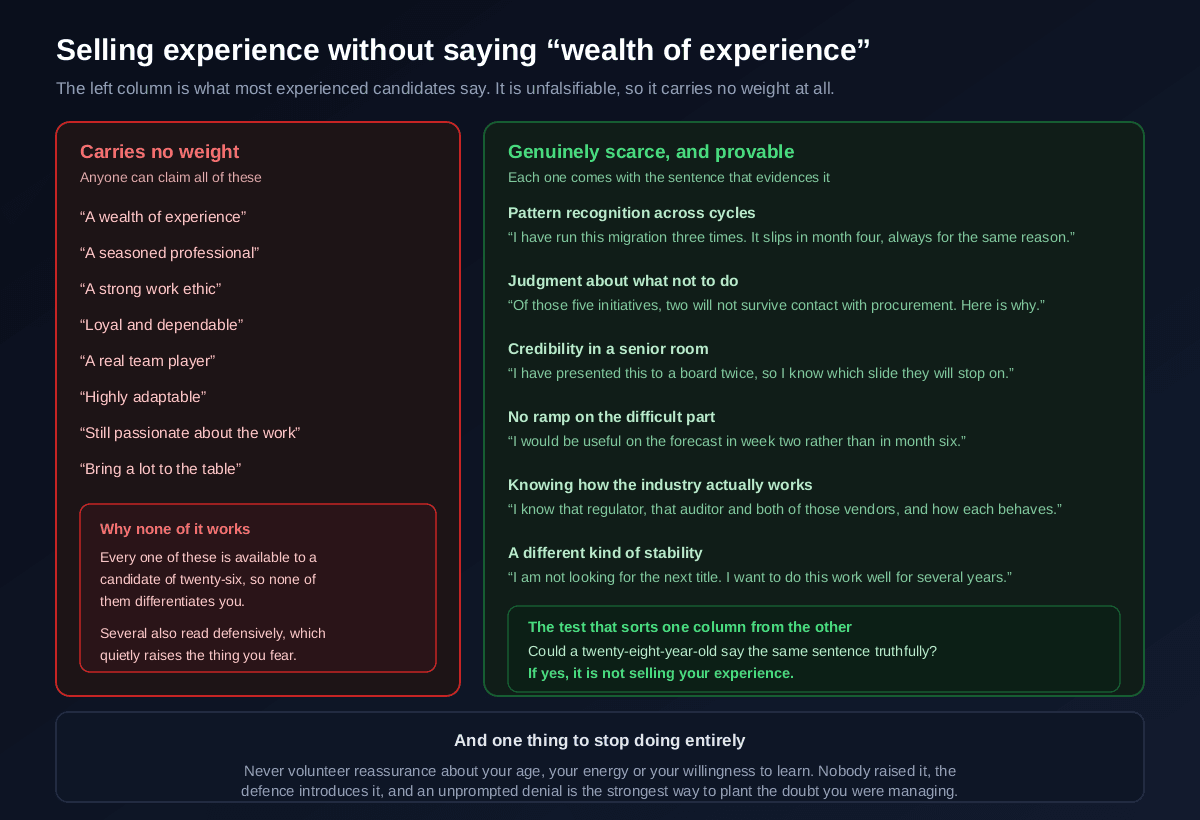
The test: could a twenty-eight-year-old say the same sentence truthfully?If yes, it is not selling your experience. "A strong work ethic" passes for anyone. "I have run this migration three times and it slips in month four, always for the same reason" does not, and it is the kind of thing a hiring manager genuinely cannot buy cheaper.
The underlying frame is worth making explicit, because it reframes the whole competition. A manager hiring a less experienced candidate is buying a ramp-up period, a supervision cost, and a real probability that the person cannot do the hard part. You can remove all three. Saying that concretely is far more persuasive than any claim about attitude, and it is checkable, which is what makes it land. Quantifying achievements is how you get those sentences onto the page.
And the thing to stop doing entirely: never volunteer reassurance about your age. "I know I have been at this a long time but I am still keen to learn" introduces a doubt nobody raised. An unprompted denial is the most reliable way to plant an idea.
What they cannot ask, and what to do if they do
Few trained interviewers ask your date of birth. The questions that actually come up are proxies, and each has a legitimate concern behind it that could have been asked neutrally.
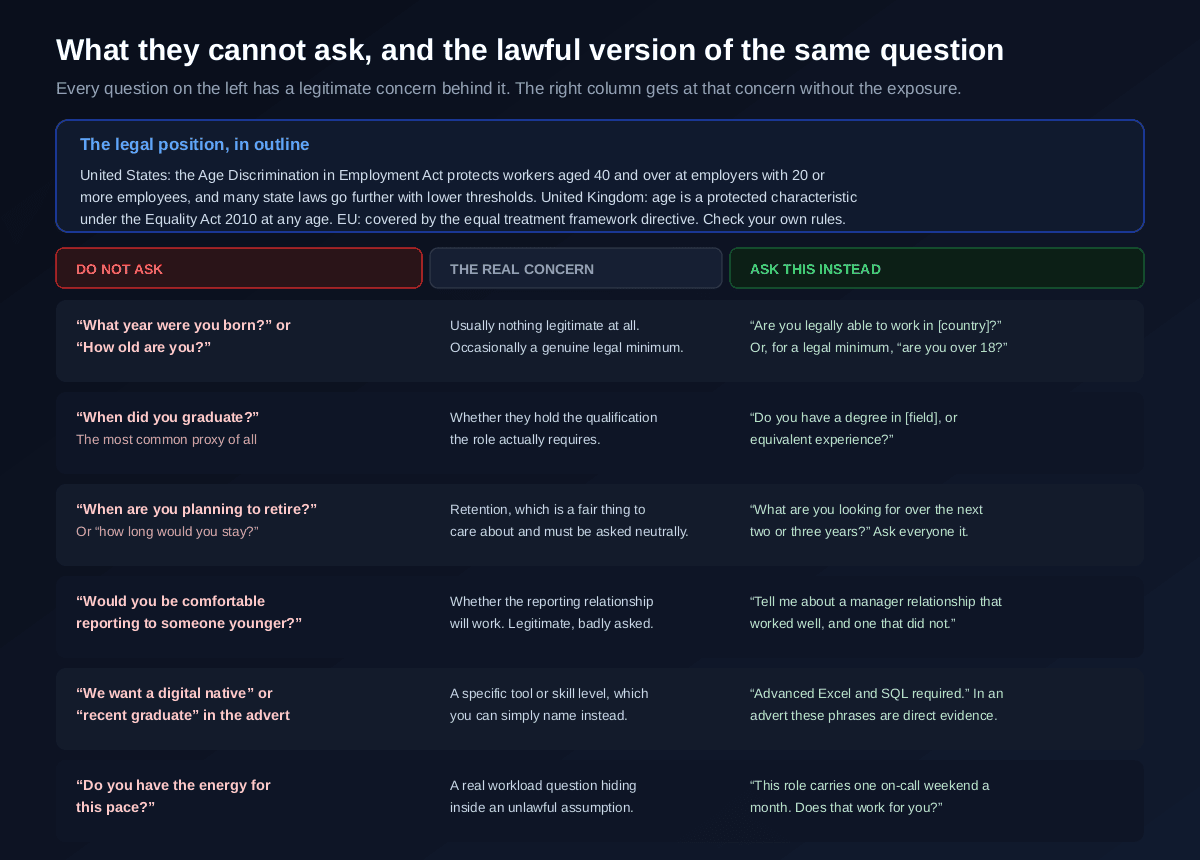
If you are asked an unlawful version, you have three reasonable options and none of them is the wrong answer.
- Answer briefly and move on. Often the pragmatic choice if you want the job and the question seemed clumsy rather than hostile.
- Redirect to the concern underneath."If you are asking about commitment, here is how I am thinking about the next three years." This answers the legitimate worry without accepting the premise, and it usually resolves the moment.
- Decline politely."I would rather keep the conversation on the role, if that is all right." Entirely reasonable, and a professional interviewer will move on.
Whichever you choose, write it down the same day: what was asked, by whom, in what words, and when. Contemporaneous notes are the only record you will have, and they cost you two minutes.
Job adverts are the one place where evidence is genuinely accessible, because the language is public and documented. "Digital native", "young and dynamic" and "recent graduate" are hard to explain away, which is exactly why careful employers strip them out. If you are curious what the internal version of a decision looks like, interview feedback covers why you almost never see it, and adverse impact covers how a pattern gets measured.
The strategy that changes the odds most
Fixing the page is the highest-leverage single afternoon. Changing your route is the highest-leverage change to your approach, and it follows directly from the funnel above: age proxies bite hardest in the cold application queue, at the exact stage where a six-second scan does all the work.
Shift the mix toward warm routes
A referral or a warm introduction skips the resume screen entirely, which is where most of the loss happens. It is not that networking is nicer at this stage, it is that it bypasses the specific mechanism working against you. The informational interviewis the machinery for this, and your existing network is genuinely deeper than a thirty-year-old's, which is one advantage that is real rather than rhetorical.
Target adjacency, not reinvention
If you are changing direction, keep one axis constant. Same function, new industry works. Same industry, new function works. Both at once asks an employer to bet on two unproven things while paying you at a level your resume does not yet support in the new field. The career change resume covers the document, and evidence beats intention: one piece of real work in the new field is worth more than any certificate.
Apply deliberately, not broadly
Twenty-two applications with an unedited resume is worse than six with a tailored one, because volume amplifies whatever the page is currently doing to you. Tailoring to the job description matters more here than at any other career stage, and why you are not getting interviews covers the non-age reasons, which are usually also present.
Make your LinkedIn match the resume you now send
If the resume compresses your early career and the profile lists everything from 1991, you have undone the edit, and you have introduced a discrepancy as well. Getting found by recruiters on LinkedIn covers the search side, which also works in your favour: recruiters search by skill and title, not by age.
Find out what your resume is actually saying about you
Most rejections happen at the six-second screen, and nobody will ever tell you why. Paste your resume and the job description into Rankid for a 0-100 match score, the requirements you have evidenced, and the exact keywords you are missing. One check free, no signup.
Check your resume freeFor employers: the seven proxies already in your process
Nobody wrote a policy to exclude experienced candidates. Seven mechanisms do it anyway, quietly, and six can be removed this week.
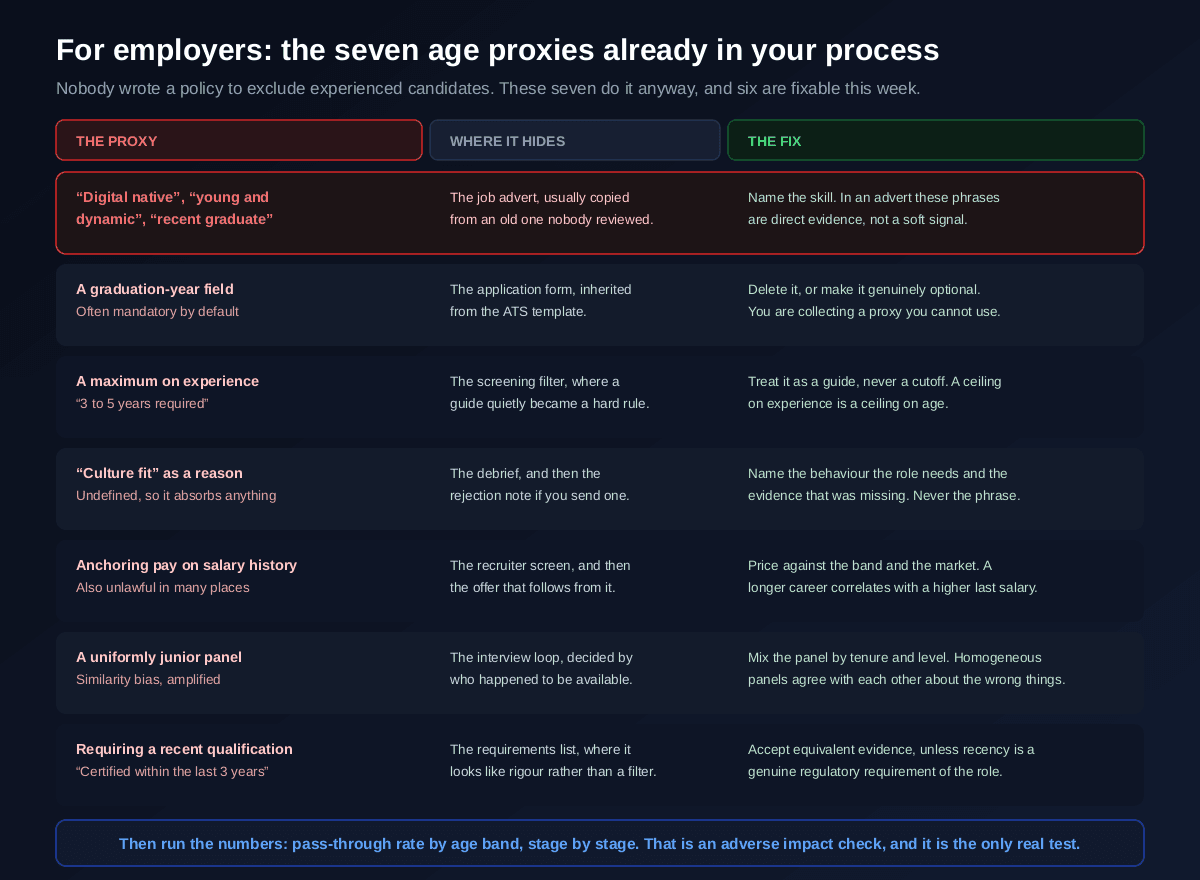
Two deserve emphasis. A maximum on years of experienceis the one that surprises people: "three to five years required" starts as a guide and becomes a hard filter somewhere in the screening process, and a ceiling on experience is a ceiling on age. And "culture fit" is undefined enough to absorb almost anything, which makes it both the least useful rejection reason and the least defensible one, as covered in interview feedback.
Then measure, because intention is not observable and pass-through rates are. Run an adverse impact check by age band at each stage, the same way you would for any other protected characteristic, and treat the result as the only real test of whether the fixes worked. Screening on capability rather than biography, as in skills-based hiring, is what makes most of this straightforward, and resume screening criteria covers keeping the bar tied to the work. Diversity hiring covers blind screening, which removes several of these proxies at once.
There is also a straightforward commercial case, separate from the compliance one. Experienced candidates typically need less ramp-up on the difficult part of a role, and a candidate who is not chasing the next title is a genuinely different retention profile from one who is, which is worth something set against the tenure patterns most teams complain about. Filtering that group out by accident is an expensive way to save nothing.
Frequently asked questions
Is age discrimination in hiring actually illegal?
Yes in most developed jurisdictions, though the scope varies and enforcement in hiring is genuinely difficult. In the United States the Age Discrimination in Employment Act protects workers aged 40 and over at employers with 20 or more employees, and many state laws go further with lower employee thresholds and in some cases protection at any age. In the United Kingdom age is a protected characteristic under the Equality Act 2010 and applies at any age, with the notable feature that direct age discrimination can sometimes be objectively justified, which is unusual among protected characteristics. In the EU it is covered by the equal treatment framework directive. The practical problem is proof at the hiring stage: you rarely learn why you were rejected, so the evidence that would demonstrate a pattern is held entirely by the employer. That is why the useful strategy is mostly not legal. Job adverts are the exception worth knowing about, because language like 'digital native', 'young and dynamic' or 'recent graduate' is documented, public and hard to explain away, which is exactly why careful employers remove it.
Should you put your graduation year on your resume?
No, in most cases. It is optional, nobody asks about its absence, and it is the single most literal age marker on the page. Keep the degree, the subject and the institution, and drop the year. Applicant tracking systems parse the qualification fine without it, and no reasonable hiring manager has ever rejected a candidate for omitting a date from a degree awarded twenty years ago. Two related fixes belong in the same edit. If your email address contains a birth year, change it, because that is even more explicit than a graduation date. And if the application form has a mandatory graduation-year field you cannot skip, fill it in accurately rather than guessing, then focus your effort on the parts of the process you do control. The honest framing here matters: this is not about deception. You are not hiding a qualification or misstating experience. You are declining to volunteer a data point that is irrelevant to whether you can do the job and that is demonstrably used against candidates.
How far back should your resume go if you are over 50?
Detail the last 10 to 15 years, then compress everything earlier into a single line with no dates. That gives you a two-page document that reads as current rather than as a complete career history, and it solves several problems at once: it removes the oldest date markers, it drops obsolete tools and titles, and it puts the space where a hiring manager is actually looking. The compressed line can be as simple as 'Earlier career: operations and logistics roles at Delta Logistics and Midwest Freight', which acknowledges the history without dating it. Two exceptions are worth keeping in mind. If an older role is genuinely the most relevant thing you have done for this specific job, keep it and say why in the summary. And in some fields, particularly academia, medicine, law and senior public sector roles, a fuller record is expected and truncating looks evasive rather than current. For the general mechanics of what to cut and what to keep, our guide to how far back a resume should go covers it in more detail.
How do you answer 'you might be overqualified for this role'?
Treat it as three separate fears and answer all three in about thirty seconds, ideally before they raise it. The first fear is cost: they think you will be outside the band, and a recruiter who believes that will move on rather than ask. Answer it with a number, unprompted: 'I am targeting 95 to 110 for this kind of scope, which I think sits inside your band.' The second fear is retention: they think you will be bored and gone within a year. Answer it with a specific, positive reason about the work rather than about your circumstances, because 'I need a job' confirms the fear exactly: 'I ran a team of nine and what I actually enjoyed was the forecasting, and this role is that full time.' The third fear, rarely spoken and often decisive, is that you will not take direction from a manager less experienced than you. Reassurance does not work here because everyone claims to be easy to work with, so use evidence: 'My last two managers were both earlier in their careers than me, and one of them promoted me.' Never say you are happy to take a step back, or that you have no ego, because both confirm what was being tested.
What can employers not ask about age in an interview?
Anything that establishes your age directly or through an obvious proxy. Do not expect to be asked your date of birth outright, because most trained interviewers know better, and the questions that do come up are usually proxies: when did you graduate, when do you plan to retire, how long would you expect to stay, would you be comfortable reporting to someone younger, and do you have the energy for this pace. Each of those has a legitimate concern behind it and a lawful way to ask it. Retention is a fair thing to care about, but the neutral version is 'what are you looking for over the next two or three years', asked of every candidate. The reporting relationship is a fair thing to test, but the neutral version is 'tell me about a manager relationship that worked well and one that did not'. If you are asked an unlawful version, you have three reasonable options and none of them is wrong: answer briefly and move on, redirect to the underlying concern ('if you are asking about commitment, here is how I think about the next three years'), or decline politely. Then write down what was asked, when, and by whom, on the same day.
How do you sell experience without sounding dated?
Use the twenty-eight-year-old test: could a candidate of twenty-eight say the same sentence truthfully? If yes, it is not selling your experience. That test immediately eliminates almost everything experienced candidates habitually say. 'A wealth of experience', 'a seasoned professional', 'a strong work ethic', 'loyal and dependable', 'highly adaptable' and 'still passionate about the work' are all available to anybody, so none of them differentiates you, and several read defensively enough to raise the very doubt you were managing. What passes the test is specific and verifiable: pattern recognition across cycles ('I have run this migration three times and it slips in month four, always for the same reason'), judgment about what not to do ('two of those five initiatives will not survive procurement, and here is why'), credibility in a senior room, no ramp-up on the difficult part of the job, and knowing how the industry actually operates including which regulators and vendors behave which way. Those are things a hiring manager cannot get from a cheaper candidate, which is precisely why they are worth saying.
Where does age bias actually happen in the hiring process?
Overwhelmingly at the resume screen, which is both the bad news and the good news. In a six-second scan nobody consciously decides to discriminate; they form an impression from a cluster of signals arriving at once, and most of those signals are things you put on the page by choice. That is where the leverage is. A smaller amount happens earlier, in application form fields that ask for a graduation year or date of birth, where the fix is simply to leave optional fields blank. Some happens at the recruiter screen, where comp expectations get anchored to the length of your career rather than to the role. Some happens at video and recorded rounds, where perceived technology fluency is inferred less from your actual skill than from your setup and from whether you apologise for the tech. Some happens at the panel, where the overqualified conversation and the unspoken worry about the reporting relationship live. And a little happens at the offer, where a longer career gets read as a willingness to accept less. Fixing the resume page addresses most of the total.
Is it too late to change careers at 50?
No, but the strategy that works is different from the one that works at thirty, and getting that wrong is what makes people conclude it is impossible. A career change at fifty succeeds on adjacency rather than on reinvention. Moving from operations in logistics to operations in healthcare works, because the function carries and the industry is learned. Moving from logistics operations to front-end development at the same time as changing industry does not, because you are asking someone to bet on two unproven things at once while paying you at a level your resume does not support in the new field. So pick the version of the change that keeps one axis constant. Two other things matter more at this stage than earlier. Evidence beats intention: a certificate is worth much less than one piece of real work in the new field, even unpaid or self-directed. And warm routes matter disproportionately, because a cold application into a new field is where every one of the page signals gets applied hardest, while a referral bypasses the screen entirely. Our career change resume guide covers the document itself.
Should you address your age directly in an interview?
Never volunteer it, and never volunteer reassurance about it. This is the single most common self-inflicted wound in this situation. Saying 'I know I have been doing this a long time, but I am still keen to learn' or 'I have plenty of energy left' or 'I am comfortable working with younger people' introduces a doubt nobody had raised, and an unprompted denial is the strongest possible way to plant an idea. The same applies to pre-emptive salary self-sabotage such as 'I am flexible, I know I am probably expensive'. If they raise it, answer it directly and briefly using the three-fear structure, then move the conversation back to the work. If they raise it unlawfully, you can still answer the legitimate concern underneath without accepting the premise. And there is one place where proactive framing genuinely helps rather than hurts, which is the retention question: saying early that you are looking to do this specific work well for several years rather than chase the next title is a positive statement about your motivation, not a defence about your age.
Do age-related resume changes count as being dishonest?
No, and the distinction is clean. Omitting a graduation year, compressing early roles into one undated line, dropping obsolete software from a skills list and updating an email address are all decisions about emphasis, which is what a resume is for. A resume has never been a complete autobiography; it is an argument for one specific job, and every candidate of every age chooses what to include. What would cross the line is misstating dates you do include, removing a role in a way that creates a false impression of continuous employment elsewhere, claiming a qualification you do not hold, or denying your age if asked directly. Two practical guardrails keep you clearly on the right side. Keep your LinkedIn consistent with your resume, because a discrepancy is what actually causes problems. And answer honestly if you are asked a direct question, even an inappropriate one, or decline to answer rather than giving a false answer. Declining to volunteer irrelevant information is not deception. Volunteering false information is.
How should you handle the salary conversation over 50?
Anchor on the role and the market, never on your salary history, and say your number before they infer one. The specific risk at this stage is that a long career gets read as an expensive candidate, and that inference happens silently and early, often before anyone speaks to you. The countermeasure is to raise the range yourself: 'I am targeting X to Y for this scope' does more work in the first conversation than anything else you can say, because it removes the assumption rather than leaving it to sit. Refuse the salary-history question, which is banned in a substantial number of US states and cities anyway and which anchors your offer to your last job rather than to this one. That matters more the longer your career, because your last salary reflects a different role at a different company in a different market. Two things not to do: do not volunteer that you are flexible or cheap, which both confirms the cost fear and prices you below the band, and do not accept a level below your capability as a strategy for getting in the door, because level is much harder to correct after joining than before.
What should employers do to reduce age bias in hiring?
Remove the proxies, then measure the outcome, because intention is not observable and pass-through rates are. Seven proxies do most of the damage and six are fixable within a week. Strip 'digital native', 'young and dynamic' and 'recent graduate' out of adverts, where such language is documented and hard to defend. Delete the graduation-year field from the application form, or make it genuinely optional, since you are collecting a protected proxy you cannot lawfully use. Stop treating a maximum on years of experience as a hard cutoff, because a ceiling on experience is a ceiling on age. Ban 'culture fit' as a rejection reason and require a named behaviour and evidence instead. Price offers against the band and the market rather than against salary history, which correlates directly with career length. Mix interview panels by level and tenure, since homogeneous panels reinforce similarity bias. And accept equivalent evidence rather than requiring a recent certification unless recency is a genuine regulatory requirement. Then run pass-through rates by age band at each stage, which is an adverse impact check and the only real test of whether any of it worked.
Is it worth applying to roles that ask for fewer years of experience than you have?
Often yes, and the 'three to five years required' line is usually a guide rather than a rule, but you should apply differently than you would to a level-matched role. The risk is not that you are unqualified, it is that you look like a mis-hire waiting to happen: expensive, likely to be bored, and probably applying out of necessity. So handle all three of those in the application itself rather than waiting for the interview. Put a target range in the covering note if you are asked for one, so nobody has to guess. State plainly and specifically why this scope is what you want, in terms of the work rather than your circumstances. And tailor hard, because a resume that reads as a former director applying to an individual contributor role without explanation gets filtered fast. Two situations where it genuinely will not work: where the pay band is so far below your last role that no explanation survives contact with the recruiter screen, and where the posting is explicitly an early-career or graduate programme, which is usually a defined scheme rather than a flexible level.
How do you compete with younger candidates for the same role?
Do not compete on the axes where you cannot win, and do not concede the ones where you can. You will not win on cost, on years of runway, or on being the obvious cultural default in a young team, and trying to compete there is what produces the defensive statements that damage candidates most. What you win on is risk reduction, which is genuinely valuable and rarely articulated. A hiring manager taking a chance on a less experienced candidate is buying a ramp-up period, a supervision cost and a real probability that the person cannot do the hard part of the job. You can remove all three, and saying so specifically is far more persuasive than any claim about work ethic: being useful on the difficult work in week two rather than month six is a concrete, checkable claim. The other lever is route. Age proxies bite hardest in the cold application funnel, at the exact stage where a six-second scan does all the work. A referral or a warm introduction skips that stage entirely, which is why networking pays off disproportionately at this point in a career rather than less.
Key takeaways
- Almost nobody rejects your age directly. They react to a cluster of proxy signals and three specific fears, and you control nearly all of them.
- Most of the loss happens at the six-second resume scan, before anyone has spoken to you. That makes one afternoon of editing the highest-leverage work in your search.
- Fix the eight page signals: graduation year, an aol or birth-year email, a full postal address, an Objective section, every job back to the 1990s, obsolete tools, 'references available on request', and a four-page .doc.
- Detail the last 10 to 15 years, then compress everything earlier into one undated 'Earlier career' line. Two pages, PDF.
- Leave the graduation year off. It is optional, nobody asks about its absence, and it is the most literal age marker on the page.
- This is emphasis, not dishonesty. Omitting irrelevant data is normal resume practice. Misstating dates or denying your age if asked would not be.
- 'Overqualified' is three fears: cost, boredom, and reporting to a younger manager. Answer all three in thirty seconds, and raise it before they do.
- Never say 'I am happy to take a step back', 'I just want to be working', 'I am flexible on salary' or 'I have no ego'. All of them confirm the fear being tested.
- Give a target salary range and never your salary history. A long career anchors an offer downward if you let it.
- Use the twenty-eight-year-old test: if a candidate of twenty-eight could say your sentence truthfully, it is not selling your experience.
- What actually sells: pattern recognition across cycles, judgment about what not to do, senior-room credibility, and no ramp-up on the hard part. What you are really selling is risk reduction.
- Never volunteer reassurance about your age or energy. An unprompted denial is the strongest way to plant the doubt you were managing.
- If asked something unlawful, you may answer briefly, redirect to the concern underneath, or decline politely. Then write down what was asked, by whom, the same day.
- Change your route, not just your resume. Age proxies bite hardest in the cold application queue, so a referral skips the exact stage where the loss happens.
- Employers: strip 'digital native' from adverts, delete the graduation-year field, stop treating experience maximums as cutoffs, ban 'culture fit', price against the band, and mix your panels.
- Employers: then run pass-through rates by age band, stage by stage. Intention is not observable. That number is.
Frequently asked questions
Is age discrimination in hiring actually illegal?
Yes in most developed jurisdictions, though the scope varies and enforcement in hiring is genuinely difficult. In the United States the Age Discrimination in Employment Act protects workers aged 40 and over at employers with 20 or more employees, and many state laws go further with lower employee thresholds and in some cases protection at any age. In the United Kingdom age is a protected characteristic under the Equality Act 2010 and applies at any age, with the notable feature that direct age discrimination can sometimes be objectively justified, which is unusual among protected characteristics. In the EU it is covered by the equal treatment framework directive. The practical problem is proof at the hiring stage: you rarely learn why you were rejected, so the evidence that would demonstrate a pattern is held entirely by the employer. That is why the useful strategy is mostly not legal. Job adverts are the exception worth knowing about, because language like 'digital native', 'young and dynamic' or 'recent graduate' is documented, public and hard to explain away, which is exactly why careful employers remove it.
Should you put your graduation year on your resume?
No, in most cases. It is optional, nobody asks about its absence, and it is the single most literal age marker on the page. Keep the degree, the subject and the institution, and drop the year. Applicant tracking systems parse the qualification fine without it, and no reasonable hiring manager has ever rejected a candidate for omitting a date from a degree awarded twenty years ago. Two related fixes belong in the same edit. If your email address contains a birth year, change it, because that is even more explicit than a graduation date. And if the application form has a mandatory graduation-year field you cannot skip, fill it in accurately rather than guessing, then focus your effort on the parts of the process you do control. The honest framing here matters: this is not about deception. You are not hiding a qualification or misstating experience. You are declining to volunteer a data point that is irrelevant to whether you can do the job and that is demonstrably used against candidates.
How far back should your resume go if you are over 50?
Detail the last 10 to 15 years, then compress everything earlier into a single line with no dates. That gives you a two-page document that reads as current rather than as a complete career history, and it solves several problems at once: it removes the oldest date markers, it drops obsolete tools and titles, and it puts the space where a hiring manager is actually looking. The compressed line can be as simple as 'Earlier career: operations and logistics roles at Delta Logistics and Midwest Freight', which acknowledges the history without dating it. Two exceptions are worth keeping in mind. If an older role is genuinely the most relevant thing you have done for this specific job, keep it and say why in the summary. And in some fields, particularly academia, medicine, law and senior public sector roles, a fuller record is expected and truncating looks evasive rather than current. For the general mechanics of what to cut and what to keep, our guide to how far back a resume should go covers it in more detail.
How do you answer 'you might be overqualified for this role'?
Treat it as three separate fears and answer all three in about thirty seconds, ideally before they raise it. The first fear is cost: they think you will be outside the band, and a recruiter who believes that will move on rather than ask. Answer it with a number, unprompted: 'I am targeting 95 to 110 for this kind of scope, which I think sits inside your band.' The second fear is retention: they think you will be bored and gone within a year. Answer it with a specific, positive reason about the work rather than about your circumstances, because 'I need a job' confirms the fear exactly: 'I ran a team of nine and what I actually enjoyed was the forecasting, and this role is that full time.' The third fear, rarely spoken and often decisive, is that you will not take direction from a manager less experienced than you. Reassurance does not work here because everyone claims to be easy to work with, so use evidence: 'My last two managers were both earlier in their careers than me, and one of them promoted me.' Never say you are happy to take a step back, or that you have no ego, because both confirm what was being tested.
What can employers not ask about age in an interview?
Anything that establishes your age directly or through an obvious proxy. Do not expect to be asked your date of birth outright, because most trained interviewers know better, and the questions that do come up are usually proxies: when did you graduate, when do you plan to retire, how long would you expect to stay, would you be comfortable reporting to someone younger, and do you have the energy for this pace. Each of those has a legitimate concern behind it and a lawful way to ask it. Retention is a fair thing to care about, but the neutral version is 'what are you looking for over the next two or three years', asked of every candidate. The reporting relationship is a fair thing to test, but the neutral version is 'tell me about a manager relationship that worked well and one that did not'. If you are asked an unlawful version, you have three reasonable options and none of them is wrong: answer briefly and move on, redirect to the underlying concern ('if you are asking about commitment, here is how I think about the next three years'), or decline politely. Then write down what was asked, when, and by whom, on the same day.
How do you sell experience without sounding dated?
Use the twenty-eight-year-old test: could a candidate of twenty-eight say the same sentence truthfully? If yes, it is not selling your experience. That test immediately eliminates almost everything experienced candidates habitually say. 'A wealth of experience', 'a seasoned professional', 'a strong work ethic', 'loyal and dependable', 'highly adaptable' and 'still passionate about the work' are all available to anybody, so none of them differentiates you, and several read defensively enough to raise the very doubt you were managing. What passes the test is specific and verifiable: pattern recognition across cycles ('I have run this migration three times and it slips in month four, always for the same reason'), judgment about what not to do ('two of those five initiatives will not survive procurement, and here is why'), credibility in a senior room, no ramp-up on the difficult part of the job, and knowing how the industry actually operates including which regulators and vendors behave which way. Those are things a hiring manager cannot get from a cheaper candidate, which is precisely why they are worth saying.
Where does age bias actually happen in the hiring process?
Overwhelmingly at the resume screen, which is both the bad news and the good news. In a six-second scan nobody consciously decides to discriminate; they form an impression from a cluster of signals arriving at once, and most of those signals are things you put on the page by choice. That is where the leverage is. A smaller amount happens earlier, in application form fields that ask for a graduation year or date of birth, where the fix is simply to leave optional fields blank. Some happens at the recruiter screen, where comp expectations get anchored to the length of your career rather than to the role. Some happens at video and recorded rounds, where perceived technology fluency is inferred less from your actual skill than from your setup and from whether you apologise for the tech. Some happens at the panel, where the overqualified conversation and the unspoken worry about the reporting relationship live. And a little happens at the offer, where a longer career gets read as a willingness to accept less. Fixing the resume page addresses most of the total.
Is it too late to change careers at 50?
No, but the strategy that works is different from the one that works at thirty, and getting that wrong is what makes people conclude it is impossible. A career change at fifty succeeds on adjacency rather than on reinvention. Moving from operations in logistics to operations in healthcare works, because the function carries and the industry is learned. Moving from logistics operations to front-end development at the same time as changing industry does not, because you are asking someone to bet on two unproven things at once while paying you at a level your resume does not support in the new field. So pick the version of the change that keeps one axis constant. Two other things matter more at this stage than earlier. Evidence beats intention: a certificate is worth much less than one piece of real work in the new field, even unpaid or self-directed. And warm routes matter disproportionately, because a cold application into a new field is where every one of the page signals gets applied hardest, while a referral bypasses the screen entirely. Our career change resume guide covers the document itself.
Should you address your age directly in an interview?
Never volunteer it, and never volunteer reassurance about it. This is the single most common self-inflicted wound in this situation. Saying 'I know I have been doing this a long time, but I am still keen to learn' or 'I have plenty of energy left' or 'I am comfortable working with younger people' introduces a doubt nobody had raised, and an unprompted denial is the strongest possible way to plant an idea. The same applies to pre-emptive salary self-sabotage such as 'I am flexible, I know I am probably expensive'. If they raise it, answer it directly and briefly using the three-fear structure, then move the conversation back to the work. If they raise it unlawfully, you can still answer the legitimate concern underneath without accepting the premise. And there is one place where proactive framing genuinely helps rather than hurts, which is the retention question: saying early that you are looking to do this specific work well for several years rather than chase the next title is a positive statement about your motivation, not a defence about your age.
Do age-related resume changes count as being dishonest?
No, and the distinction is clean. Omitting a graduation year, compressing early roles into one undated line, dropping obsolete software from a skills list and updating an email address are all decisions about emphasis, which is what a resume is for. A resume has never been a complete autobiography; it is an argument for one specific job, and every candidate of every age chooses what to include. What would cross the line is misstating dates you do include, removing a role in a way that creates a false impression of continuous employment elsewhere, claiming a qualification you do not hold, or denying your age if asked directly. Two practical guardrails keep you clearly on the right side. Keep your LinkedIn consistent with your resume, because a discrepancy is what actually causes problems. And answer honestly if you are asked a direct question, even an inappropriate one, or decline to answer rather than giving a false answer. Declining to volunteer irrelevant information is not deception. Volunteering false information is.
How should you handle the salary conversation over 50?
Anchor on the role and the market, never on your salary history, and say your number before they infer one. The specific risk at this stage is that a long career gets read as an expensive candidate, and that inference happens silently and early, often before anyone speaks to you. The countermeasure is to raise the range yourself: 'I am targeting X to Y for this scope' does more work in the first conversation than anything else you can say, because it removes the assumption rather than leaving it to sit. Refuse the salary-history question, which is banned in a substantial number of US states and cities anyway and which anchors your offer to your last job rather than to this one. That matters more the longer your career, because your last salary reflects a different role at a different company in a different market. Two things not to do: do not volunteer that you are flexible or cheap, which both confirms the cost fear and prices you below the band, and do not accept a level below your capability as a strategy for getting in the door, because level is much harder to correct after joining than before.
What should employers do to reduce age bias in hiring?
Remove the proxies, then measure the outcome, because intention is not observable and pass-through rates are. Seven proxies do most of the damage and six are fixable within a week. Strip 'digital native', 'young and dynamic' and 'recent graduate' out of adverts, where such language is documented and hard to defend. Delete the graduation-year field from the application form, or make it genuinely optional, since you are collecting a protected proxy you cannot lawfully use. Stop treating a maximum on years of experience as a hard cutoff, because a ceiling on experience is a ceiling on age. Ban 'culture fit' as a rejection reason and require a named behaviour and evidence instead. Price offers against the band and the market rather than against salary history, which correlates directly with career length. Mix interview panels by level and tenure, since homogeneous panels reinforce similarity bias. And accept equivalent evidence rather than requiring a recent certification unless recency is a genuine regulatory requirement. Then run pass-through rates by age band at each stage, which is an adverse impact check and the only real test of whether any of it worked.
Is it worth applying to roles that ask for fewer years of experience than you have?
Often yes, and the 'three to five years required' line is usually a guide rather than a rule, but you should apply differently than you would to a level-matched role. The risk is not that you are unqualified, it is that you look like a mis-hire waiting to happen: expensive, likely to be bored, and probably applying out of necessity. So handle all three of those in the application itself rather than waiting for the interview. Put a target range in the covering note if you are asked for one, so nobody has to guess. State plainly and specifically why this scope is what you want, in terms of the work rather than your circumstances. And tailor hard, because a resume that reads as a former director applying to an individual contributor role without explanation gets filtered fast. Two situations where it genuinely will not work: where the pay band is so far below your last role that no explanation survives contact with the recruiter screen, and where the posting is explicitly an early-career or graduate programme, which is usually a defined scheme rather than a flexible level.
How do you compete with younger candidates for the same role?
Do not compete on the axes where you cannot win, and do not concede the ones where you can. You will not win on cost, on years of runway, or on being the obvious cultural default in a young team, and trying to compete there is what produces the defensive statements that damage candidates most. What you win on is risk reduction, which is genuinely valuable and rarely articulated. A hiring manager taking a chance on a less experienced candidate is buying a ramp-up period, a supervision cost and a real probability that the person cannot do the hard part of the job. You can remove all three, and saying so specifically is far more persuasive than any claim about work ethic: being useful on the difficult work in week two rather than month six is a concrete, checkable claim. The other lever is route. Age proxies bite hardest in the cold application funnel, at the exact stage where a six-second scan does all the work. A referral or a warm introduction skips that stage entirely, which is why networking pays off disproportionately at this point in a career rather than less.