Career Catfishing: Why New Hires Vanish Before Day One (and Who's Really Ghosting Whom)
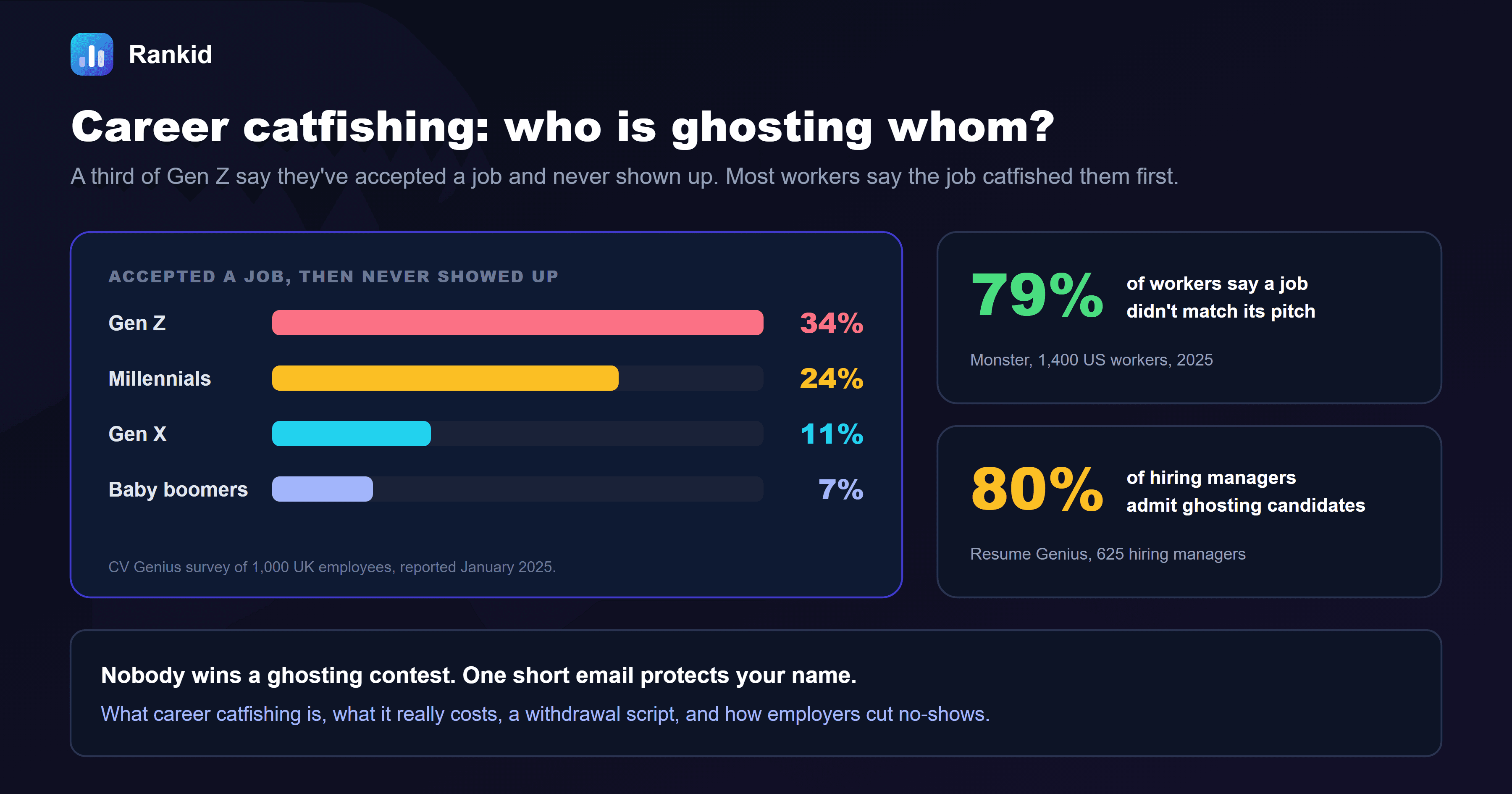
The offer is signed. The laptop is on the desk, the manager has cleared the morning, and the team has been told a new colleague starts today. Nine o'clock comes and goes. So does ten. The phone goes to voicemail. This is career catfishing, and a third of Gen Z workers in one survey say they've done it. Before you decide who the villain is, there's a second number worth seeing: 79% of workers say a job has done the same thing to them.
Quick answer
Quick answer: career catfishing means accepting a job offer and then not showing up on day one, with no notice. In a UK survey, 34%of Gen Z said they'd done it. It's usually legal, but it can leave a permanent "do not rehire" mark and a recruiter who remembers you. If you've changed your mind, a three-sentence withdrawal email does the same job with none of the damage. Employers can prevent most no-shows by describing the job honestly and staying in touch between the offer and the first day.
What is career catfishing?
Career catfishing is when someone goes through a hiring process, accepts the offer, and then never arrives for their first day, without telling the employer they've changed their mind. The name comes from online dating, where a catfish is someone who isn't who they appeared to be.
It's a specific kind of ghosting. It differs from related terms in when it happens:
- Interview ghosting: a candidate or employer goes silent during the process. See why employers ghost after interviews.
- Career catfishing: the candidate has said yes, and disappears before day one.
- Job abandonment: an existing employee stops coming to work. See job abandonment.
Career catfishing statistics
The term took off in January 2025 when resume company CV Genius published a survey of 1,000 UK employees.
- 34% of Gen Z respondents said they had accepted a job and never shown up. The figures were 24% for millennials, 11% for Gen X and 7% for baby boomers.
- The same survey found 38% of Gen Z had left a job without formally resigning, against 26% of millennials, 15% of Gen X and 10% of boomers.
- It isn't new. A 2019 Indeed survey found 22% of US job seekers had accepted an offer and not turned up on the first day, and 83% of employers said they had been ghosted somewhere in the hiring process.
Read these numbers carefully
Career catfishing runs in both directions
The phrase is now used for three different behaviors, and only one of them is the candidate disappearing.
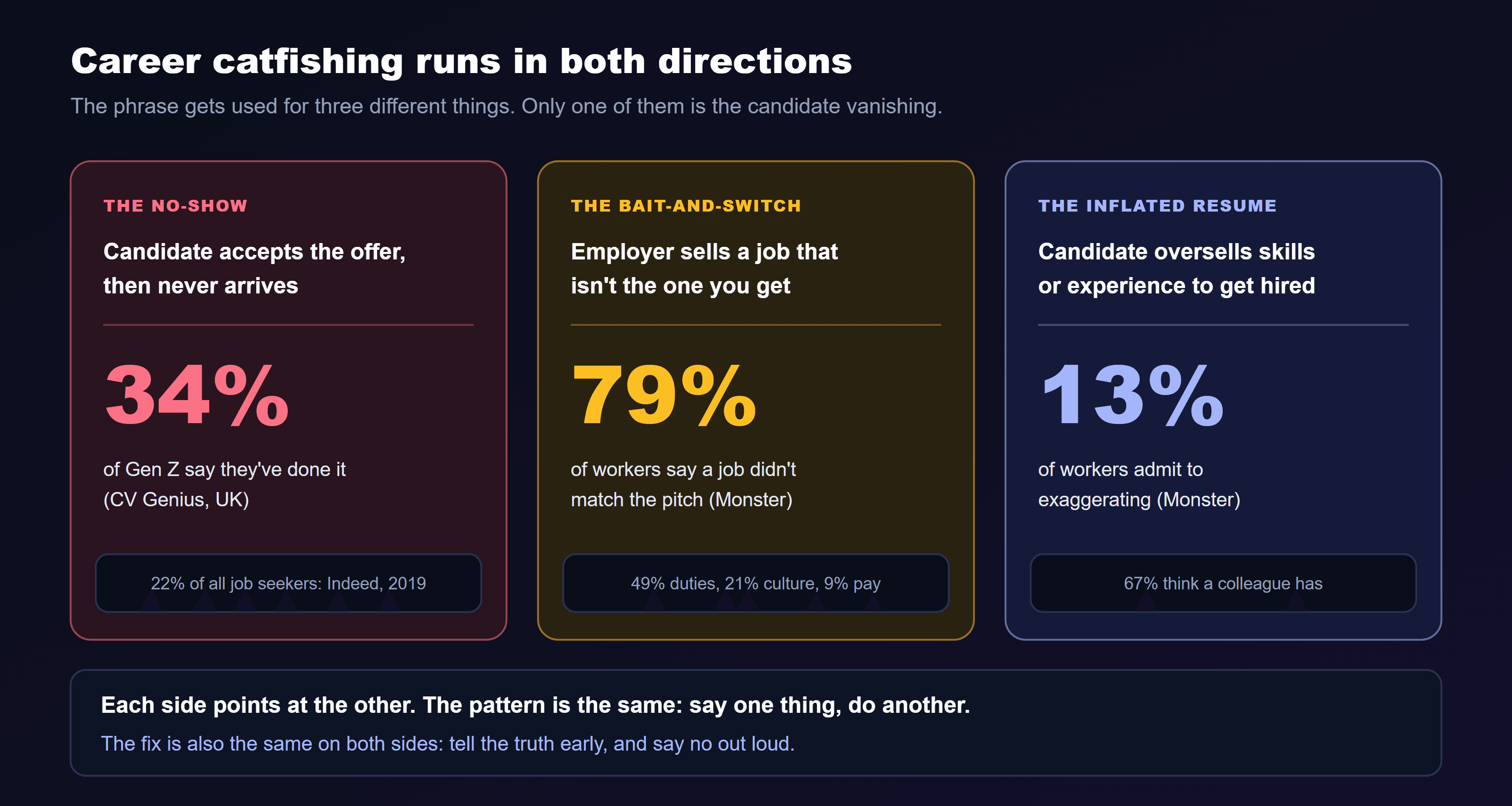
- The no-show. The original meaning: the candidate accepts and never arrives.
- The bait-and-switch.The employer describes one job and delivers another. In Monster's 2025 survey of 1,400 US workers, 79%said they had taken a job that didn't live up to how a recruiter or hiring manager described it. For 49% the responsibilities were different, for 21% the culture was misrepresented, and for 9% pay or benefits were overstated.
- The inflated resume. The candidate oversells themselves. In the same survey, 13% admitted to exaggerating their background, and 67% believed at least one colleague had. At the extreme end this becomes outright fraud; see fake job candidates.
Add one more figure: 80% of hiring managers in a Resume Genius survey admitted they had stopped responding to candidates. Seen together, career catfishing looks less like a generational flaw and more like the latest move in a hiring culture where both sides have learned that silence has no immediate cost.
Why people accept a job and don't show up
- A better offer arrived. Candidates rarely stop interviewing when they accept. If a stronger offer lands in the gap, the first one loses. Our guide to handling multiple job offers covers how to manage the timing honestly.
- The current employer countered. A raise to stay can undo an acceptance overnight. See counteroffers when you resign.
- The offer changed, or the truth came out. The contract shows a lower salary, a different title, more days in the office or a clause nobody mentioned.
- The process wore them out.Six rounds and eight weeks of slow replies don't build loyalty. Some candidates describe ghosting as returning the treatment they received.
- Silence after "yes." Weeks with no contact give doubts room to grow.
- Avoiding a hard conversation. This is what turns a change of mind into a no-show. Withdrawing feels confrontational, so people do nothing.
Is career catfishing illegal?
In the US, generally not. Most jobs are at-will, so either side can end the relationship at any point, including before it begins. Employers use the same freedom when they rescind an offer. There are three things to check, though:
- Money you've already received. Sign-on bonuses and relocation payments often come with repayment terms. See stay-or-pay contracts.
- A signed contract with a notice clause.In the UK and much of Europe, a signed employment contract can bind you to give notice even if you haven't started. Employers seldom pursue it, but the obligation can exist. See notice periods.
- Agency terms.If a staffing agency placed you, your agreement with them may set out what happens if you don't start.
This is general information, not legal advice. If you've signed a contract, read it.
What career catfishing really costs you
There's no lawsuit and no fine, which is why it feels free. The cost arrives later, and usually where you can't see it.
- A "do not rehire" note. Most applicant tracking systems let recruiters flag a candidate record. That note can outlast the recruiter who wrote it and apply to every role at that company and its subsidiaries.
- People move. The recruiter you ghosted will work at two or three more companies over the next decade, and hiring managers in the same industry talk to each other.
- Agencies remember longest. A staffing firm that looked bad in front of its client is unlikely to put you forward again.
- You lose the fallback.If the better offer falls through, you can't go back to an employer you left waiting at the door. Someone who withdrew politely sometimes can.
The employer pays too: a reopened search, a team covering the gap, and the runner-up candidate who has often accepted another job by then. Our cost-per-hire guide shows how quickly that adds up.
Changed your mind? Send the 3-sentence withdrawal email
Backing out of an accepted offer is allowed, and recruiters handle it all the time. What they remember is whether you told them. Call if you can, then send this so there's a written record.
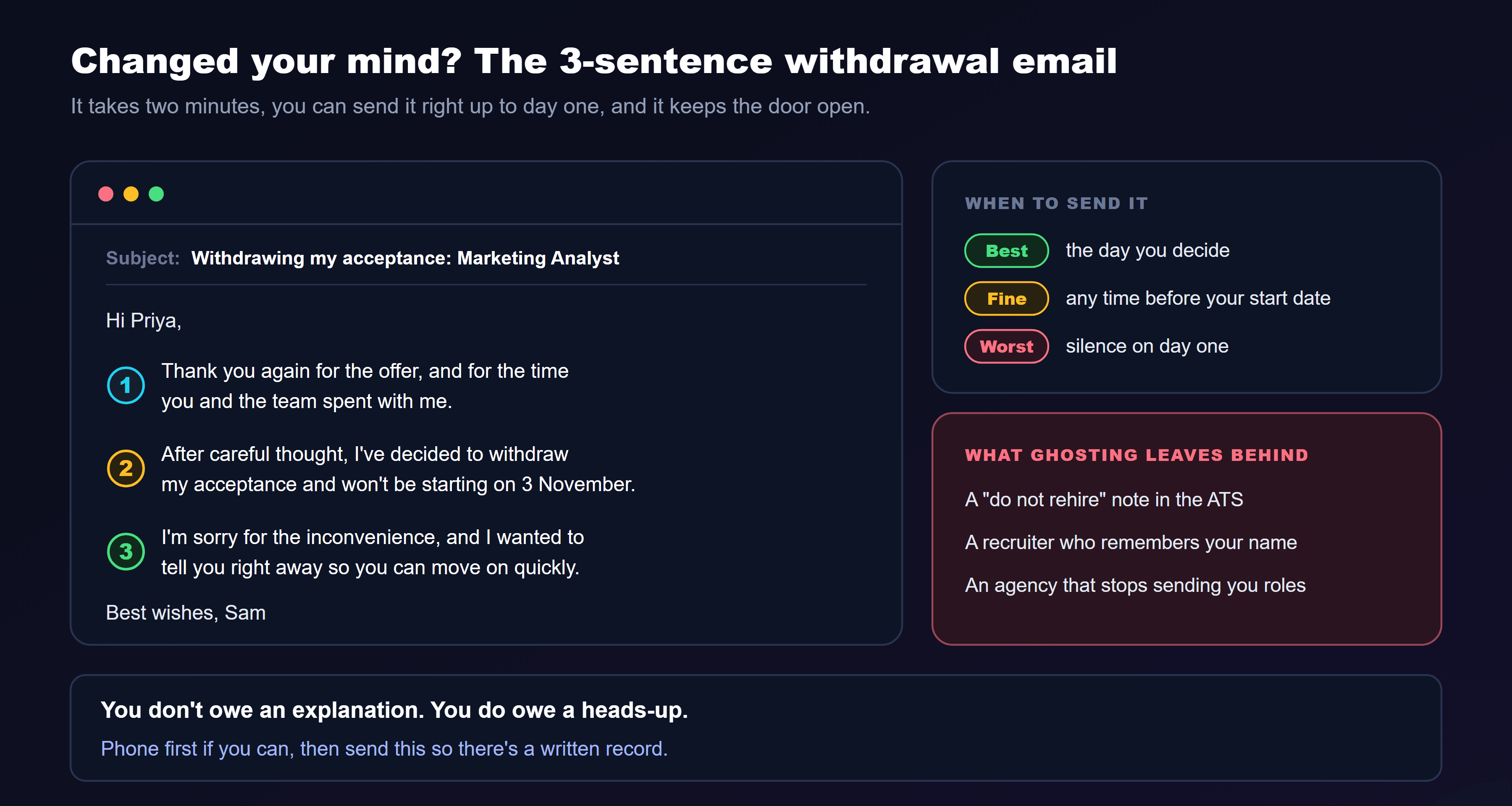
Thank them
Say it plainly
Apologize and give them time back
You don't have to explain why. If you want to, one honest line is enough: "I've accepted a role that's a closer fit for where I want to go." Avoid criticizing the company or reopening the negotiation unless you would actually stay for a better offer. For more wording, see how to respond to a job offer.
Already missed day one?
What to do if the job catfished you
You started, and the role isn't the one you were sold. Before you disappear in return:
- Compare it against what's in writing. Pull up the job description, the offer letter and any emails. List the specific differences.
- Raise it early.In the first two weeks, tell your manager: "The role was described as X, and so far it's mostly Y. Can we talk about how to get it closer to X?" Some gaps are onboarding chaos, not deception.
- Set a date to decide.Give it 30 to 60 days. If nothing changes, start looking, and resign properly when you're ready.
- Tell the truth about it later.A very short stint is easy to explain: "The role turned out to be substantially different from the one I accepted."
- Ask sharper questions next time."What did the last person in this role spend most of their week on?" and "Can I speak to someone on the team?" are hard to answer dishonestly. More in questions to ask in an interview.
Make sure the job fits before you say yes
Paste your resume and the job description into Rankid for a free 0-100 match score and the exact requirements you meet and miss. If the role isn't what you want, you'll see it before you accept, not on day one. No signup required.
Check your match score freeFor employers: how to prevent first-day no-shows
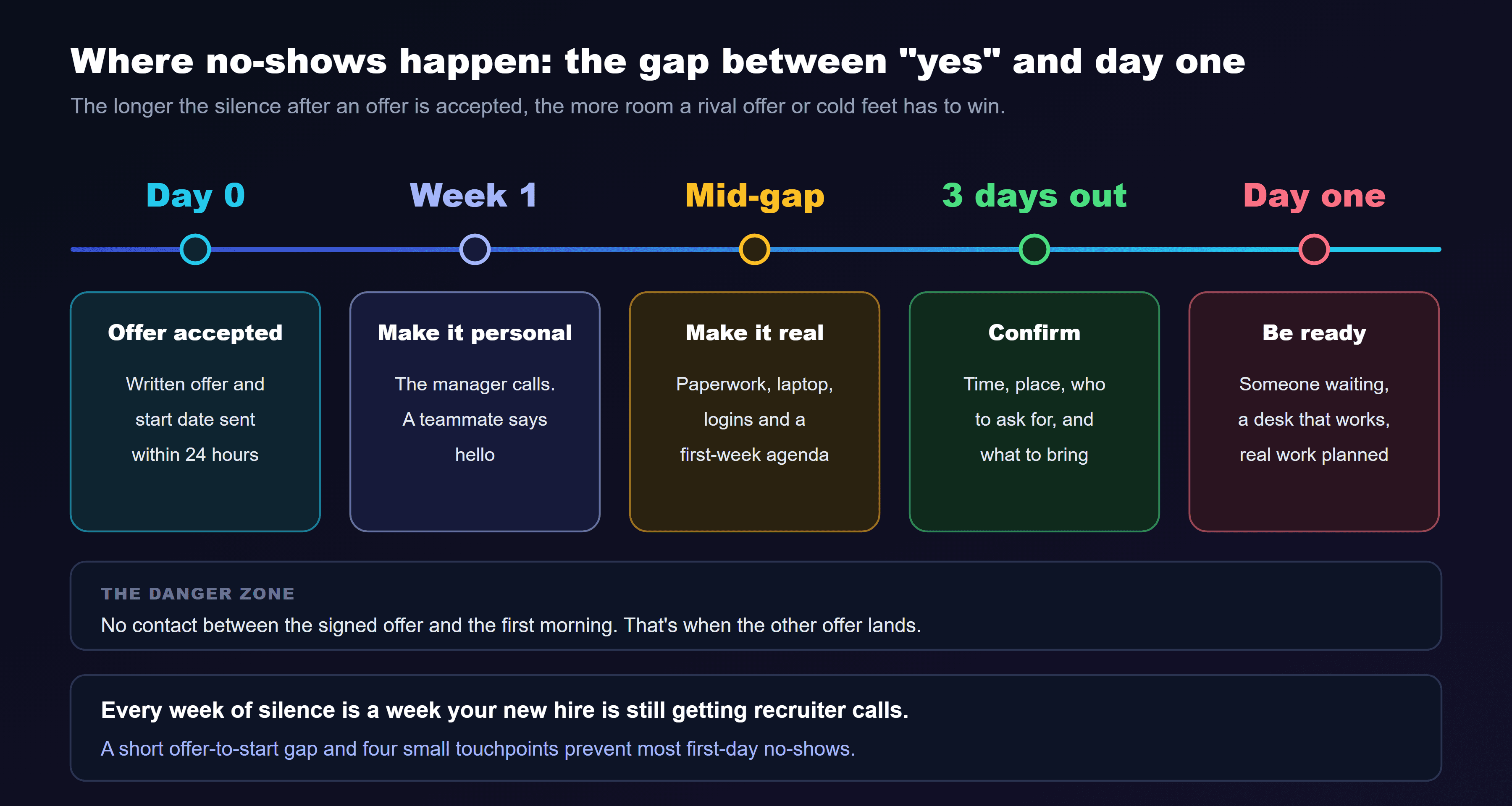
Most no-shows are decided in the quiet weeks between the accepted offer and the start date. That gap is the part of hiring you control completely.
- Describe the real job.Include the hard parts. A candidate who accepted knowing about the on-call rota won't back out when they find out about it. See how to write a job description.
- Move faster. Long processes produce more competing offers. Our hiring process guide shows where time is usually lost.
- Send the written offer within a day. A verbal yes with no paperwork is not a commitment on either side.
- Shorten the gap where you can. If a start date is six weeks away, plan for at least four contacts in that time.
- Have the manager call. People find it much harder to ghost a person than a recruiting inbox.
- Start onboarding before day one. Paperwork, equipment and a first-week agenda make the job feel real. See employee onboarding.
- Make withdrawing easy.Tell candidates directly: "If anything changes, just tell me. No hard feelings." It sounds minor, and it removes the reason most people stay silent.
- Keep the runner-up warm. Don't send the rejection email to your second choice until your first has started. A strong talent pipeline turns a no-show from a crisis into a delay.
- Stop ghosting candidates yourself.If 80% of hiring managers go silent on applicants, it's hard to be surprised when applicants return the favor. See candidate experience.
Need a backup shortlist in minutes?
When a new hire doesn't turn up, Rankid re-scores your existing applicants against the job description on a consistent 0-100 scale, with the evidence behind each score, so you can call your next-best candidates the same day. First 5 resumes free, no signup.
Try bulk screening freeFrequently asked questions
What is career catfishing?
Career catfishing is when a candidate accepts a job offer and then doesn't show up for the first day, without telling the employer. The name comes from online dating, where 'catfishing' means presenting a false version of yourself. The term became popular in early 2025 after a CV Genius survey found 34% of Gen Z workers in the UK said they had done it. It's also used in reverse, for employers who misrepresent a job, and for candidates who exaggerate their qualifications.
How common is career catfishing?
In CV Genius's survey of 1,000 UK employees, 34% of Gen Z respondents said they had accepted a job and never shown up, compared with 24% of millennials, 11% of Gen X and 7% of baby boomers. Earlier US data from Indeed in 2019 found 22% of job seekers had accepted an offer and not turned up on day one, and 83% of employers said they had been ghosted at some stage of hiring. These are self-reported lifetime figures, so the share of any single employer's hires who vanish is far lower.
Is career catfishing illegal?
In the United States, generally no. Most employment is at-will, which means either side can end it at any time, including before it starts. The main exceptions are if you signed a contract with specific commitments, or accepted a sign-on bonus or relocation payment with repayment terms. Outside the US, a signed employment contract can carry a notice obligation even before your start date. Legal or not, it has professional costs.
Can you back out of a job offer after accepting it?
Yes. It's legal in most situations and employers deal with it regularly. What matters is how you do it. Tell the hiring manager or recruiter as soon as you've decided, ideally by phone followed by a short email. Thank them, state clearly that you are withdrawing your acceptance, and apologize for the inconvenience. You don't have to give a detailed reason.
Why do people accept a job and not show up?
The most common reasons are a better offer arriving after they accepted, a counteroffer from their current employer, and second thoughts about the role, pay or commute. Long, slow hiring processes make it worse, as does silence between the offer and the start date. Some candidates also say that being ghosted by employers has made ghosting feel acceptable. Avoiding an awkward conversation is the reason people stay silent rather than withdrawing.
What happens if you don't show up for the first day of a new job?
The employer will usually try to contact you, then treat the offer as declined and reopen the search. You'll typically be marked as not eligible for rehire in the company's applicant tracking system, and the recruiter and hiring manager will remember. If a staffing agency placed you, it may stop sending you roles. You may also have to repay any sign-on or relocation money you received.
What does it mean when an employer catfishes you?
It means the job turned out to be meaningfully different from what you were told: different duties, hours, pay, manager, location or culture. Monster's 2025 survey of 1,400 US workers found 79% had accepted a job that didn't match how a recruiter or hiring manager described it. Of those surveyed, 49% said responsibilities were different, 21% said the culture was misrepresented, and 9% said pay or benefits were overstated.
How can employers prevent new hires from not showing up?
Shorten the gap between offer and start date, and fill it with contact. Send the written offer within 24 hours, have the hiring manager call in the first week, send paperwork, equipment details and a first-week agenda, and confirm the logistics a few days before. Describe the job honestly, including its downsides, so there's nothing for a new hire to discover and back out over. And keep a warm second-choice candidate in case it happens anyway.
Key takeaways
- Career catfishing is accepting a job offer and then not showing up on day one, without telling the employer.
- In a CV Genius survey of 1,000 UK employees, 34% of Gen Z said they'd done it, versus 24% of millennials, 11% of Gen X and 7% of boomers.
- It runs both ways: 79% of US workers say a job didn't match its description (Monster, 2025), and 80% of hiring managers admit ghosting candidates (Resume Genius).
- It's generally legal in the US under at-will employment, but check sign-on bonus terms, signed contracts and agency agreements.
- The real cost is reputational: a 'do not rehire' flag, a recruiter who remembers, and no fallback if your other offer collapses.
- A three-sentence email (thank them, withdraw clearly, apologize) takes two minutes and avoids all of it.
- If the job catfished you, compare it with what's in writing, raise it in the first two weeks, and set a date to decide.
- Employers prevent most no-shows with honest job descriptions, a short offer-to-start gap, and regular contact before day one.
Frequently asked questions
What is career catfishing?
Career catfishing is when a candidate accepts a job offer and then doesn't show up for the first day, without telling the employer. The name comes from online dating, where 'catfishing' means presenting a false version of yourself. The term became popular in early 2025 after a CV Genius survey found 34% of Gen Z workers in the UK said they had done it. It's also used in reverse, for employers who misrepresent a job, and for candidates who exaggerate their qualifications.
How common is career catfishing?
In CV Genius's survey of 1,000 UK employees, 34% of Gen Z respondents said they had accepted a job and never shown up, compared with 24% of millennials, 11% of Gen X and 7% of baby boomers. Earlier US data from Indeed in 2019 found 22% of job seekers had accepted an offer and not turned up on day one, and 83% of employers said they had been ghosted at some stage of hiring. These are self-reported lifetime figures, so the share of any single employer's hires who vanish is far lower.
Is career catfishing illegal?
In the United States, generally no. Most employment is at-will, which means either side can end it at any time, including before it starts. The main exceptions are if you signed a contract with specific commitments, or accepted a sign-on bonus or relocation payment with repayment terms. Outside the US, a signed employment contract can carry a notice obligation even before your start date. Legal or not, it has professional costs.
Can you back out of a job offer after accepting it?
Yes. It's legal in most situations and employers deal with it regularly. What matters is how you do it. Tell the hiring manager or recruiter as soon as you've decided, ideally by phone followed by a short email. Thank them, state clearly that you are withdrawing your acceptance, and apologize for the inconvenience. You don't have to give a detailed reason.
Why do people accept a job and not show up?
The most common reasons are a better offer arriving after they accepted, a counteroffer from their current employer, and second thoughts about the role, pay or commute. Long, slow hiring processes make it worse, as does silence between the offer and the start date. Some candidates also say that being ghosted by employers has made ghosting feel acceptable. Avoiding an awkward conversation is the reason people stay silent rather than withdrawing.
What happens if you don't show up for the first day of a new job?
The employer will usually try to contact you, then treat the offer as declined and reopen the search. You'll typically be marked as not eligible for rehire in the company's applicant tracking system, and the recruiter and hiring manager will remember. If a staffing agency placed you, it may stop sending you roles. You may also have to repay any sign-on or relocation money you received.
What does it mean when an employer catfishes you?
It means the job turned out to be meaningfully different from what you were told: different duties, hours, pay, manager, location or culture. Monster's 2025 survey of 1,400 US workers found 79% had accepted a job that didn't match how a recruiter or hiring manager described it. Of those surveyed, 49% said responsibilities were different, 21% said the culture was misrepresented, and 9% said pay or benefits were overstated.
How can employers prevent new hires from not showing up?
Shorten the gap between offer and start date, and fill it with contact. Send the written offer within 24 hours, have the hiring manager call in the first week, send paperwork, equipment details and a first-week agenda, and confirm the logistics a few days before. Describe the job honestly, including its downsides, so there's nothing for a new hire to discover and back out over. And keep a warm second-choice candidate in case it happens anyway.